
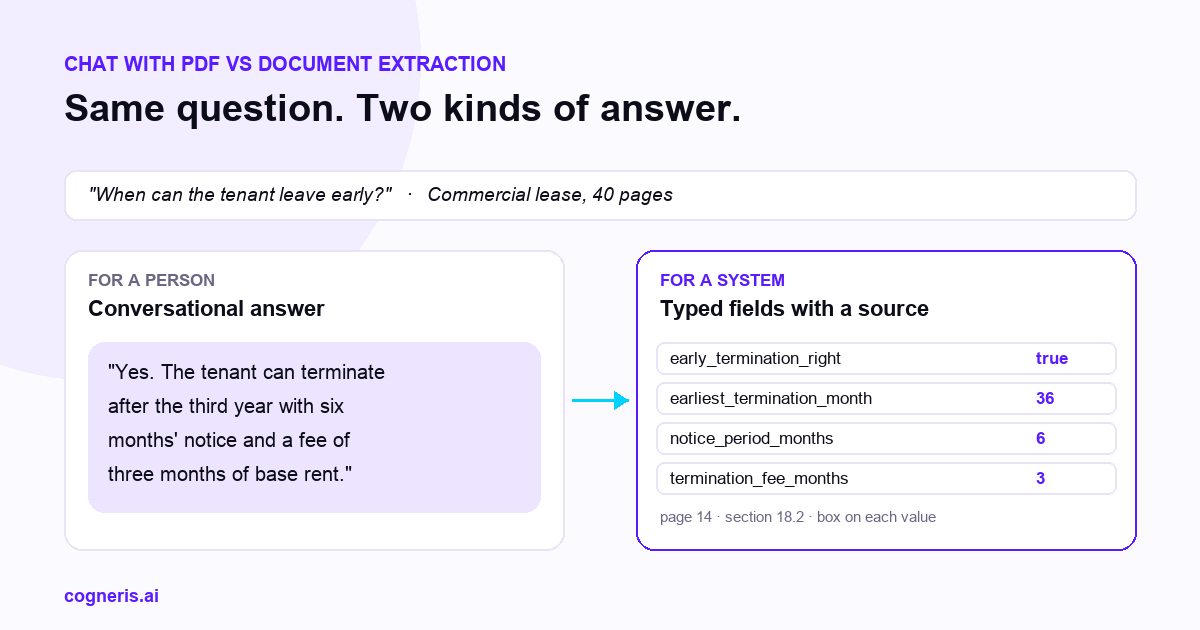
An analyst opens a 40-page commercial lease in a chat with PDF tool and types: "When can the tenant leave early?" The answer comes back in two tidy sentences: the tenant may terminate after month 36 with six months' notice and a fee of three months' base rent. The analyst checks the clause, nods, and moves on. For that person, at that moment, the tool did exactly its job.
Now ask the same question of 3,000 leases and write the answers into a portfolio system that flags early-exit exposure by quarter. The two sentences are no longer an answer. They are a string that some other piece of code has to parse, and the next lease will phrase it differently. The question did not change. The reader did.
Two readers, two kinds of answer
The difference between chat with PDF and document extraction is not the model, the OCR, or the file format. It is who reads the answer next.
- A person — reads prose, tolerates rephrasing, notices when something sounds off, and can ask a follow-up. Conversation suits that reader.
- A system — reads a field. It needs the same field name, the same type, and the same format every time, plus a way to tell a real value from a missing one. Prose suits that reader badly.
Cogneris states the same line on its document parsing API page: conversational answers are for a user who needs them; parsing or extraction is for software that needs structured output it can store, validate, or act on.
The same clause, answered twice
Here is the lease question as a conversation would answer it and as a schema would. The lease, values and page number are illustrative.
| What the reader needs | Conversational answer | Field with a schema |
|---|---|---|
| Is there an early exit? | "Yes, the tenant can terminate early…" | early_termination_right: true |
| From when | "after the third year" | earliest_termination_month: 36 |
| Notice | "with six months' notice" | notice_period_months: 6 |
| Cost | "a fee of three months of base rent" | termination_fee_months_of_base_rent: 3 |
| Where it says so | Sometimes a quoted sentence | Page 14, section 18.2, with a bounding box on each value |
Both columns can be correct. Only one can be summed, compared across a portfolio, or checked by a rule that says the notice period must be at least three months.
Where a conversation stops being enough
A chat answer is a good draft for a person and a weak contract for a system. The gaps show up in the same places every time:
- Phrasing drifts — ask the same question twice, or of two similar documents, and the wording changes: "36 months", "the third anniversary", "year four". A parser has to guess which forms mean the same thing.
- Types are implied — "three months of base rent" is a number, a unit, and a reference to another field. Prose carries all three in one phrase and none of them in a form a database can hold.
- Absence is ambiguous — "I could not find a termination clause" might mean there is none, the scan was unreadable, or the clause sits in an amendment that was not uploaded. A field can be null with a reason; a sentence leaves the reader to infer it.
- Evidence is optional — a chat may quote the clause when asked. An extraction that carries a page reference and bounding box on every value makes the check routine instead of a second question.
- Review is all or nothing — a person either trusts the answer or rereads the document. With per-field confidence and validation, only the uncertain fields need a reviewer.
None of this makes the conversational answer wrong. It makes it unfinished for anything downstream of a person. A separate risk is that a model can produce confident text that no page supports.
Turn the question into a field
The practical path between the two is to treat a recurring question as a field definition waiting to be written. When the same question gets asked of more than a handful of documents, write down what a correct answer looks like:
- Name — one stable field name, such as
notice_period_months, used for every document. - Type and unit — an integer in months, not "six months" in one file and "180 days" in the next. Normalization is part of the definition.
- Rule — what makes the value acceptable: a range, a required companion field, a cross-check against another part of the document.
- Missing state — what to return when the document is silent, and when it is unreadable. Those are different outcomes and should not share one empty value.
- Evidence — the page and region the value was read from, so a reviewer can confirm it without searching.
That list is a schema. Cogneris lets you request a shipped template or pass an inline JSON schema, and returns validated JSON with confidence scores, citations, page references, bounding boxes, and validation status on each value, as described on the document extraction API page. Low-confidence or high-risk fields can route to human review without holding back the rest of the document.
When conversation is the right tool
Extraction is not the answer to every question about a document. A conversation fits when:
- The question is one-off — a lawyer checking one unusual clause, an analyst reading a single report. Writing a schema for a question asked once is overhead.
- The question is still forming — early in a project, people do not yet know which fields matter. Asking freely is how they find out; the questions that keep coming back become the schema.
- The answer is an explanation — "why does this clause conflict with the amendment?" asks for reasoning a person will judge, not a value a system will store.
Long, mixed questions over large document sets sit in between. Whether to retrieve passages, extract fields, or both is a per-question decision.
A simple test before you choose
Ask what happens to the answer after it is read. If a person reads it and decides, a conversation is fine and often faster. If the answer is stored, compared, summed, checked by a rule, or handed to another system, it needs a schema, a type, and a source. The deciding question is not "can the tool find this?" but "who acts on the result, and what do they need to trust it?"
A structured result needs its source and context. For how coordinates on each value should be specified, see bounding boxes as an API contract.