
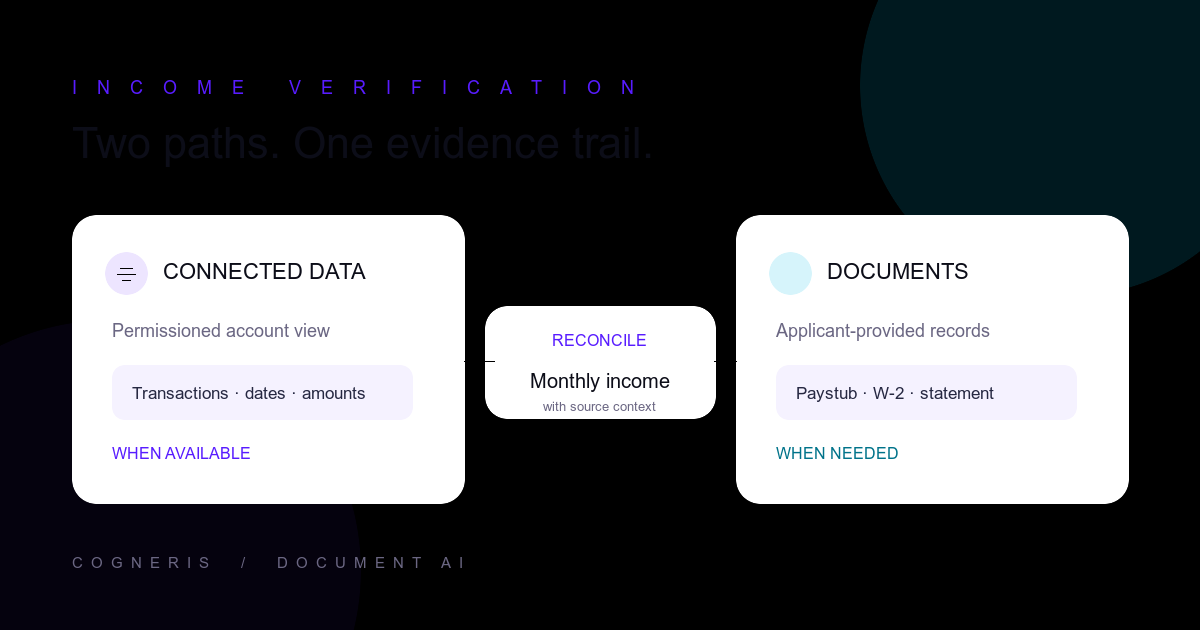
An income file is ready for review, but the applicant cannot connect a bank account. That changes which evidence is available; it does not answer whether the income is present or absent. A connected account and a document packet are two ways to assemble a view of income, and each leaves a different trail.
The practical question is not which path is universally better. It is which source can answer the question at hand, for the period being reviewed, with enough context to explain the result.
Two sources, different windows
Permissioned account data can show transactions posted to an account. Applicant-provided records can show earnings as reported by an employer, tax form, or bank statement. Neither source alone is a complete account of a person’s finances.
| Evidence path | What it can show | What still needs context |
|---|---|---|
| Connected account data | Deposits and other transactions available for the connected account and requested period. | Whether a deposit is payroll, whether another account receives part of the pay, and what dates or amounts are outside the feed. |
| Paystub | Employer, pay period, gross pay, deductions, net pay, and year-to-date amounts shown on that statement. | Whether the period is representative and how the net pay was allocated. |
| W-2 | Wages and withholding reported for a completed tax year, in the form’s defined boxes. | How that tax year relates to current pay and to the income question being reviewed. |
| Bank statement PDF | Transactions and balances for the accounts and dates covered by the statement. | Whether a credit is recurring income, a transfer, a refund, or another kind of deposit. |
A lender may use connected data when the applicant authorizes access and the needed account history is available. Documents can fill a specific gap, such as an account that cannot be linked or earnings that need an employer or tax record. Some workflows use both. The income verification overview describes Cogneris as complementary to Plaid and MX bank-feed data when both sources are available. The comparison is about the evidence each path supplies, not a claim that one provider is defective or that one source replaces every other source.
Build the monthly view without flattening the evidence
Start with the question and the period. A paystub is tied to a pay date and pay period. A W-2 covers a calendar year. A statement records what posted to an account during its statement dates. A connected feed has its own available date range. Put those periods beside the values before comparing them.
Consider this fictional example. A reviewer needs a current monthly income view, but the account connection is unavailable. Two paystubs show recurring gross wages; a W-2 provides a prior-year reference; and a statement PDF shows deposits for one account. The reviewer can calculate a monthly view from the available pay records, then use the statement to check whether the displayed deposits are consistent with the stated net pay and dates. The W-2 is context for a different period, not a replacement for current pay.
The example does not assume that every net-pay amount lands in one account. A person may split a deposit, use another account, or have deductions between gross and net. A missing deposit is a question to resolve with the applicant or additional evidence, not proof that the income does not exist.
A fallback path that stays reviewable
- Record the missing connection — note which account or period could not be supplied and what the applicant authorized. Do not silently treat the gap as zero income.
- Ask for records that match the question — for current earnings, request dated pay records; use tax forms for their stated year and statements for their covered accounts and dates.
- Normalize by month and source — keep gross pay, deductions, net pay, posted deposits, and period boundaries as distinct values. Do not combine unlike figures into one unlabeled total.
- Reconcile differences — compare dates and amounts, identify an explanation supported by the records, and leave an unresolved difference visible for review.
- Keep the citation — retain the source document, page or transaction reference, extracted field, and the reviewer’s note together.
Extraction can help turn a paystub, W-2, or statement into structured fields with source references. It does not establish that a document is genuine, make an underwriting decision, or determine whether the applicant qualifies. Those decisions stay with the lender and its review process.
When to use one path or both
Use connected data when the applicant can authorize the requested account and the available history matches the period. Use documents when a connection is unavailable, the earnings record itself matters, or the reviewer needs a source the feed does not provide. Combine them when that adds a distinct check, and label each source so the reviewer can see what it corroborates.
A paystub and a deposit do not report the same event. Gross wages can differ from net pay after deductions, and net pay can be split across accounts. A W-2 reports a completed tax year, not the latest pay period. These are reasons to reconcile with context, not reasons to force every number to match.
The goal is a supported monthly view: each amount has a period, each period has a source, and each remaining difference is visible to a person. If a bank cannot be linked, the file can still move forward with documents, as long as the evidence and its limits remain clear.
This is an operational example, not credit, tax, or financial advice. A lender’s own policy and the applicable rules determine what evidence it accepts and how it makes a decision.