
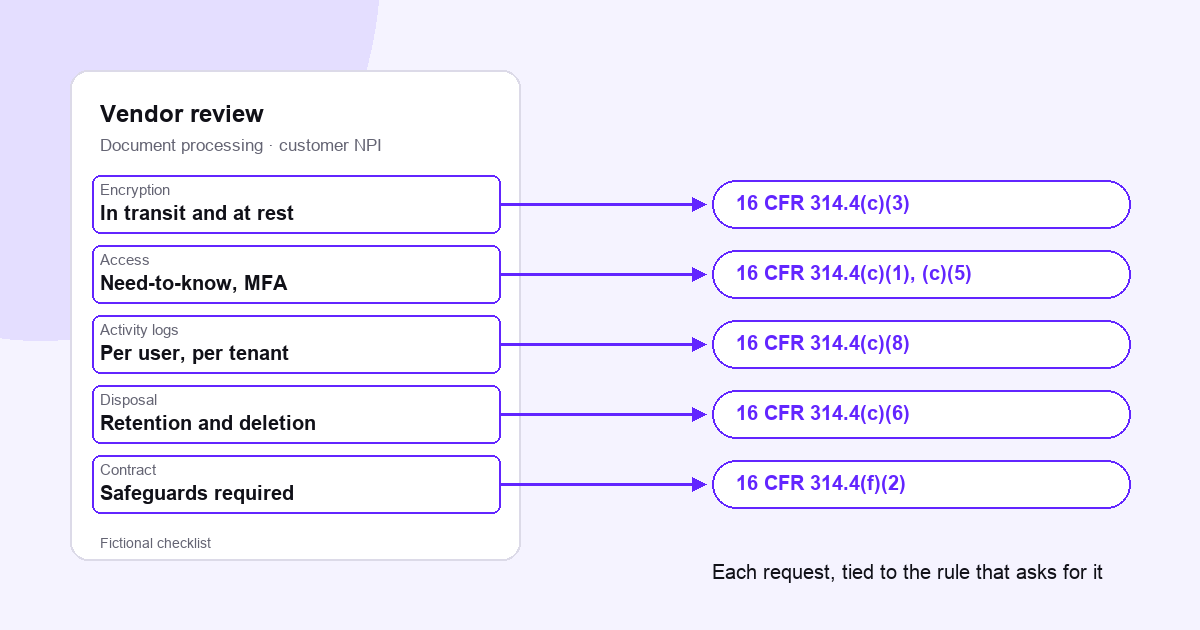
A lender sends a borrower’s bank statements, paystubs, and tax returns to an extraction service. The service reads account numbers, balances, employers, and Social Security numbers, and returns structured fields. Every one of those documents carries nonpublic personal information, and the vendor that reads them is, in the language of the Gramm-Leach-Bliley Act (GLBA) rules, a service provider.
That label matters because of what it does not move. Handing documents to a vendor moves the processing. It does not move the obligation to protect the information. The financial institution still has to show that it chose the vendor with care, wrote the safeguards into the contract, and keeps checking. This article turns those duties into a checklist of requests you can send a document processing vendor, with the regulatory text behind each one. It is not legal advice; your counsel decides which rule applies to you and how.
Which safeguards rule applies
GLBA section 501(b) is implemented by more than one rule. Financial institutions under the Federal Trade Commission’s jurisdiction—mortgage brokers, non-bank lenders, finance companies, tax preparers, and others—follow the FTC Safeguards Rule, 16 CFR part 314. Insured banks follow the Interagency Guidelines Establishing Information Security Standards, published by each banking agency; the FDIC’s version is Appendix B to 12 CFR part 364.
Both define the vendor the same way. Under 16 CFR 314.2, a service provider is any person or entity that “receives, maintains, processes, or otherwise is permitted access to customer information” through services provided directly to the institution. A document AI service that receives a statement to extract it fits that sentence without stretching it.
Three duties in one paragraph
The FTC rule puts vendor oversight in 16 CFR 314.4(f). The institution must take reasonable steps to select and retain service providers capable of maintaining appropriate safeguards, require them by contract to implement and maintain those safeguards, and periodically assess them based on the risk they present and the continued adequacy of their safeguards. The interagency guidelines say the same in section III.D—due diligence, contract, and monitoring—and add that monitoring should include reviewing “audits, summaries of test results, or other equivalent evaluations” of the provider.
Read together, the duties describe evidence, not reassurance. Selection needs something you examined. The contract needs clauses you can point to. Periodic assessment needs a date and a result. The checklist below is built so that every request produces one of those three things.
The checklist, with the rule behind each request
The safeguards in 16 CFR 314.4(c) are written for the institution’s own program, but they are the natural measure of whether a provider is “capable of maintaining appropriate safeguards.” Use them as the questions, and keep the answer that comes back.
| Ask the vendor for | Rule text it maps to | Evidence to keep |
|---|---|---|
| Encryption of customer information in transit over external networks and at rest, and who manages the keys | 16 CFR 314.4(c)(3); interagency III.C.1.c | Security documentation naming protocols, algorithms, and key management; the contract clause that requires them |
| How access to your documents is authenticated and limited to people who need it, including multi-factor authentication | 16 CFR 314.4(c)(1) and (c)(5) | Access policy, production-access approval process, and the roles that can see tenant data |
| Logging of who accessed or exported customer information | 16 CFR 314.4(c)(8) | A sample log export for your tenant showing user, action, and time |
| Retention settings and how deletion is carried out | 16 CFR 314.4(c)(6) | The configured retention period, the deletion procedure, and a deletion confirmation you can request |
| Every other party that touches the documents, and notice before that list changes | 16 CFR 314.4(f)(2); interagency III.D.2 | The current subprocessor list, the flow-down terms, and the notice period |
| Results of security testing | Interagency III.D.3 | Summaries of penetration tests or other evaluations, dated |
| How fast the vendor tells you about an incident | 16 CFR 314.4(h) and (j) | The notification commitment in the contract, in hours or days |
The disposal row has a number worth knowing. Section 314.4(c)(6) requires procedures to dispose of customer information no later than two years after it was last used to provide a product or service, unless it is needed for business operations, required by law, or cannot feasibly be targeted. A vendor that keeps source documents indefinitely by default makes that procedure harder to show.
Incident notice is now a deadline
Since May 13, 2024, 16 CFR 314.4(j) requires an FTC-covered institution to notify the Commission no later than 30 days after discovering a notification event involving the information of at least 500 consumers. A notification event is the acquisition of unencrypted customer information without authorization—and information counts as unencrypted if the key was accessed too.
Your 30 days start at discovery, and if the event happens at the vendor, discovery depends on how quickly the vendor tells you. That makes the vendor’s notification commitment a number to negotiate, not a courtesy. Ask what it is, where it is written, and what the notice will contain: the types of information involved, the date range, and the number of consumers affected are among the items the FTC form asks for.
Model providers are part of the chain
A document AI vendor may send page content to a large language model provider during extraction. If it does, that provider also receives customer information, and the questions above apply one level down. Ask whether model calls are made with retention disabled, whether the provider can train on the content, whether model use can be turned off per workflow, and in which region the calls run.
The contract mechanics of that layer—listing, notice, objection—are covered in what a DPA needs to say about AI sub-processors. Provider concentration and continuity are a separate risk, discussed in frontier provider due diligence. For GLBA, the point is narrower: every party in the chain is somewhere your safeguards have to reach.
What Cogneris publishes, and how to use it
Our banking page states that Cogneris’s controls are aligned with the GLBA Privacy Rule and Safeguards Rule: customer information encrypted in transit (TLS 1.3) and at rest (AES-256-GCM with GCP KMS), role-based access with audit logging, and LLM API calls configured with zero retention. It lists sub-processors on the data protection page and provides a written information security program to Enterprise customers on request. The security page describes tenant-configurable retention, a 30-day soft-delete window with immediate hard deletion on request, 30 days’ notice before sub-processor changes, and a 48-hour target for notifying customers of a confirmed personal-data breach.
Treat those as statements to verify, not as your assessment. Map each one to a row of the checklist, ask for the document behind it, and record what you received and when. Alignment is our description of our controls; whether they are adequate for your customer information is your determination to make.
Periodic means more than once
The rule asks for periodic assessment based on risk, without fixing an interval. A reasonable trigger list is short: a new subprocessor, a change of processing region, a new document type carrying more sensitive fields, a security incident, or a contract renewal. When one occurs, repeat the rows it affects and date the result.
The file that comes out of this process is small: a checklist, the vendor’s answers, the contract clauses, and a few dated reviews. It is also exactly what an examiner or auditor will ask to see. Extraction moves documents to a vendor; the evidence of oversight stays with you.