
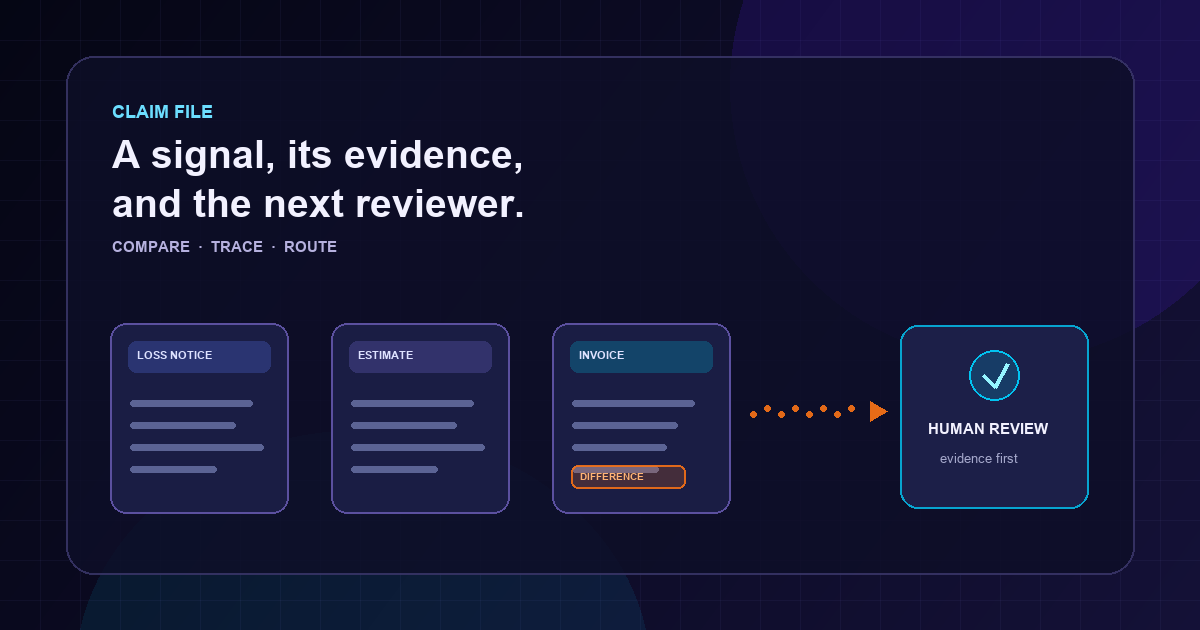
An adjuster opens a property claim with a first notice, a repair estimate, photos, and a contractor invoice. The invoice includes a line that the estimate does not. The difference could be a missing supplement, a changed scope, a document attached to the wrong claim, or something that deserves a closer look. The document mismatch is observable. Its cause is not.
That distinction is the starting point for useful insurance claim fraud detection. A system can surface a signal, show the source, and route the file to the right reviewer. It should not turn a mismatch into a finding about a person.
A signal is a reason to ask, not a finding
California’s Special Investigative Unit regulations define a “red flag” as facts, circumstances, or events that alone or together support an inference that insurance fraud may have been committed. The same rules define reasonable belief around objective justification based on articulable facts and rational inferences. In California, they assign insurer anti-fraud personnel a role in identifying and referring suspected fraud to the SIU. These are California requirements; reporting duties and processes vary by jurisdiction. A red flag is a prompt for review, not proof of intent or a coverage decision. California Code of Regulations, Title 10, §§ 2698.30 and 2698.35–.38 · California Department of Insurance: SIU Compliance Office.
That boundary should appear in the product design. Label a result as a discrepancy or review signal. Preserve the exact document values and their origins. Let the insurer’s written procedures decide who receives it, and leave investigation, coverage, payment, and any external referral to authorized people.
Make every signal reviewable
A useful referral begins with a small, auditable packet rather than a single score:
- The observed difference — the two fields, documents, or events that do not line up, described without assigning intent.
- The source for each value — document name, page or region, extracted value, and confidence, with the original file kept available.
- The comparison rule — what was compared, which claim or policy context was in scope, and why the difference crossed a review threshold.
- The surrounding timeline — dates received, processed, and revised, so a later supplement is not mistaken for a contradiction.
- The handoff and outcome — who reviewed it, what evidence they considered, and whether the signal was resolved, referred, or left open.
In the California example, the SIU rules call for written detection and referral procedures, a thorough claim-file analysis, preservation of evidence, and a concise investigation summary. A well-formed digital packet helps people follow those steps; it does not perform the investigation for them.
Signals need context before routing
The examples below are review patterns, not a fraud checklist. Each one can also have an ordinary explanation. The point is to show the evidence a reviewer needs before deciding what happens next.
| Signal to surface | Evidence to keep together | Referral / next review step |
|---|---|---|
| Estimate and invoice lines differ | Both line items, amounts, document versions, dates, and any supplement reference | Ask the adjuster to confirm whether the scope changed or a supplement is missing |
| A document or image resembles one in another claim | Original files, matching regions, upload times, claim dates, and the comparison method | Check for a shared source, batch submission, or legitimate reuse before escalating |
| A submitted document shows an edit or inconsistent total | Original upload, extracted values, visible differences, and a hash for each preserved copy | Have a trained reviewer inspect the source and request clarification through the normal process |
| Several claims share a party, provider, vehicle, or repair detail | Normalized identifiers, the time window, linked documents, and permitted data sources | Check whether the pattern has a claim-specific explanation; route under the insurer’s written criteria |
| Dates or event details disagree across the file | Reported loss date, document dates, received timestamps, and the field’s source location | Resolve time-zone, transcription, and revision differences before treating the mismatch as unusual |
A high similarity score is not self-explanatory. A household may file multiple claims, a fleet may share a repair provider, and a contractor may use the same estimate template for every job. Reviewers need the matching evidence and the rule that found it, plus an easy way to say why the match is not relevant.
Separate extraction, investigation, and claim decisions
These are three different jobs. Document extraction reads and organizes the packet. Investigation tests a suspicion against the complete claim file and other authorized evidence. Coverage and payment decisions apply the policy and the insurer’s process. Joining them into one automated outcome makes it difficult to tell whether a result came from a document error, a rule, or an investigator.
For that reason, a signal should create a review task, not an automatic denial, payment hold, or statement that fraud occurred. If a reviewer corrects an extracted value, keep both the original and corrected values with the reason. If the signal is referred, retain the evidence and the referral record. If it is cleared, record what resolved it so the same benign pattern does not keep reappearing without context.
The claims document processing API describes classification, extraction, citations, validation, and review state for claim packets. Its job is to make the documents and their evidence easier to work with; the carrier’s authorized team owns the investigation and claim decision.
Measure the handoff, not the number of flags
A larger count of alerts does not mean better fraud detection. Track whether a referral contains the source documents and comparison details reviewers need, how long it takes to reach the right queue, which signals are repeatedly cleared, and whether extraction errors contributed. Review those outcomes by claim type and process, with appropriate access controls, so a noisy rule can be narrowed instead of treated as a person-level conclusion.
Use outcomes to improve the rule and the evidence packet. Do not train a threshold to maximize referrals or let a cleared signal become a negative label on a claimant. The useful measure is whether the system helped a trained reviewer reach a well-supported next step.
Keep document fraud in its own lane
Document manipulation is one possible source of a claim signal, but it is only one part of the picture. Our article on generative document fraud looks at synthetic and altered documents and the checks that can help examine them. This article focuses on what happens when claim records, documents, and patterns raise a question. In both cases, the system should show its evidence and leave the conclusion to a human reviewer.
For related context, see how claim documents fit together after first notice of loss. A complete, traceable file is useful for adjusting a claim whether or not a fraud concern is raised.
The signal is the beginning of the review
Insurance claim fraud detection works best when each signal is specific, traceable, and limited to the question it can support. Compare the documents, preserve their sources, explain the mismatch, and route it under a written process. The person reviewing the claim still determines what the evidence means.