
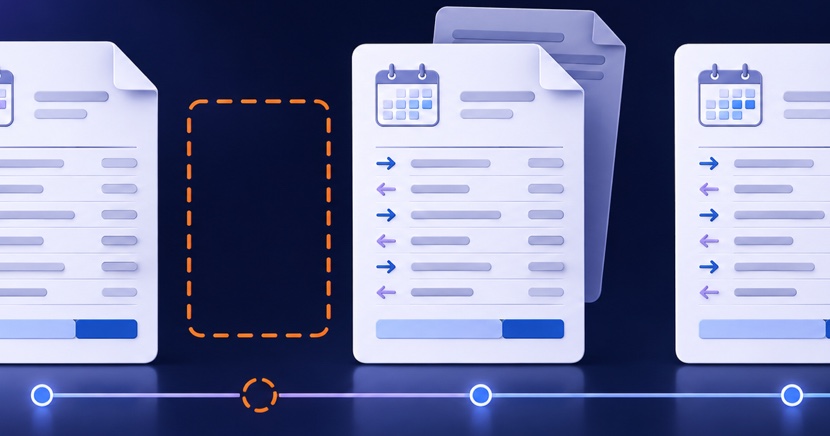
The statement extraction workflow can organize multiple files, but a packet can contain three bank statements, and every statement can balance on its own. Yet if February is missing, the packet does not show what happened between January’s closing balance and March’s opening balance. The arithmetic is complete inside each file; the evidence across the period is not.
Multi-month bank statement continuity is the check across those boundaries. It asks whether the supplied statements cover the expected dates, whether their pages form a complete sequence, and whether each reported ending balance connects to the next opening balance. A gap is a question to resolve, not a conclusion about the account.
One statement can balance while the sequence has a gap
Imagine a reviewer receives a January statement and a March statement. January runs from the first through the thirty-first. March runs from the first through the thirty-first. Both statements include opening and closing balances, and both reconcile their own deposits and withdrawals. No February statement is in the packet.
The two statements can be internally correct and still leave a month of activity unsupported. If January closes at $10,600 and March opens at $12,100, the $1,500 difference is not an error the reviewer can fix from those two files. It represents net activity during a period for which the packet contains no statement. The appropriate next step is to request or locate the missing period, then review the evidence that explains the movement.
That is different from checking whether one statement’s opening balance plus its signed transactions equals its closing balance. Both checks matter, but they answer different questions:
| Check | Question it answers | What a pass does not prove |
|---|---|---|
| Within one statement | Do the reported transactions reconcile to that statement’s ending balance? | That the statement is authentic or that every expected month was supplied. |
| Across statements | Are the periods and pages continuous, and does one ending balance connect to the next opening balance? | That each transaction has been classified or that the account meets a policy. |
Read the statement dates, not the file names
A folder label such as “three months” or “Q1 bank statements” is a request, not proof of coverage. A scan can be named for the month it was uploaded, contain the wrong account, or begin halfway through a statement cycle. Use the period printed on each statement and compare it with the period the review requires.
Statement cycles do not always start on the first day of a calendar month. One account may close on the 12th; another on the last business day. The check should follow the dates actually printed, looking for uncovered days or unexplained overlap. A month label alone can hide both.
The example below is fictional and shows a continuous sequence where each statement reports balances:
| Statement period | Opening balance | Deposits | Withdrawals | Closing balance |
|---|---|---|---|---|
| January 1–31 | $10,000 | $3,000 | $2,400 | $10,600 |
| February 1–28 | $10,600 | $2,700 | $3,100 | $10,200 |
| March 1–31 | $10,200 | $2,900 | $2,200 | $10,900 |
Each row balances internally, and each month begins at the prior month’s closing balance. If February is removed, January and March may still each reconcile, but the chain no longer explains the period between them. Keep the missing interval visible instead of filling it with an assumed value.
Check page order before comparing totals
Continuity depends on the pages that make up each statement. Page numbers can reveal a missing leaf; the same page appearing twice can repeat transactions if the file is processed as a simple list. A clean statement-level total will not always make that duplication obvious, especially when the duplicated page is a summary or a page with no transactions.
Compare page numbers, printed period, account reference, and repeated content. When two pages appear identical, inspect the page image and the source file before excluding anything. A same-day transaction for the same amount can occur twice legitimately, so amount and date alone are not a safe deduplication key. Preserve the original pages and record why a page was flagged or excluded.
Overlapping periods also need context. A corrected statement may replace an earlier version; a bank may issue a supplemental page; two accounts may share one combined PDF. Treat each of these as a source relationship to document, not as a reason to silently delete a page.
Use two balance checks, with a review path
First reconcile each statement on its own, using the bank’s sign convention and the values it reports. Then compare the closing balance of one period with the opening balance of the next when both are present and refer to the same account and currency. If the values differ, mark the boundary for review and look for a missing page, adjustment, statement version, or period gap.
Do not rewrite a transaction to make the totals agree. The bank statement converter guidance calls for checking period boundaries, missing or duplicated pages, duplicate rows, ambiguous dates, and amount signs, and says to investigate discrepancies instead of silently changing a value. The amount that fails to connect is a pointer back to the source evidence.
These checks are easiest to review when they preserve the statement identifier, page number, printed date range, extracted balance, and source location. A reviewer can then see which two records were compared and decide what additional evidence is needed.
What stitching does—and does not—settle
Cogneris describes stitching multi-month bank statement bundles into one logical document. That makes a bundle easier to process as a single submission. It does not, by itself, establish that every expected period was supplied or that no page was repeated. Sequence checks still need to compare the periods and page references that the documents actually contain.
The bank statement extraction flow also describes statement-period extraction, transaction-level confidence, and balance reconciliation. Those fields support a reviewable sequence check: keep the dates and balances with their source pages, then flag gaps or disagreements for a person to examine.
Keep the finding narrow
A missing month or repeated page is a document-completeness finding. It does not show why the page is absent, whether a transaction is suspicious, or whether an applicant should be approved. If the question is what individual deposits and withdrawals mean, that is a separate analysis of transaction lines. If one statement is replaced, a separate workflow must determine which prior checks remain valid.
For a useful handoff, record the expected period, the dates and pages received, the boundary that did not connect, and the source location for each value. Request the specific missing or corrected statement, then rerun the same checks against the updated packet. The goal is a traceable sequence—not a guess that makes the numbers look complete.
A practical continuity checklist
- Confirm the account — match the masked account reference and currency across every statement.
- Map date coverage — compare the requested period with the printed start and end dates, including non-calendar statement cycles.
- Check page sequence — look for missing page numbers, repeated pages, and unexplained supplemental versions.
- Reconcile each statement — use the bank’s signed transactions and reported balances; investigate a difference instead of editing a value.
- Bridge the periods — compare one statement’s close with the next statement’s opening balance when both are reported.
- Keep exceptions reviewable — retain source pages and record what needs follow-up without turning a gap into a fraud or credit decision.
A packet is complete when its dates and pages support the period under review and every exception has a clear next step. One statement can tell you whether its own numbers add up. The sequence tells you whether the evidence covers the time you meant to review.
This sequence check complements transaction categorization: categorization labels individual lines, while continuity compares periods and balances.
If a period is missing, the operational follow-up is a request for evidence.