
A borrower who just accepted a new job is a common file with an uncommon gap. There is no paystub from the new employer, no year-to-date figure, and no W-2 from it. What exists is an offer letter: a document in which an employer states the position, the pay, and the day the work starts.
That letter can support an income review, but only for what it actually says. It is a statement about the future, issued on a date, often with conditions attached. A reliable extraction keeps all three of those properties visible instead of turning “$72,000 per year starting January 11” into a salary field that looks like one already being paid.
An offer letter is not a verification letter
An employment verification letter reports what an employer confirmed about current or past work: the hire date, the role held, the pay in effect. An offer letter reports terms that have not started yet. The fields overlap—employer, position, pay—but their meaning does not.
Keep a document type on the record that says which one you extracted. A reviewer who sees “base salary $72,000” needs to know whether that figure was paid last month or is scheduled to begin in six weeks. The same number answers different questions depending on the document it came from.
Map the terms, the acceptance, and the conditions
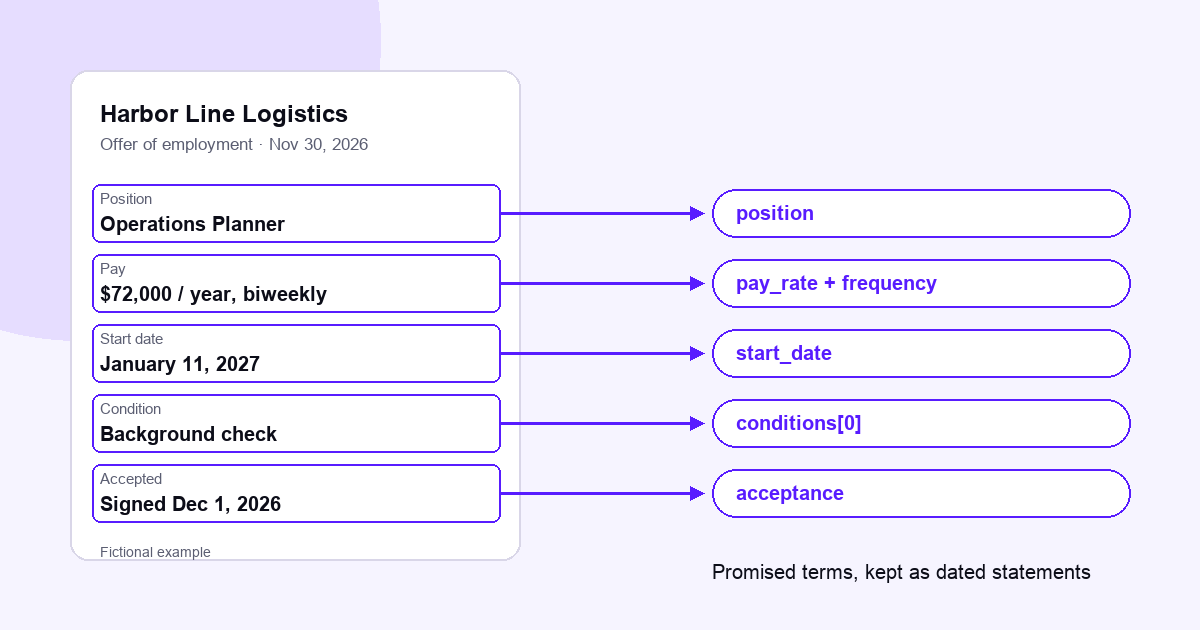
Consider a fictional offer from Harbor Line Logistics to Daniel Ortiz. It offers the position of Operations Planner at $72,000 per year, paid biweekly, with a start date of January 11, 2027. It is dated November 30, 2026, says the offer is contingent on a background check, and carries Daniel’s signature accepting it on December 1, 2026. The example is invented; the table shows how each line becomes a field a reviewer can trace.
| Field | What the letter says | How to preserve it |
|---|---|---|
| Employer | Harbor Line Logistics | Keep the issuer exactly as printed, with its page region. |
| Candidate | Daniel Ortiz | Retain the source spelling; match identity only under the workflow’s rules. |
| Position | Operations Planner | Store the exact title. Do not infer seniority or pay band. |
| Pay type and rate | $72,000 per year, paid biweekly | Keep amount, unit, and pay frequency as separate values. |
| Start date | January 11, 2027 | Normalize for comparison; keep the printed form. |
| Letter date | November 30, 2026 | Date the offer itself, distinct from the start date. |
| Acceptance | Signed by the candidate, December 1, 2026 | Record how and when acceptance is shown, and where. |
| Conditions | Contingent on a background check | Capture each condition verbatim as its own item. |
Two of those rows are the ones most often lost. Acceptance is easy to skip because it sits at the bottom of the page, and conditions are easy to skip because they read like boilerplate. Both decide whether the letter describes a commitment or a proposal.
Contingencies are fields, not footnotes
Offers are often conditional: a background check, a drug screen, a license, proof of work authorization, or a reference check. An extractor should list every condition the letter states, in the letter’s words, and stop there. Whether a condition has been satisfied is not something the offer letter can tell you. That answer comes from somewhere else—usually the employer—and should be recorded with its own source and date.
Lender policies care about exactly this distinction. The Fannie Mae Selling Guide section on employment offers or contracts (B3-3.3-03) describes reviewing a fully executed offer that identifies the employer, the borrower, the position, the type and rate of pay, and the start date. In one of its two paths the offer must also be non-contingent, or the lender must confirm before closing that any conditions of employment were satisfied. An extraction that dropped the contingency line would hide the very fact that path depends on.
Acceptance has more than one shape
Not every accepted offer carries a wet signature. The same Fannie Mae section allows acceptance to be shown by a signed agreement, a written confirmation such as an email, or other verifiable means. So record the form of acceptance—signature on the letter, a separate email, an electronic signature certificate—along with its date and the document it appears in.
If the letter is unsigned and nothing in the file shows acceptance, the correct output is “acceptance not shown.” A blank field that a later step silently treats as accepted is the failure to avoid. The extractor reports; the reviewer decides what the file still needs.
The start date is a date, not a verdict
Timing rules belong to the program, not to the document. Fannie Mae’s section, for instance, expects the start date to fall no earlier than 30 days before the note date or no later than 90 days after it, and it requires a verbal verification of employment—or, when the start date is on or after the note date, confirmation from the employer that the offer terms have not changed. None of that can be read from the letter alone, because the note date is not on it.
The extraction’s job is to output the start date and the letter date cleanly, so a rule engine or a reviewer can compare them with dates from other documents. Do not compute eligibility windows inside the extraction step, and do not shift a start date because a later email mentions a different one. Record the second date as a separate statement from a separate source.
Fixed pay, variable pay, and words like “eligible”
Offer letters mix guaranteed terms with possibilities. “Base salary of $72,000” is a stated rate. “Eligible for an annual bonus of up to 10%” is not a number anyone has earned, and “a sign-on bonus of $5,000” is a one-time payment, not a monthly figure. Hourly offers raise a different question: a rate of $28 per hour says nothing about hours unless the letter guarantees them.
Keep each pay element as its own item with its type—fixed base, hourly rate, bonus eligibility, one-time payment—and never annualize or multiply what the letter did not. This matters downstream: Fannie Mae’s non-contingent path, for example, limits qualifying income to fixed base income. Lenders also exclude certain relationships, such as employment by a family member or by a party to the transaction. A letter rarely proves either; when the document cannot answer, route the question to a person instead of guessing.
Reconcile when the first paystub arrives
An offer letter is a bridge, and the bridge ends when the borrower is paid. Fannie Mae’s other path has the lender obtain the most recent paystub supporting the qualifying income before the loan is delivered. That paystub becomes a second record to compare with the first: same employer, same rate and frequency, a pay period starting on or after the stated start date.
Compare like with like. The paystub reports earnings for a period; the offer letter reports a rate and a start date. A difference—a different rate, a later start, a different legal employer name—should be visible as a difference, with both sources attached. The payroll extraction page covers how paystubs, W-2s, and related earnings records are structured once they exist.
Keep the promise and its proof apart
Document extraction does not decide whether an applicant qualifies, and it does not certify employment. What it can do is make an offer letter inspectable: each term tied to the page it came from, each condition listed, acceptance recorded in the form it took, and every unanswered question marked as unanswered. A reviewer can then see what the employer promised, when, under which conditions, and what still needs proof from another source.