
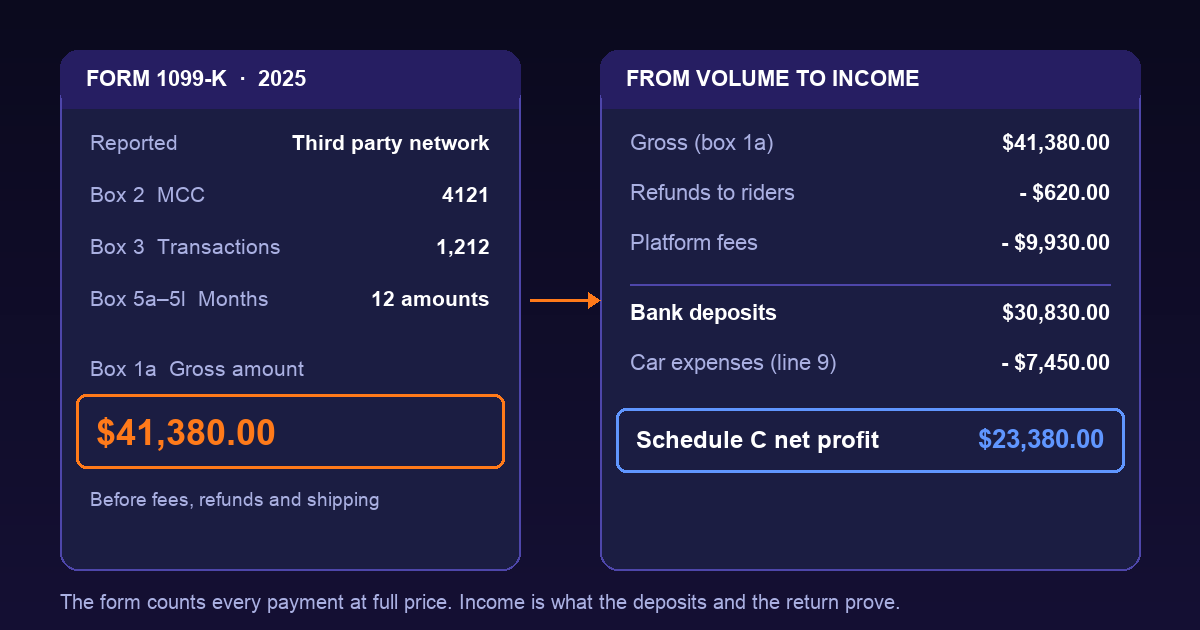
A loan officer asks a rideshare driver for proof of income, and the driver sends a Form 1099-K. It looks like the right document. It comes from the platform, it carries the driver’s name and tax ID, it has one large number in box 1a, and the IRS gets a copy. It is tempting to read that number as the year’s income.
It is not. Box 1a is the gross amount of the payments the platform settled for the driver, before the platform took its fee, before refunds to riders, and before any cost of doing the work. For many people paid through apps and marketplaces, the gap between box 1a and what they actually earned is a quarter of the figure or more. Some of the amount may not be income at all.
This piece describes what a 1099-K reports, what it leaves out, and how to verify platform income by reading the form together with the bank deposits and the tax return, so the number used for a decision is one the documents support.
What the form is a record of
Form 1099-K, Payment Card and Third Party Network Transactions, is filed by a payment settlement entity. There are two kinds. A merchant acquirer settles card payments: a business that takes credit, debit or gift cards through a terminal or an online checkout gets a 1099-K from its card processor. A third party settlement organization, or TPSO, settles payments through a network: payment apps, ride-hailing and delivery platforms, freelance marketplaces, resale sites, ticket exchanges and crowdfunding platforms.
The two kinds report under different thresholds. A card processor reports every payee, however few the payments. A TPSO is required to report a payee only when the year’s gross payments exceed US$ 20,000 and the number of transactions exceeds 200. The dollar limit went back to that level under the One, Big Beautiful Bill, and a platform may still send a form below it. So the presence of a 1099-K does not mean the person earned a lot, and its absence does not mean the person earned nothing.
The form arrives by January 31 for the previous calendar year. One payer files a separate form for card transactions and for network transactions, even for the same payee. A person who works on three platforms gets up to three forms, and one who also takes cards at a market stall gets a fourth.
The boxes, and what each one counts
The Instructions for Form 1099-K define each box. The definitions matter more than the labels, because most of them are gross.
| Box | What it holds | What it does not hold |
|---|---|---|
| 1a. Gross amount | Total reportable payments for the calendar year, valued on the transaction date | Any adjustment for credits, cash equivalents, discounts, fees, refunds or shipping |
| 1b. Card not present | The part of 1a where the card was not present or was keyed in: online, phone, catalogue | A separate amount; it is already inside 1a |
| 1c. Cash tips | Cash tips included in 1a (new box) | Tips outside the platform |
| 1d. TTOC | Up to two Treasury Tipped Occupation Codes | An amount |
| 2. MCC | The four-digit merchant category code assigned to the payee | Proof of what the payee actually does |
| 3. Number of payment transactions | Transactions processed for the payee | Refund transactions |
| 4. Federal income tax withheld | Backup withholding, when the payee did not give a correct TIN | Estimated tax the payee paid |
| 5a–5l. Monthly amounts | The gross for each month, January to December | Net payouts by month |
| 6–8. State | State, filer’s state ID, state tax withheld | State income |
Two checkboxes near the top say who filed and what was reported. One says whether the filer is the payment settlement entity itself or an electronic payment facilitator or other third party filing for it; in the second case the settlement entity’s name and phone appear above the account number. The other says whether the form reports payment card transactions or third party network transactions. Like every 1099, the form also has a CORRECTED box, and the payee’s copy may show only the last four digits of the tax ID.
The IRS page on what to do with a 1099-K puts the point plainly: the gross payment amount is not adjusted for fees, credits, refunds, shipping, cash equivalents or discounts, and those items are not taxable income. The form reports volume. Income is something the payee works out from it.
Make one year concrete
Take a driver who works only on one ride-hailing platform. The 1099-K for 2025 shows box 1a of US$ 41,380.00 and 1,212 transactions in box 3. The platform keeps a service fee from each fare and pays the rest out weekly. Over the year:
| Line | Amount | Where it comes from |
|---|---|---|
| Gross fares (box 1a) | US$ 41,380.00 | Form 1099-K |
| Refunds to riders | − US$ 620.00 | Platform annual summary |
| Platform service fees | − US$ 9,930.00 | Platform annual summary |
| Paid out to the driver | US$ 30,830.00 | 52 deposits on the bank statements |
| Car expenses (standard mileage) | − US$ 7,450.00 | Mileage log; Schedule C line 9 |
| Net profit | US$ 23,380.00 | Schedule C line 31 |
Three documents, three numbers, and all three are correct. The 1099-K says US$ 41,380.00, because it counts every fare at its full price. The bank statements say US$ 30,830.00, because the platform deducted its fee and the refunds before paying. The return says US$ 23,380.00, because the driver also paid for fuel, insurance and wear on the car. On Schedule C the gross goes on line 1, the refunds on line 2, the platform fees on line 10, the car on line 9, and the net profit lands on line 31.
A decision made on box 1a overstates income by 77 percent. A decision made on deposits alone overstates it by 32 percent. Neither error shows on the face of the form.
Not everything on a 1099-K is business income
The gross can be too high for reasons that have nothing to do with fees. The IRS lists several, and an extraction should be ready to see them.
- Personal items sold at a loss — a sofa or a phone sold on a resale site for less than it cost is not taxable, but the sale can still appear in box 1a. It is not business revenue, and it should not be annualized.
- Payments from family and friends — a shared dinner or a roommate’s share of rent should not be on a 1099-K at all. When it is, the fix is a corrected form showing zero.
- A shared card terminal — a terminal used by two businesses puts both sets of sales on one form, under one tax ID.
- A business bought, sold or converted — a terminal that was not updated reports sales before or after the change under the wrong owner or entity.
- Cash back — cash a customer took at the till with a debit card is reported, and it is not gross receipts.
- Several lines of business — one terminal for a shop and a rental reports both, though they belong on different schedules.
The opposite also happens. A form can understate income: cash, checks and direct transfers are not on any 1099-K, and a platform below the threshold may send nothing. The tax return is where the person reports all of it, which is why it carries the final word on income and the 1099-K does not.
Reconcile the form against the deposits
The bank statements are the second document. The useful question is not whether the deposits equal box 1a, because they should not. It is whether the gap can be explained.
- Identify the payer — platform payouts carry the platform’s name in the description. Sum the deposits from that payer for the year, and keep them apart from payroll, transfers between own accounts and refunds from merchants.
- Bridge gross to deposits — box 1a less refunds, less platform fees, less any instant-payout charges, should land near the deposit total. The platform’s annual or monthly summary usually prints those terms. A residual of a few percent can be timing; a residual of a third is a question.
- Compare month by month — boxes 5a to 5l give the gross per month by transaction date. Deposits lag by the payout schedule, so December fares can arrive in January. The months should move together; a month with gross and no deposits points at a second bank account.
- Check the tax ID and the name — the payee TIN and name on the form should be the applicant’s. A form issued under a business’s EIN belongs with that business’s return, not the individual’s Schedule C.
Deposits that exceed the bridged amount are not a failure either. They may be another platform, a cash business, or personal money moving in. Each of those needs its own document, not a larger multiplier on the 1099-K.
Reconcile the form against the return
For a sole proprietor, the Schedule C instructions say to check every Form 1099 for business income that belongs on line 1, gross receipts, and name the 1099-K among them. So the third check is between the forms and the return.
Sum box 1a across all 1099-Ks for the year and compare with Schedule C line 1. Gross receipts lower than the 1099-K total is a question, not an error: the difference may be personal items, gifts, cash back or a shared terminal, and the return or its notes should say which. Gross receipts much higher is common and usually fine, because the return also includes income no platform reported. When the person files more than one Schedule C, match each form to the business it belongs to by MCC, platform and account number.
The net profit, not the gross, is where an income figure starts. Reading Schedule C line by line, and the adjustments a lender makes to it, is covered in The net profit is not the income. For employees, where a paystub, a W-2 and the deposits play the same three roles, see The paystub and the W-2 should not match.
What the extraction should return
Cogneris reads 1099s alongside bank statements and tax returns for lenders and embedded-finance platforms. A useful record for one 1099-K has four parts:
- Header — tax year, filer and settlement entity names, filer TIN, payee name, payee TIN (last four digits), account number, the filer-type box, the transaction-type box and the CORRECTED box.
- Amounts — boxes 1a to 4, the twelve monthly amounts and the state boxes, each with its sign and the page region it came from.
- Form checks — the twelve months add up to box 1a; boxes 1b and 1c do not exceed 1a; a corrected form replaces the original rather than adding to it; two forms from the same payer for the same year are either different transaction types or duplicates.
- Cross-document checks — the bridge from gross to deposits by payer, the monthly comparison, the TIN match against the applicant, and the total of box 1a against Schedule C line 1.
Each check that fails should say which number is off and by how much. In the example, if the platform summary is missing, a useful message reads: box 1a is US$ 41,380.00, deposits from the platform are US$ 30,830.00, and US$ 10,550.00 is unexplained until the fees and refunds are on file. A message that reads only “income mismatch” sends the reviewer back to all three documents.
Some cases should go to a person: a 1099-K under a name or TIN that is not the applicant’s, a form marked corrected with no original on file, a platform gross with no matching deposits, a Schedule C whose gross receipts are below the 1099-K total with no explanation, and a year with backup withholding in box 4, which says the platform did not have a valid TIN.
Volume first, then income
A 1099-K is an honest document about one thing: how much money passed through a card processor or a platform for one payee in one year. It was never meant to say what the payee earned. Reading it as income turns a fee, a refund or a sold sofa into earnings. Reading it as volume, and bridging that volume to the deposits and the return, turns three numbers that disagree into one figure the documents support, and a list of the differences a reviewer still needs to see.
This article describes how to read and check Form 1099-K for income verification. It is not tax, legal, credit or financial advice. Reporting rules change, and the IRS instructions for the year in question, the platform’s own statements and a tax professional control how a specific person reports their income.
Sources
- Instructions for Form 1099-K — payment settlement entity, merchant acquirer and TPSO; filer and transaction-type checkboxes and a separate form for card and network transactions; box 1a gross amount “without regard to any adjustments for credits, cash equivalents, discount amounts, fees, refunded amounts, shipping amounts”; the TPSO de minimis exception of more than US$ 20,000 and more than 200 transactions; boxes 1b, 1c (cash tips, new), 1d, 2, 3 (excluding refunds), 4 (backup withholding), 5a–5l and 6–8; truncated payee TIN.
- Understanding your Form 1099-K (IRS, updated October 28, 2026) — card processors report regardless of amount; payment apps and marketplaces above US$ 20,000 in more than 200 transactions, and may report less; copy by January 31; types of platforms; personal payments from family and friends.
- What to do with Form 1099-K (IRS) — gross not adjusted for fees, credits, refunds, shipping, cash equivalents or discounts; personal items sold at a loss or gain; Schedule C for gig workers and other sole proprietors; corrected forms; shared terminal, business bought or sold, entity change, cash back and multiple sources of income.
- About Form 1099-K (IRS) — FAQs on the threshold under the One, Big Beautiful Bill; the dollar limit reverts to US$ 20,000 (November 17, 2025).
- Instructions for Schedule C (Form 1040) (2025) — line 1 gross receipts, checking Forms 1099 including 1099-K; line 2 returns and allowances; line 9 car and truck expenses; line 10 commissions and fees.