
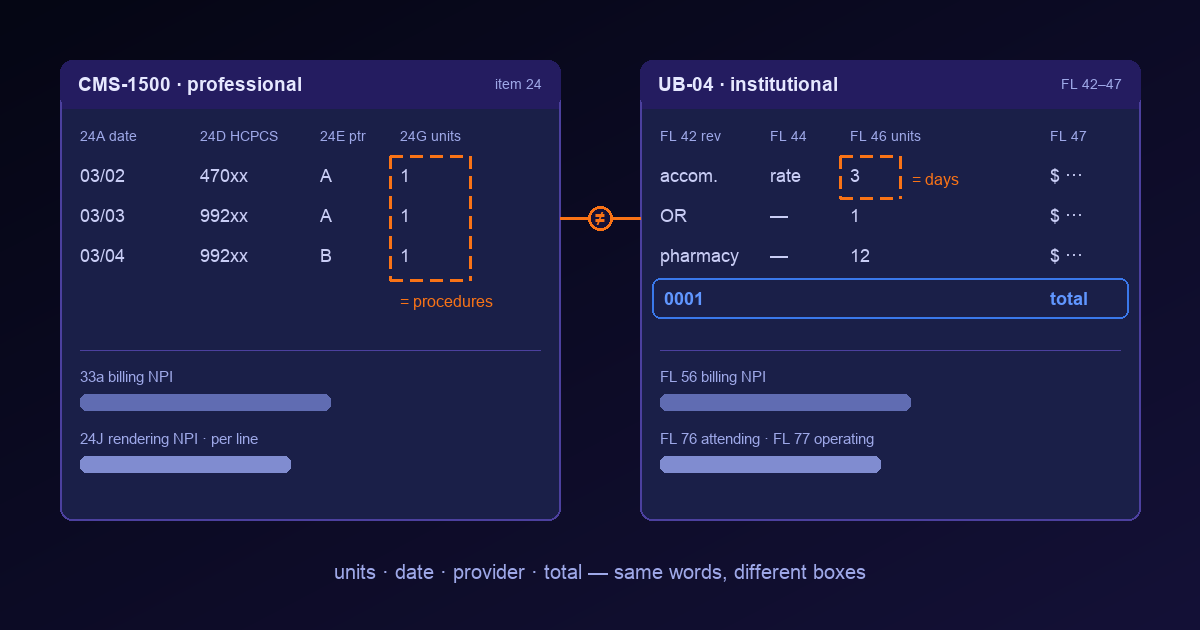
Ask a healthcare extraction pipeline for “the claim” and it will usually return a tidy object: patient, payer, billing provider NPI, dates of service, diagnosis codes, procedure codes, units and charges. Point it at a professional claim from a physician practice and the object looks right. Point the same pipeline at a hospital bill and the object still looks right. Every field is populated, every code validates, the totals add up.
And half of it can mean something different from what the schema says it means. The professional claim and the institutional claim are not two layouts of one form. They are two forms, maintained by two different committees, that describe care in different units. A line on one is a procedure a clinician performed on a date. A line on the other is a category of charge a facility accumulated over a stay. Put both into one flat schema and “units,” “date of service” and “provider” quietly stop meaning one thing.
This article walks through the two paper claim forms used in US healthcare billing, the CMS-1500 and the UB-04, using the field-by-field instructions in the Medicare Claims Processing Manual. It covers what a line means on each form, a table of fields that look equivalent and are not, a single hospital admission billed on both, the ways a shared schema fails, and what the extraction has to deliver so that a reviewer can trust the numbers.
Two forms, two committees
The CMS-1500 is the professional and supplier claim. Chapter 26 of the Medicare Claims Processing Manual says that providers sending professional and supplier claims to Medicare on paper must use it, and that the form is maintained by the National Uniform Claim Committee (NUCC). The current version is 02/12, approved by the Office of Management and Budget in June 2013 under control number 0938-1197. Physicians, nonphysician practitioners and suppliers such as laboratories and ambulance services bill on it.
The UB-04, which Medicare calls Form CMS-1450, is the institutional claim. Chapter 25 of the same manual describes it as a uniform institutional provider bill suitable for billing multiple third-party payers, with approved coding maintained by the National Uniform Billing Committee (NUBC). Hospitals, skilled nursing facilities, home health agencies and hospices bill on it.
The split is not cosmetic. A surgeon and the hospital where the surgery happened bill for the same operation on the same day, on different forms, to the same payer. The surgeon is billing for professional work. The hospital is billing for the room, the operating suite, the supplies, the drugs and the nursing. Neither claim is a copy of the other, and a pipeline that expects one shape will misread whichever form it was not designed for.
Medicare requires most claims to be sent electronically, and the manual notes that paper is for providers that meet an exception. That does not make the paper forms rare in extraction work. They still arrive as scans, faxes, PDF attachments, appeal packets and records requests, and the printed form is the layout people recognise when they review a claim. The structure described here is the structure a document pipeline has to read.
What a line means on each form
The heart of the CMS-1500 is item 24, the service lines. Each line carries a date or date span of service in 24A, a place of service code in 24B, a HCPCS procedure code with up to four modifiers in 24D, a diagnosis pointer in 24E, a charge in 24F, days or units in 24G, and the rendering provider’s NPI in 24J. The line is a professional event: this clinician did this procedure, for this diagnosis, at this kind of place, this many times.
The heart of the UB-04 is the revenue code block, form locators 42 through 48. Each line carries a revenue code in FL 42, a description in FL 43, a HCPCS code or a rate in FL 44, a service date in FL 45, units in FL 46, total charges in FL 47 and non-covered charges in FL 48. The line is a charge category: this department or type of accommodation accumulated this much over the billing period.
Three instructions from Chapter 25 show how different that is. First, FL 44 holds a HCPCS code for outpatient services, but on inpatient hospital bills it holds the accommodation rate instead. The same column carries a procedure on one bill and a price on another. Second, FL 46 units “quantify services by revenue code category,” and the manual’s own examples are the number of days in a type of accommodation and pints of blood; only when HCPCS codes are required do units equal the number of times a procedure was performed. Third, there is no fixed total line on the form. The provider enters revenue code 0001 as the last line, and the amount beside it in FL 47 is the sum of all charges billed.
The CMS-1500 handles the total differently. Item 28 is a separate box for the total of the charges in 24F. On one form the grand total is a field; on the other it is a line that looks exactly like every other line.
Fields that look equivalent and are not
The table below pairs the fields a shared schema is tempted to merge. The left two columns cite the Medicare instructions for each form. The right column is what changes in meaning.
| Concept | CMS-1500 (professional) | UB-04 (institutional) | What differs |
|---|---|---|---|
| Kind of claim | No type-of-bill field; place of service on every line (24B) | FL 4 type of bill, four digits: facility type, bill classification and a frequency digit for the bill’s sequence in the episode | Only the UB-04 says, in one field, whether this bill is an original or a later bill in the same episode |
| Dates | From and to date per line (24A); a span longer than one day needs a valid “to” date | FL 6 statement covers period for the whole bill; FL 45 line dates required on outpatient bills; FL 12 admission date | A professional date belongs to a service; an institutional date often belongs to a stay |
| Service code | HCPCS plus up to four modifiers (24D) | Revenue code (FL 42), with HCPCS in FL 44 for outpatient, accommodation rate in FL 44 for inpatient | The revenue code is the line key; HCPCS may be absent by design |
| Units | Days or units (24G); anesthesia reported as minutes | Units by revenue category (FL 46): days, pints, or times performed when HCPCS is required | Summing units across forms adds days to minutes to procedures |
| Diagnoses | Up to 12 ICD codes in item 21, lettered A to L; one pointer per line in 24E | Principal diagnosis in FL 67 and up to 17 others in FL 67A–Q, each with a present-on-admission indicator; no per-line pointer | The professional line links to a diagnosis; the institutional bill lists diagnoses for the stay |
| Procedures | HCPCS on the service line | FL 74 principal procedure code and date, inpatient only; not used on outpatient claims | An inpatient procedure lives outside the charge lines |
| Providers | Rendering NPI per line (24J); billing provider NPI in 33a | Billing provider NPI in FL 56; attending in FL 76; operating in FL 77 when a surgical procedure is listed | “Provider NPI” names a different role on each form |
| Total | Item 28, a separate box | Revenue code 0001 as the last line, total in FL 47 | A line-level parser counts the UB-04 total as a service |
None of these rows is a coding rule. They are what the form instructions say each box holds, and each one is a place where a schema built for one form gives the wrong label to a value from the other.
One admission, two claims
Take a patient admitted to a hospital for a planned surgery, who stays three nights and is discharged. Two claims describe that admission.
The hospital bills on a UB-04. FL 4 carries an inpatient type of bill. FL 6 gives the statement period, admission to discharge. FL 12 and FL 13 give the admission date and hour, and FL 17 the discharge status as of the through date. The charge block has an accommodation revenue code with three units, because the units are days, and the accommodation rate in FL 44. Further lines carry the operating room, pharmacy, supplies and laboratory as revenue categories, each with its own total. The last line is revenue code 0001 with the sum. The principal diagnosis is in FL 67 with its present-on-admission indicator, the surgery is in FL 74 as an ICD procedure code with its date, the attending physician is in FL 76 and the surgeon in FL 77.
The surgeon bills on a CMS-1500. Item 21 lists the diagnoses with letters. Item 24 has a line for the operation with a HCPCS code, a pointer to diagnosis A, one unit, place of service 21 for inpatient hospital, and the surgeon’s NPI in 24J. If the surgeon also billed hospital visits on the following days, each has its own line and date. Item 28 has the total.
Now flatten both into one schema with “date of service,” “procedure code,” “units,” “provider NPI” and “charges” per line. The hospital lines have no procedure code, because inpatient FL 44 holds a rate, so the procedure appears to be missing; it is in FL 74. The accommodation line reports three units, and a downstream report that totals “services” counts three procedures. The 0001 line becomes a service line and the bill’s charges are counted twice. The “provider NPI” on the hospital claim is the facility’s billing NPI, and on the surgeon’s claim it is the individual rendering NPI. A deduplication rule keyed on patient, date and NPI will neither merge nor separate the two claims for the right reason.
Each value in that flattened table can be cited to a box on a real form. The problem is not extraction accuracy. The problem is that the schema assigned the value a meaning the form never gave it.
Five ways a single schema fails
The failures are predictable once the forms are set side by side.
- Units collapse — days of accommodation, pints of blood, anesthesia minutes and procedure counts all land in one numeric column. Any average, sum or threshold over that column is meaningless across forms.
- The diagnosis link breaks — on the CMS-1500 the line points to one diagnosis letter. On the UB-04 the diagnoses belong to the bill. A schema with a per-line diagnosis either invents a link for institutional lines or drops the pointer for professional ones.
- Provider roles are mislabeled — rendering, billing, attending and operating are four roles. One “provider” field picks one of them per form, and not the same one.
- The total is counted as a service — revenue code 0001 is a line on the form and a total in meaning. A parser that treats every row in the charge block as a service doubles the charges.
- The bill’s sequence is lost — the fourth digit of FL 4 is the frequency code, the sequence of this bill in the episode. Drop it and a later bill for the same stay looks like a new claim.
The last one matters beyond extraction. Duplicate detection, accruals and appeal tracking all depend on knowing whether a bill stands alone or relates to an earlier one, and the UB-04 states it in a field the CMS-1500 does not have.
Classify the form, then extract the line
The fix is an order of operations, not a better parser. Identify which form the document is before deciding what a field means. The layouts are distinct enough that classification is reliable, and the type-of-bill field is itself a signal: a document with FL 4 populated is institutional.
Then extract into a shared envelope and form-specific lines. The envelope holds what genuinely is common: patient, insured, payer, billing provider and its NPI, the billing period and the total charge. The lines are different types. A professional line has a date span, place of service, HCPCS and modifiers, diagnosis pointer, units and rendering NPI. An institutional line has a revenue code, an optional HCPCS or rate, an optional line date, units in the revenue category’s own sense, total and non-covered charges. Diagnoses and inpatient procedures sit at the bill level on the institutional side, each with its own qualifiers.
Finally, validate against the form’s own instructions rather than a generic rule. A few checks come straight from the manual:
- On the CMS-1500, a line whose dates span more than one day needs a valid “to” date, and 24E carries exactly one pointer.
- On the CMS-1500, the sum of 24F should equal item 28.
- On the UB-04, the amount on the 0001 line should equal the sum of the other FL 47 amounts.
- On outpatient UB-04 bills, each iteration of a revenue code needs its own line date; a service rendered five times appears five times.
- On the UB-04, FL 74 procedures appear only on inpatient bills.
A failed check is not an extraction error to be retried until it passes. It is a flag for a reviewer, with the boxes that disagree cited.
What the extraction has to deliver
For a reviewer, an auditor or a downstream system, the output of claim-form extraction should answer more than “what does this box say.” At minimum it should carry:
- The form type, CMS-1500 or UB-04, with the form version where it is printed.
- For institutional bills, the type of bill split into its parts, including the frequency digit.
- Lines typed by form, with units labeled by what they count: days, minutes, procedures or the revenue category’s own unit.
- Every NPI tagged with its role: billing, rendering, attending or operating.
- Diagnoses at the level the form puts them, with the pointer letter on professional lines and the present-on-admission indicator on institutional ones.
- The total as a total, never as a line, plus the result of the arithmetic checks above.
- A citation from each value to its item or form locator, so a reviewer can find the box.
That last point is what makes the rest auditable. “Units: 3” is ambiguous. “Units: 3, FL 46, accommodation revenue line, unit is days” is something a reviewer can check against the paper in seconds.
Extraction, not coding
None of this is billing or coding guidance. Which revenue code, HCPCS code, modifier or diagnosis belongs on a claim is decided by the provider, the code sets and the payer’s rules. The Medicare manual quoted here is one payer’s instructions for completing the forms, and the NUBC and NUCC maintain the full specifications for every payer. The point is narrower: before a value from a claim form can be compared, totaled or routed, the pipeline has to know which form it came from and what that box is defined to hold.
Read the form before the field
A CMS-1500 line is a service a clinician performed. A UB-04 line is a category of charge a facility accumulated. Both carry dates, codes, units, providers and amounts, and in almost every case those words mean something different on each form.
So classify the form first. Extract into a common envelope and two kinds of line. Label units by what they count and NPIs by the role they play. Treat the total as a total. Then the claim object is not just populated; each field means what its name says, and it can point back to the box it came from.