
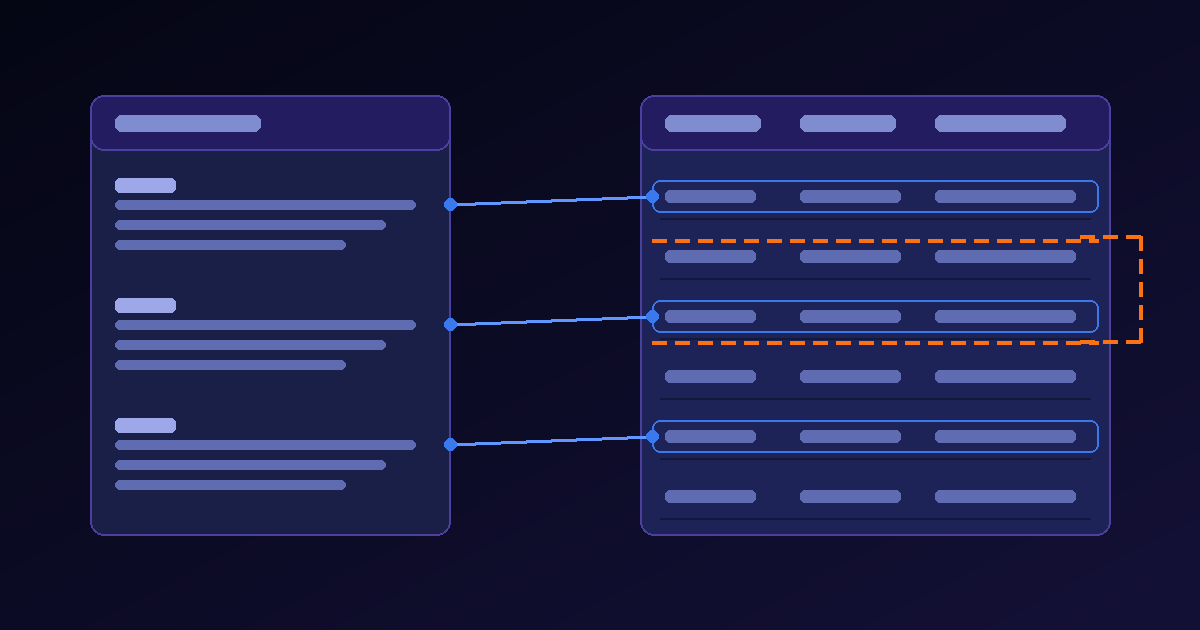
A distribution agreement for a single film can run to sixty pages, and the question the rights team needs answered from it fits on one line: can this title play on this kind of service, in this country, on this date, and is anyone else allowed to show it at the same time? The agreement answers that question, but never in one place. The territory is defined on page two, the media in a schedule, the license period by reference to a release date nobody knew when the contract was signed, and the exclusivity in a grant clause that is then narrowed by a holdback three sections later.
That is why a rights window is not a date. It is a combination: a title, a territory, a kind of exploitation, a start, an end and an exclusivity flag, held together by the clauses that produced them. Extracting the expiry date of a contract and calling it the window loses every dimension the answer depends on. Extracting the dimensions without the clauses loses the evidence a person needs when two windows collide.
This piece describes the shape a content rights window should take when it comes out of a contract, where each part hides, which disagreements an extraction pipeline should surface rather than settle, and what it should hand to the people who keep the rights record. It is about reading agreements accurately. It is not legal advice about what any agreement means.
A window is a row, not a date
The industry already has a working model for this, because studios and retailers exchange availability data every day. The Entertainment Merchants Association and MovieLabs publish the Avails format for it, and their description of the term is a good place to start: avails are the business information about when, where and under what rules an asset can be offered. In the Avails specification each transaction carries a license type, a territory, an optional list of excluded territories, a start, an end and a set of named terms, one of which is whether the offer is exclusive.
Read that list as the columns of a row and the shape of a rights window follows:
- Title — the film, the episode or the season the grant covers, as named in the schedule of titles.
- Territory — where the grant applies, and separately where it does not. A territory is often a list minus an exception, not a single country.
- Media — the kind of exploitation: theatrical, electronic sell-through, transactional video on demand, subscription streaming, advertising-supported streaming, free ad-supported channels, pay television, free television.
- Start and end — each either a calendar date or a condition, such as a number of days after theatrical release.
- Exclusivity — whether the licensee is the only one allowed to exploit the title in that territory and medium during that period, and any carve-outs.
- Language — when the grant is limited to dubbed or subtitled versions, or when a language is held back.
Change any one of these and the answer to the rights question changes. An SVOD window in the United States says nothing about SVOD in Mexico, and nothing about free television in the United States. So the unit of extraction is the row, and a contract usually produces several of them.
The vocabulary is a decision you make
One detail in the Avails specification is worth slowing down for. Its list of license types names electronic sell-through, video on demand, subscription video on demand, pre-order sell-through, pre-release and library, says that additional values may be used by agreement between sender and receiver, and notes that any of these models can be paid or free. Advertising-supported streaming and free ad-supported channels are not on the enumerated list.
That is not a gap in the standard. It is a reminder that media categories are defined by contracts and by the businesses that sign them, not by a fixed taxonomy. One agreement defines “Free Television” to include free ad-supported streaming channels; another defines it as over-the-air broadcast only and treats every internet service as a separate medium. A pipeline that maps both phrases to the same media code has made a legal reading on the reader’s behalf.
The practical rule is to keep two values for media in every row: the contract’s own term, quoted with its definition, and the code in your catalogue’s vocabulary that you map it to. When the mapping is obvious, the two sit side by side and nobody looks twice. When it is not, the row says so, and a person decides which media the grant actually covers.
Where each part of the window hides
Rights terms are rarely in the sentence that grants the rights. A typical license agreement spreads them across five kinds of text:
- Definitions — “Territory”, “License Period” and each media term are usually defined once, near the start, and then used as capitalised words everywhere else. The grant clause cannot be read without them.
- The grant — who may exploit which titles, by which media, in which territory, and on what exclusivity. This is the sentence most extraction targets, and it is the one that leans hardest on the definitions.
- Schedules — title lists, per-title periods, and sometimes per-territory dates. A schedule can override the general license period for a single title.
- Holdbacks and exclusivity carve-outs — promises by the licensor not to exploit, or not to license others to exploit, a medium during a period. These narrow other windows, often in other agreements.
- Amendments — extensions, added territories and added titles, signed months or years later.
Which of those documents wins when they disagree is a question of contract order, and we have written about it separately in The document you extracted is not the contract. For rights windows the consequence is simple: a row extracted from the original agreement alone is a row that may already have been changed.
Relative dates stay relative
The start and end of many windows are not dates when the contract is signed. They are events: the initial theatrical release in the territory, the first broadcast of an episode, the end of the preceding window. The Avails specification handles this with conditions instead of dates — a start or end can be “Open”, can be tied to the theatrical or sell-through date, and can carry a lag, a duration added to or subtracted from that event.
An extraction pipeline should do the same. When a clause says the license period begins ninety days after the initial theatrical release of the picture in the territory, the row should hold the event, the lag and the clause, not a date computed from a release the pipeline guessed. When the event later happens, the date can be resolved and recorded with the source of the release date beside it. A window that was computed from an assumed date and stored as if it had been read is the most expensive kind of wrong value, because it looks exactly like a right one.
The same discipline applies to open ends. A license that runs “until terminated in accordance with Section 14” has no end date. Writing the contract’s outer term into the end column turns a termination right into a fixed expiry that the agreement does not contain.
Clause, territory, media, dates, exclusivity, page
Put together, each window becomes a row with its evidence attached. The example below uses a fictional film, Northern Line, and a fictional license agreement with a streaming service, to show the kinds of rows a single contract produces.
| Clause | Territory | Media | Start / end | Exclusivity | Source |
|---|---|---|---|---|---|
| 2.1 Grant of rights | “the United States and English-speaking Canada” | Subscription streaming (“SVOD” as defined in 1.18) | Theatrical release in the territory + 120 days / 24 months after start | Exclusive | p. 4, with definitions on pp. 2–3 |
| 2.3 Holdback | Same as 2.1 | Advertising-supported streaming and free ad-supported channels | Licensor holds back for the whole SVOD period | Holdback, not a grant | p. 5 |
| 2.4 Carve-out | Same as 2.1 | Airline and hotel exhibition | Not limited by 2.1 | Excluded from the exclusivity in 2.1 | p. 5 |
| Schedule A, line 1 | Same as 2.1 | Same as 2.1 | End extended to 36 months after start | Exclusive | p. 22 |
| Amendment No. 1, §1 | Mexico added | Same as 2.1 | Fixed start 2027-03-01 / end same as Schedule A | Non-exclusive | Amendment, p. 1 |
Three things in that table do work that a list of extracted dates would not. The territory is quoted, because “English-speaking Canada” is a contractual phrase and not a region code. The holdback is its own row, because it limits what the licensor can grant to anyone else, including in other agreements. And the schedule line changes the end of the main grant for this title, which only becomes visible when the schedule is read as part of the same window.
Territories do not always map to codes
Catalogue systems store territories as codes. MovieLabs’ Common Metadata, which the Avails format builds on, defines a region either as an ISO 3166-1 two-letter country code or as an ISO 3166-2 subdivision or UN M.49 area code. That is exactly right for a database, and exactly where contracts start to resist.
Some contract territories map cleanly: “the United States, its territories and possessions” becomes a set of codes, and an excluded province becomes a subdivision. Others do not map at all. A territory defined by language, by former political borders, or by “any country in which the Licensee operates its service as of the Effective Date” is a rule, not a list. A pipeline can propose codes for it; it should not silently choose them. The row keeps the quoted definition, the proposed codes, and a flag saying the mapping needs a person.
Where windows collide
Single rows are only half the job. The value of a structured rights record is that windows can be compared against each other, across the clauses of one contract and across contracts for the same title. The comparisons that matter are mechanical once the rows exist:
- Overlapping exclusives — two exclusive grants for the same title, territory and media with intersecting periods. One of them is wrong, or one of them is narrower than it looks.
- Grants inside a holdback — a license to an advertising-supported service that starts while a holdback in a subscription deal is still running.
- Gaps — a title with no active window in a territory where the business assumed it was available.
- Unresolved conditions — windows whose start still depends on an event that has already happened, so the date can now be fixed and checked.
- Upcoming expiries — ends that fall inside a notice period, while there is still time to renew or to plan the title’s next window.
Each of those is a finding for the rights team, not a decision for the pipeline. An overlap between two exclusive grants may be a drafting error, a deliberate carve-out the extraction missed, or a real conflict that needs a lawyer. The extraction’s job is to show the two rows and the two clauses side by side, with page references, so that the question can be asked in minutes rather than discovered after the title has gone live in the wrong place.
What the window does not tell you
It is worth being clear about the edges of this record. A window says whether a title may be exploited; it does not say what the exploitation earns. License fees, revenue shares, minimum guarantees and recoupment belong to the money side of the same agreements, and checking statements against them is a separate job, which we covered in A royalty statement starts with the contract.
A window also does not interpret ambiguous language. Whether a new kind of service falls inside a medium the contract defined years ago, whether a carve-out survives an amendment, whether a termination right has been triggered: those are questions for the people who own the agreement and their counsel. The extraction should make them easy to see and easy to answer. It should not answer them.
What the extraction has to deliver
For each window, an extracted rights record should carry:
- The row — title, territory, excluded territories, media, start, end, exclusivity and language, each as its own field.
- The contract’s words — the quoted territory and media terms, with the definitions they depend on, beside the mapped codes.
- The conditions — event, lag and source for any relative date, kept as conditions until they are resolved.
- The source — document, clause and page for every value, including the schedule line or amendment that changed it.
- The flags — unmapped territories, media terms that need a reading, overlaps, holdback conflicts and open ends, each with a plain reason.
This is the shape Cogneris works toward in media and entertainment: territory, term, exclusivity, media windows across theatrical, SVOD, AVOD, FAST and broadcast, and language rights, extracted as structured rights records ready for catalogue operations, with the source clause kept beside each value so your rights team can check it against the page.
Keep the row and the clause together
A content rights window is the answer to a narrow question — this title, this medium, this place, this time — assembled from text that was never written to answer it directly. Reading the agreement well means producing the row. Reading it honestly means keeping the clauses, definitions and conditions that produced the row attached to it, and leaving the judgement calls visible.
Do that, and the rights record stops being a spreadsheet that someone has to trust. It becomes something that can be checked: every window traceable to a page, every collision shown with both sides, and every assumption written down where the next person can see it.
Sources
- Avails and Title List (MovieLabs) — EMA Content Availability Metadata, defined by the Entertainment Merchants Association with MovieLabs; avails as information about the time, location and business rules for offering an asset.
- EMA Content Availability and Offer Status Data, TR-META-AVAIL v2.25 (PDF) — transaction fields LicenseType, Territory, TerritoryExcluded, Start/End and their conditions with lag; the enumerated license types and the provision for additional values by agreement; the Exclusive and ExclusiveAttributes terms; HoldbackLanguage.
- Common Metadata, TR-META-CM v2.25 (PDF) — Region-type as an ISO 3166-1 alpha-2 country code, or an ISO 3166-2 or UN M.49 code.