
A services agreement rarely states its own end date in one place. The term clause says how long the first period runs. The renewal clause says what happens when it ends. The notice clause says how either side has to tell the other. The termination clause sometimes adds a notice period of its own. And the governing law clause decides which rules read all of them. Each clause can be correct by itself, and the four of them can still describe two different deadlines.
A contract clause consistency check reads those clauses side by side before anyone signs. It does not interpret them. It puts the values each clause states next to each other, cites where each one came from, and flags the pairs that disagree so a reviewer can resolve them while the draft is still open.
This piece covers the comparisons worth running, a worked example with two flags, and where the check stops. The examples are fictional. Nothing here is legal advice. A flag tells the reviewer where to look, and deciding what the clauses mean stays with them.
Four clauses, one timeline
The clauses that set a contract's timeline are drafted in different sections, often by different people, and amended at different moments of a negotiation. A redline that moves the initial term from two years to three may never touch the renewal clause that still counts its notice window from the end of year two. A notice clause that requires courier delivery may sit unchanged under a renewal clause that now allows email.
| Comparison | Clauses read together | What a disagreement looks like |
|---|---|---|
| Term length | Term clause, renewal clause, definitions | The term clause says 3 years; the renewal clause counts from the end of a 2-year initial term. |
| Start date | Term clause, recitals, signature block | The term runs from the Effective Date, which the recitals define one way and the cover page dates another way. |
| Notice period | Renewal clause, termination for convenience | Non-renewal needs 60 days' notice; termination for convenience needs 90, and both clauses can end the agreement on the same date. |
| Notice method | Renewal clause, notice clause | The renewal clause accepts written notice by email; the notice clause excludes email for any notice under the agreement. |
| Law and forum | Governing law clause, jurisdiction clause | Delaware law with the courts of New York as exclusive forum. That can be deliberate, so the flag asks a question, not a correction. |
Term against renewal
The first comparison is the one our contract extraction page names: whether the term length is consistent across the term clause and the renewal clause. It fails in two ways.
- The length moved and the counting did not — a renewal clause that says "at the end of the second contract year" survives a redline that made the initial term three years. The extraction reads both values with their clause citations, and the check compares the length implied by each.
- The start date has two candidates — "the Effective Date" and "the date of the last signature" are not always the same day. A term that runs from one and a renewal that counts from the other produce deadlines a few weeks apart. The check flags which definition each clause uses.
- A defined term carries the number — when "Initial Term" is defined in the definitions section and the term clause only refers to it, both locations need reading. A comparison that only reads section 2 misses the value.
Renewal against notice
A renewal clause usually carries its own notice requirement: auto-renew for one year unless either party gives notice at least 60 days before the end of the then-current term. That requirement depends on the notice clause for everything it does not say: who receives notice, at which address, by which methods, and when a notice counts as given.
The check reads the renewal clause's period and method next to the notice clause's methods and receipt rule. Three results are worth separating:
- Consistent — the renewal clause defers to the notice clause, and the notice clause allows the methods the parties plan to use.
- Conflicting — the renewal clause allows a method the notice clause excludes, or the two clauses set different periods for the same event.
- Incomplete — the renewal clause requires notice, and the notice clause is missing, refers to an exhibit that is not attached, or leaves the address blank.
Termination for convenience belongs in the same comparison. When one party can end the agreement on 90 days' notice at any time, the 60-day non-renewal window still matters for the renewal date, and the reviewer should see both periods together instead of discovering the second one later.
Governing law against forum
Governing law and forum are separate clauses and often point at different places on purpose. A check here does not decide whether the combination is wise. It records the law, the forum, whether the forum is exclusive, and whether an arbitration clause elsewhere in the agreement sends disputes somewhere else entirely. A forum clause and an arbitration clause that both claim the same disputes are the combination a reviewer most needs to see before signature.
A worked example
A fictional master services agreement between Customer Inc. and Vendor Co. comes back from extraction with these fields, each citing its source clause:
| Field | Value | Source |
|---|---|---|
effective_date | 2026-04-15 | Cover page |
initial_term | 3 years from the Effective Date | §2.1 |
renewal | Auto-renew 1 year; non-renewal notice 60 days before the end of the second contract year | §2.2 |
termination_for_convenience | Customer only, 90 days' notice | §16.2 |
notice_methods | Courier or registered mail; email excluded | §18.1 |
renewal_notice_method | Written notice, email accepted | §2.2 |
governing_law | Delaware | §17.1 |
forum | Delaware Court of Chancery, exclusive | §17.2 |
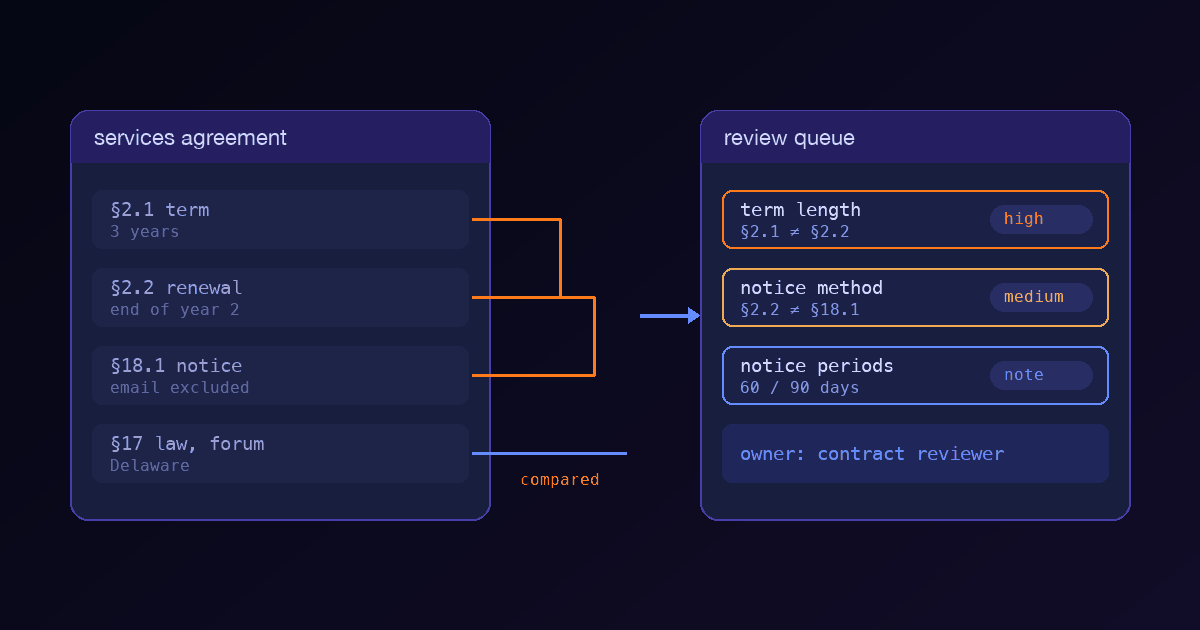
The consistency check returns two flags and one note:
- Term length, high — §2.1 sets a 3-year initial term; §2.2 counts the notice window from the end of the second contract year. One of the two was not updated.
- Notice method, medium — §2.2 accepts email for non-renewal notice; §18.1 excludes email for any notice under the agreement.
- Notice periods, note — non-renewal needs 60 days and termination for convenience needs 90. They do not conflict, and the reviewer sees both periods side by side.
Law and forum agree and no arbitration clause was found, so that pair returns no flag. Each flag carries both citations, so the reviewer opens §2.1 and §2.2 side by side instead of searching the draft.
A check flags. It does not decide.
The output of a consistency check is a list of disagreements with evidence, not a corrected contract. Which clause wins when two disagree depends on drafting intent, on the negotiation history, and on how the governing law treats the conflict. Those questions belong to the person reviewing the contract, and the check exists to make sure they are asked while the draft can still change.
The same discipline applies to severity. A term-length conflict that moves the renewal date by a year is worth a different queue than a notice-method mismatch. Teams that already route deviations from an approved contract playbook by severity can route consistency flags into the same review, with the same evidence attached.
Where the check sits
The comparison is cheapest before signature, when fixing a stale cross-reference is a redline. After signature, the same conflict becomes a question about which date the counterparty will accept. Run it on each draft that changes the term, renewal, notice, or dispute clauses, and run it again on the execution version, because the last round of edits is the one most likely to move a number without moving its neighbors.
One boundary matters. This check reads one agreement. When an order form or statement of work sets its own term on top of the master agreement, the question of which document controls comes first, and the consistency check runs inside the answer to that question.
Before you rely on the check
- The fields defined per contract type — initial term, start date definition, renewal period, renewal notice period and method, notice methods and address, termination periods, governing law, forum, and arbitration.
- Definitions read with the clauses — a value carried by a defined term is extracted from the definitions section, with its own citation.
- Comparisons written down — which pairs of fields are compared, and what counts as a conflict, an incomplete clause, or a note.
- Severity agreed with the reviewers — so a conflict that moves a deadline is never queued behind a formatting question.
- A human owner for every flag — the check routes, and the reviewer resolves and records the decision.