
An orthopedic clinic sees a patient for knee pain, injects both knees and bills the patient’s commercial plan, which the clinic is in network with. Three weeks later the remittance arrives. Every line has an allowed amount, a contractual adjustment, a coinsurance share and a payment. Every line balances. Nothing on it looks like a denial.
The remittance can still be short. An explanation of benefits, or the 835 electronic remittance behind it, reports the amount the payer decided to allow. Whether that amount is the one the clinic agreed to is a question the remittance cannot answer, because the agreement is not on it. It is in the payer contract: the fee exhibit, its amendments, and the rules for how lines are reduced. A payment below the contracted amount is an underpayment, and the only way to see it is to put the two documents side by side, line by line.
This piece walks through that comparison with an invented claim and an invented contract. The clinic, the payer, the rates and every dollar amount are fictional. The adjustment codes are real and were checked against the official X12 lists. None of this is legal, billing or contract advice, and a real contract has to be read on its own terms.
What the remittance actually says
A remittance explains each line as a chain. The billed charge comes first. The payer then subtracts adjustments, each one tagged with a group code and a claim adjustment reason code (CARC). What remains is the allowed amount, which is split between what the patient owes and what the payer pays.
The adjustment that turns a charge into an allowed amount is usually CARC 45. The X12 list defines it as “Charge exceeds fee schedule/maximum allowable or contracted/legislated fee arrangement.” Its usage note says the amount cannot equal the whole charge and that it is used only with group code CO or PR, depending on who is liable. For an in-network claim the group is normally CO, contractual obligation: the provider absorbs the reduction and does not bill it to the patient. The patient’s share arrives under PR, patient responsibility, with its own reason codes: 1 for deductible, 2 for coinsurance, 3 for co-payment.
Read carefully, CO-45 says that the payer reduced the charge to its fee arrangement. It does not say which arrangement, and it does not say the arrangement was loaded correctly. A payer that priced a line from last year’s table, or from the wrong exhibit, still reports the reduction as CO-45. The code is the same on a correct line and on a short one.
What the contract says instead
The fictional contract in this example sets reimbursement in five clauses that matter for the claim:
- Rate basis — professional services are paid at the rate in Exhibit B for the date of service.
- Amendment — Amendment 2 raises the Exhibit B rates for office visit codes by 4% for dates of service on or after January 1, 2026.
- Multiple procedures — when more than one procedure is performed on the same date, the second and later procedures are paid at 50% of their rate.
- Drug carve-out — injectable drugs listed in Exhibit D are paid at the fixed per-unit rate in that exhibit, not under the general fee schedule.
- Lesser of — on every line the allowed amount is the lower of the billed charge and the contracted rate.
None of those clauses appears on the remittance. The amendment, in particular, is often a separate document signed after the base agreement, and a contract file that holds the agreement without its amendments will price the claim wrong in the same way the payer did. The question of which document governs when two of them disagree is its own problem, covered in contract order of precedence.
A claim compared line by line
The visit is on February 12, 2026, and the bill has four lines. The table puts the remittance and the contract next to each other. Coinsurance under the plan is 20% of the allowed amount.
| Line | Code × units | Billed | EOB allowed | Adjustments on the EOB | Paid | Contract allowed | Variance |
|---|---|---|---|---|---|---|---|
| 1 | 99214-25 × 1 | $210.00 | $127.50 | CO-45 $82.50; PR-2 $25.50 | $102.00 | $132.60 | −$5.10 |
| 2 | 20610-RT × 1 | $180.00 | $96.00 | CO-45 $84.00; PR-2 $19.20 | $76.80 | $96.00 | $0.00 |
| 3 | 20610-LT × 1 | $180.00 | $48.00 | CO-45 $84.00; CO-59 $48.00; PR-2 $9.60 | $38.40 | $48.00 | $0.00 |
| 4 | J7321 × 2 | $260.00 | $120.00 | CO-45 $140.00; PR-2 $24.00 | $96.00 | $190.00 | −$70.00 |
| Total | $830.00 | $391.50 | CO $438.50; PR $78.30 | $313.20 | $466.60 | −$75.10 |
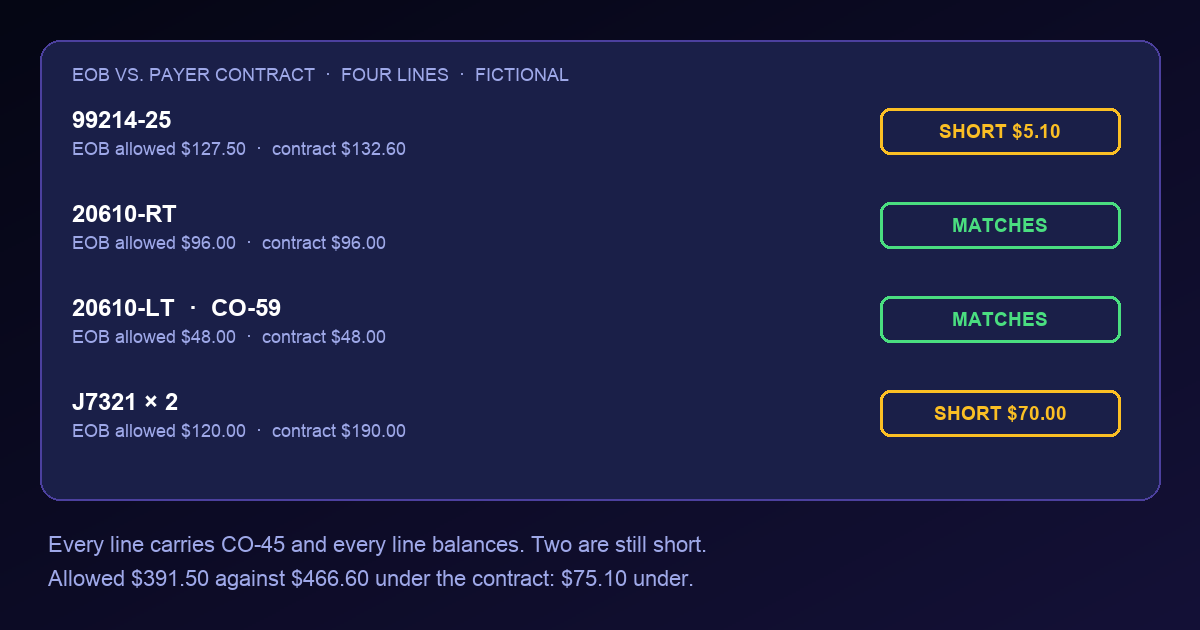
Line 1 is the office visit. The base Exhibit B rate is $127.50; with the 4% amendment for office visits, the rate for a 2026 date of service is $132.60. The payer allowed $127.50. It priced the line without the amendment, which never reached its fee table. The shortfall is $5.10 of allowed amount.
Line 2 is the injection in the right knee. The contracted rate is $96.00, the payer allowed $96.00, and the line is correct.
Line 3 is the same injection in the left knee. It shows a second reduction, CO-59, which X12 defines as “Processed based on multiple or concurrent procedure rules.” At first glance the line looks underpaid by half. It is not: the contract’s multiple-procedure clause pays the second procedure at 50%, so $48.00 is exactly what the clinic agreed to. A variance check that ignores the clause would flag this line and send someone to appeal a correct payment.
Line 4 is the drug, two units of a hyaluronan injection. Exhibit D carves it out at $95.00 per unit, so the contracted amount is $190.00. The payer allowed $120.00, $60.00 per unit, which is what its general drug schedule pays. The carve-out was not applied. The shortfall is $70.00.
Across the claim, the payer allowed $391.50 where the contract supports $466.60, a difference of $75.10. Every line on the remittance balances, and lines 1 and 4 carry the same CO-45 as the correct lines 2 and 3.
Where the money actually went
A $75.10 gap in allowed amount is not a $75.10 gap in payment, because coinsurance is computed on the allowed amount. Repriced under the contract, line 1 would be paid $106.08 instead of $102.00, and line 4 would be paid $152.00 instead of $96.00. The payer owes $60.08 more. The other $15.02 is coinsurance the patient was never asked for, because the patient’s share was also computed on the lower amount.
That split matters for how the gap is recovered. The difference is not a balance the clinic can simply bill the patient for: the payer’s adjudication sets the patient’s share, so the usual route is to dispute the payment and have the claim reprocessed at the correct allowed amount, which corrects both numbers. What the dispute has to show is the contract clause, the date of service and the arithmetic for each short line.
There is also a quieter cost. A posting rule that writes off every CO adjustment as contractual writes off the underpayment with it. On line 4, the $140.00 CO-45 includes the $70.00 the payer should not have taken. Once it is posted as a write-off, nothing in the ledger says it was ever owed.
Three ways a comparison goes wrong
- Comparing to the wrong year — the contract rate has to be the one in force on the date of service, not on the date the claim was paid or the date the comparison runs. A claim for December 2025 paid in January 2026 is priced on the 2025 table, and checking it against 2026 rates invents an underpayment.
- Ignoring the reduction rules — multiple-procedure, bilateral and bundling clauses lower allowed amounts on purpose. Line 3 shows the effect: a check that compares each line to its full rate flags payments that are exactly right.
- Skipping the lesser-of rule — if the clinic bills less than the contracted rate, the contract pays the billed charge. Comparing the allowed amount to the rate alone reports a shortfall that the contract never promised.
All three produce false positives, and false positives are what make a team stop trusting the variance report. The comparison has to apply the contract the way the contract is written before it calls anything short.
What extraction has to return
The comparison needs two structured records that line up on the same keys.
From the remittance, each service line needs its date of service, procedure code, modifiers, units, billed charge, allowed amount and payment, plus every adjustment as a separate entry with its group code, reason code and amount. Remark codes belong with the line they explain. At claim level the record needs the payer, the plan or product, the claim number, the rendering and billing provider identifiers, and the payment date. A line that arrives as a single “adjustments” total has lost the information the comparison runs on.
From the contract, the record needs the rate basis for each code or category, each amendment with its effective date, the reduction rules, the carve-outs with their own rates and units, the lesser-of clause, which products the contract covers, and the deadline for disputing a payment. Each value should carry the page it came from, so a dispute can quote the clause rather than restate it.
Two checks keep the extraction honest before any pricing runs. Each line should balance: billed charge minus all adjustments equals the payment. And the remittance totals should equal the sum of the lines. A line that does not balance points to an extraction miss, not an underpayment, and it should go to review before anyone compares it to a contract. The broader question of what each adjustment code should trigger is covered in routing EOB adjustment codes, and carrying a primary payer’s amounts into a secondary claim in secondary EOB coordination.
Where review still sits
The arithmetic is mechanical once both records are right. The judgment is not. Contracts use defined terms, exhibits that reference other exhibits, and amendments that change one table but not another. Whether a drug belongs to a carve-out, whether a modifier changes the reduction, and whether a dispute is still inside its window are questions for the person who manages the contract. What automation can do is find the lines worth that person’s time and attach the evidence: the remittance line, the contract clause, the date and the calculation.
On the claim above, that is two lines out of four, $60.08 owed by the payer, and a $15.02 change in the patient’s share once the claim is reprocessed. The remittance showed none of it.
Sources
- X12 Claim Adjustment Reason Codes — definitions and usage notes for codes 1, 2, 3, 45 and 59 (X12).
- X12 Claim Adjustment Group Codes — CO (Contractual Obligation), PR (Patient Responsibility), OA and PI (X12).
The clinic, the payer, the contract, the claim and every dollar amount above are invented for illustration. This article is general information about document handling, not legal, billing or contract advice.