
A bank statement and a credit card statement look alike. Both have a period, a list of dated lines and a balance at the end. Both arrive as PDFs that lenders, accountants and expense teams have to read. It is tempting to send them through the same parser and the same check: opening balance, plus money in, minus money out, equals closing balance.
That check fails on a card statement, and it fails quietly. On a deposit account the balance is money the customer has. On a card account the balance is money the customer owes. A payment lowers it, a purchase raises it, and two lines that never appear in the transaction list, fees and interest, also raise it. A card statement also carries fields that a bank statement does not have at all: a payment due date, a minimum payment, a late payment warning and interest split by type of balance.
This piece describes the arithmetic of a card statement, the fields that matter, where they are required to appear on US statements, and what an extraction should return so the new balance can be checked rather than just copied.
The new balance has its own equation
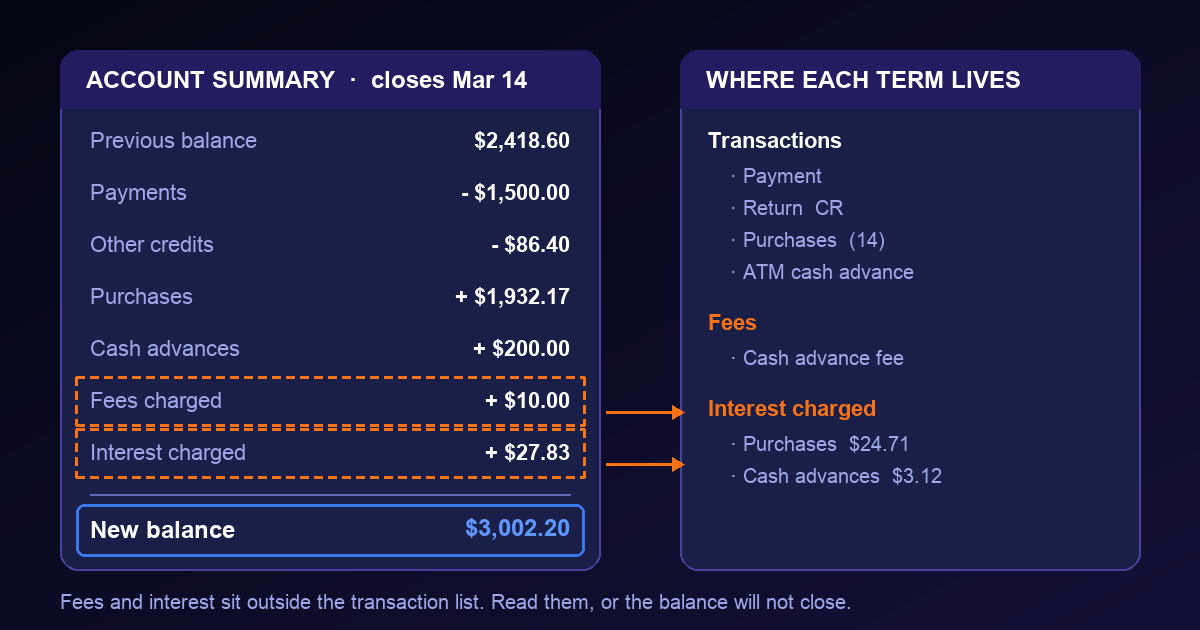
Most US card statements open with an account summary. The labels vary by issuer, but the structure is close to this:
Previous balance − payments − other credits + purchases + balance transfers + cash advances + fees charged + interest charged = new balance.
Each term has a source in the rules. Regulation Z, the US rule that implements the Truth in Lending Act, lists what a periodic statement for an open-end credit plan has to disclose in 12 CFR 1026.7(b). It starts with the previous balance, the balance outstanding at the beginning of the billing cycle. It asks for each credit transaction to be identified, and for any credit to the account to be shown with its amount and date. It ends with the closing date of the billing cycle and the balance outstanding on that date, which is the new balance.
Two terms in the equation are not transactions. Interest and fees are charged by the card issuer, and Regulation Z puts them in their own sections. Interest goes under a heading called Interest Charged, itemized and totaled by type of transaction. Other charges go under a heading called Fees. Both sections must show a total for the statement period and a total for the calendar year to date. A parser that only reads the transaction table will miss both, and the balance will not close.
Make one statement concrete
Take a statement for a billing cycle that closes on March 14. The account summary reads:
| Summary line | Amount | Where it comes from |
|---|---|---|
| Previous balance | US$ 2,418.60 | New balance of the February statement |
| Payments | − US$ 1,500.00 | One payment line in the transaction list |
| Other credits | − US$ 86.40 | One merchant return |
| Purchases | + US$ 1,932.17 | Sum of the purchase lines |
| Balance transfers | US$ 0.00 | No lines |
| Cash advances | + US$ 200.00 | One ATM withdrawal |
| Fees charged | + US$ 10.00 | Fees section: cash advance fee |
| Interest charged | + US$ 27.83 | Interest section: US$ 24.71 on purchases, US$ 3.12 on cash advances |
| New balance | US$ 3,002.20 | Closing date March 14 |
The arithmetic closes: 2,418.60 − 1,500.00 − 86.40 + 1,932.17 + 200.00 + 10.00 + 27.83 = 3,002.20. That is the first check an extraction should run, and it should run on the extracted lines, not on the summary alone. Add up the purchase lines and compare with the purchases total. Add up the interest by type and compare with the interest total. If every section adds up to its own total and the totals add up to the new balance, the statement was read completely.
Now look at three ways the same statement is commonly misread.
- The fee is dropped. The US$ 10.00 cash advance fee sits in the Fees section, not next to the ATM withdrawal. A parser that reads only the transaction table returns a new balance US$ 10.00 higher than its own lines can explain, and the US$ 27.83 of interest is missing for the same reason.
- A credit keeps the wrong sign. Issuers print credits as negative amounts, with a minus sign, in parentheses or with a CR suffix. If the return of US$ 86.40 is read as a purchase, the purchase total is wrong by US$ 172.80, twice the amount, because the line was subtracted from one side and added to the other.
- The bank equation is applied. Treating payments as deposits and purchases as withdrawals turns the debt the wrong way round. The result is a balance that moves in the opposite direction, and a check that fails on every statement or, worse, is switched off.
The fields a bank statement does not have
A deposit statement mostly needs a period, the lines and the balances. A card statement carries more, because it is also a bill. Regulation Z sets most of these fields, and the extraction should return each one with the page and region it came from.
| Field | What it says | Rule |
|---|---|---|
| Closing date and new balance | The end of the billing cycle and the balance on that date | 1026.7(b)(10) |
| Payment due date | The date the payment is due; the same day of the month for each billing cycle | 1026.7(b)(11) |
| Late payment fee and penalty rate | The fee, and any higher rate, that a late payment can trigger | 1026.7(b)(11) |
| Minimum payment due | The amount that keeps the account current this cycle | Grouped with the due date under 1026.7(b)(13) |
| Minimum payment warning | How long repayment takes, and what it costs, if only the minimum is paid; and a 3-year payment estimate | 1026.7(b)(12) |
| Annual percentage rates | Each rate, with the types of transactions it applies to | 1026.7(b)(4) |
| Balance subject to interest rate | The balance each rate was applied to, and how it was determined | 1026.7(b)(5) |
| Interest charged and fees | Itemized, with totals for the period and the year to date | 1026.7(b)(6) |
| Deferred interest date | The date a promotional balance must be paid in full to avoid the interest | 1026.7(b)(14) |
Most issuers also print a credit limit and the credit available. Those are useful for utilization, but they are not in the list above, so their absence is not an error.
Regulation Z also says where some of these fields go. The due date must be on the front of the first page. The late payment fee and the penalty rate must be stated close to the due date. The new balance and the minimum payment warning must be close to the minimum payment due, and all of them must be grouped together. That is why the box near the top of page one, with the new balance, the minimum payment and the due date, looks so similar from one issuer to the next. It is also why that box is the right place to look for those values first, and why a value found elsewhere should be treated with care.
Four dates, four different jobs
A card statement has more dates than a bank statement, and they do different things.
- Transaction date is when the purchase happened. It matters for matching a receipt or an expense report.
- Posting date is when the issuer recorded it. It decides which billing cycle the line belongs to.
- Closing date ends the cycle. A payment posted the day after the closing date belongs to the next statement, even if the customer sent it before.
- Payment due date is when the bill is due. It falls after the closing date, and it should fall on the same day of the month every cycle.
Mixing them causes real errors. An expense team that files a line by its posting date can push a March purchase into April. A lender that reads the due date as the end of the period computes the wrong number of days. A reconciliation that expects a payment on this statement, because it was sent before the closing date, raises a false exception. The extraction should keep all four, labelled, and should not collapse them into one field called date.
Interest is split by balance type
One account can carry several balances at different rates: purchases, cash advances, balance transfers and sometimes a promotional rate. Regulation Z requires each rate, the type of transaction it applies to, and the balance it was applied to. The interest section then shows the charge for each type.
This matters for two reasons. First, the totals have to add up: in the example, US$ 24.71 plus US$ 3.12 is the US$ 27.83 on the summary. Second, the split explains the cost. A borrower with a small cash advance balance can pay a visible share of the interest on it, because cash advance rates are often higher and cash advances often have no grace period. Reading only the total hides that.
The year-to-date totals give a second check across statements. The interest charged so far this year on the March statement should equal the February year-to-date figure plus the March period figure. The same applies to fees. January starts again from the period figure. When a series of statements breaks this chain, a statement is missing, a page was skipped, or one figure was misread.
What the extraction should return
Cogneris reads Visa, Mastercard and American Express statements alongside bank statements. A useful record for one card statement has four parts:
- Header — issuer, account (masked), billing cycle start and closing date, payment due date, credit limit if printed.
- Summary — each account summary line as printed, with its sign, plus the new balance and the minimum payment due.
- Lines — each transaction with transaction date, posting date, description, amount and sign, and the section it came from: payments and credits, purchases, cash advances, balance transfers, fees or interest.
- Checks — the balance equation, each section against its total, interest by type against total interest, and, when the previous statement is available, its new balance against this previous balance and the year-to-date chain.
Every value carries the page and region it came from, so a reviewer can see the number on the document in one click. A check that fails should say which term is off and by how much. In the misread example above, a useful message reads: fees charged on the summary is US$ 10.00, no fee lines were extracted, and the new balance cannot be reproduced. That points the reviewer at the Fees section on page two instead of the whole statement.
Some cases should go to a person instead of being resolved automatically: a statement whose equation does not close after all sections are read, two statements that claim the same billing cycle, a previous balance that does not match the last new balance on file, a missing page in a multi-page statement, and a deferred interest date that falls within the next cycle.
Where this sits next to bank statements
For deposit accounts, the useful work happens in the transaction lines: income, recurring obligations, returns and reversals. That is covered in The statement is worth its lines, not its balance, and most of it applies to card lines too. A card purchase still has a merchant and a category, and a return still has to be paired with its purchase.
What changes is the frame around the lines. The balance runs the other way. Fees and interest are separate sections that the balance depends on. The bill fields, the due date and the minimum payment, have no counterpart on a deposit statement. Lenders that count revolving debt need the balance and the minimum payment, and the card statement prints both in the same box. An extraction that treats a card statement as a bank statement with different labels gets the lines right and the account wrong.
Some statements legitimately lack fields. Regulation Z exempts charge cards that must be paid in full each cycle from the minimum payment warning, and it also skips the warning in a cycle after two cycles paid in full, or when the minimum payment would pay off the balance. A missing warning on those statements is expected, not an extraction failure. The record should say which exemption applies when it can tell, and leave the field empty otherwise.
Read the bill, then the lines
A card statement is two documents in one: a list of transactions and a bill for the balance they produced. The list looks like a bank statement. The bill does not. Reading both means taking the account summary, the fees and the interest as seriously as the purchases, and running the card equation instead of the bank one. When every section adds up to its total and the totals add up to the new balance, the extraction can be trusted. When they do not, the difference says where to look.
This article describes how to read and check credit card statements. It is not legal, credit or financial advice. Statement formats differ by issuer, and the cardholder agreement and the issuer’s own disclosures control what a specific account owes.
Sources
- 12 CFR 1026.7, Periodic statement (Regulation Z) — for open-end (not home-secured) plans: previous balance (b)(1), identification of transactions (b)(2), credits with amount and date (b)(3), periodic rates as annual percentage rates by type of transaction (b)(4), balance subject to interest rate (b)(5), Interest Charged and Fees with period and year-to-date totals (b)(6), closing date and new balance (b)(10), due date on the same day of each month and late payment costs (b)(11), minimum payment warning and its exemptions (b)(12), grouping on the first page (b)(13), deferred interest date (b)(14).