
A 71-year-old man spends four days in a community hospital with pneumonia. On the day he goes home, the attending physician signs a discharge summary of a little over a page. In the following week that page is read by his primary care physician, a home health agency, a care manager at his health plan and, eventually, a utilization reviewer. None of them were at the bedside, and none of them want the whole chart.
That is the point of the document. A discharge summary is the hospital’s account of how the stay ended and what happens next. Discharge summary extraction should return that account as structured fields: the outcome, where the patient went, who sees him next and when, which medicines changed, and which results were still pending when he left. It is a different job from abstracting the whole record, and treating it as a short version of the chart is how the useful parts get lost.
This piece walks through one summary, field by field. The hospital, the patient, the dates and every clinical detail are invented. The regulatory text quoted is real and was read at eCFR. None of it is clinical advice.
What the rule asks the summary to say
For hospitals that take part in Medicare, the content of the medical record is set by the conditions of participation at 42 CFR 482.24. Paragraph (c)(4) lists what every inpatient record must document, and item (vii) is the discharge summary: it must carry the “outcome of hospitalization, disposition of case, and provisions for follow-up care.”
Three things, then, and none of them is “a summary of everything that happened.” The same list separates the summary from its neighbors. Item (ii) is the admitting diagnosis. Item (viii) is the final diagnosis, with the record completed within 30 days after discharge. The orders, nursing notes, medication records and laboratory reports sit in item (vi). A summary often repeats pieces of all of these, but what only the summary is required to settle is how the stay ended and what was arranged afterward.
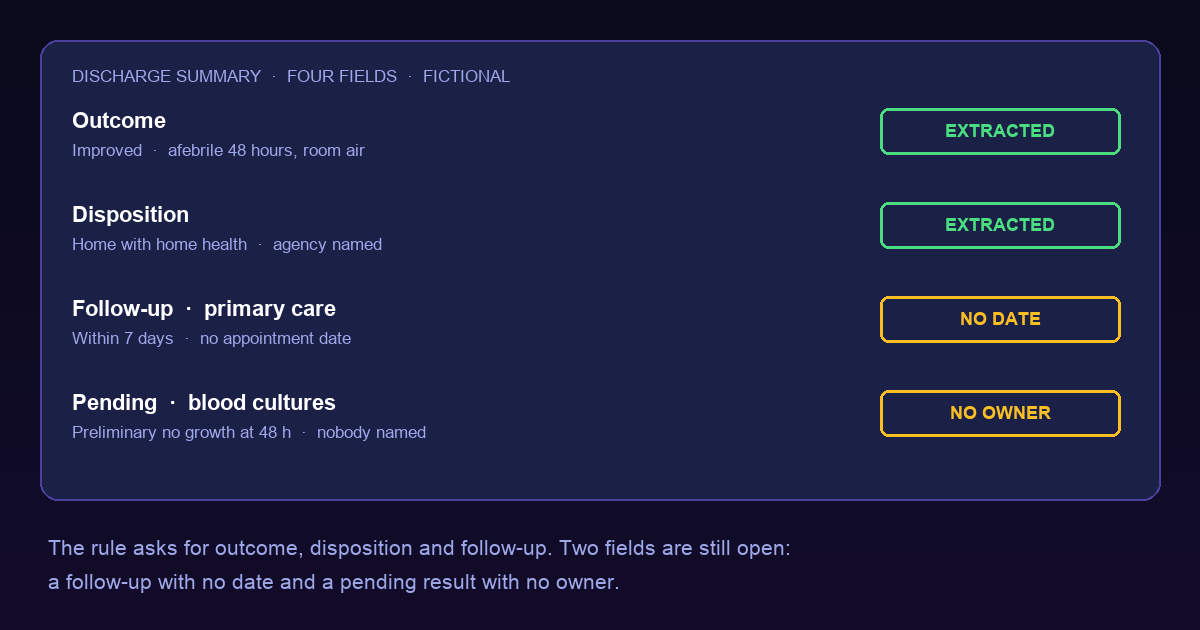
That gives extraction a shape. Outcome, disposition and follow-up are the fields the document exists to hold, so they are the fields that have to come back complete and checkable. Everything else is context.
One summary, field by field
The fictional patient was admitted on March 3, 2026 and discharged on March 7. His summary has the usual headings: admission and discharge dates, diagnoses, hospital course, condition at discharge, discharge medications, follow-up and pending results. The table shows what an extraction should return from it, and where each value actually sits on the page.
| Field | Value returned | Where it sits in the summary | Check |
|---|---|---|---|
| Admission / discharge | 2026-03-03 / 2026-03-07 | Header block | Discharge on or after admission; length of stay 4 days |
| Admitting diagnosis | Community-acquired pneumonia | “Reason for admission” | Kept apart from the final diagnoses |
| Final diagnoses | Right lower lobe pneumonia; acute kidney injury, resolved; hyponatremia | “Discharge diagnoses” | Each diagnosis has its own status |
| Outcome | Improved; afebrile 48 hours, on room air | “Condition at discharge” and last paragraph of the course | Stated, not inferred from the course |
| Disposition | Home with home health services | “Discharged to” | Mapped to a closed list; the agency named |
| Follow-up | Primary care within 7 days; nephrology in 2 weeks; repeat chest X-ray in 6 weeks | “Follow-up” | Each item has a who and a when |
| Pending results | Blood cultures, final read (no growth at 48 hours) | One line under “Labs” | Each pending item has an owner |
Two rows already show the difference between reading the page and extracting from it. The outcome is not under one heading: “Condition at discharge: stable” is on one line, and the evidence that the pneumonia improved is the last paragraph of the hospital course. An extraction that returns only “stable” has the label without the content. The pending blood culture is worse: it is a parenthesis in the laboratory paragraph, not a heading of its own, and a model that summarizes the labs as “cultures negative” has turned a preliminary result into a final one.
Disposition is a list, not a phrase
“Discharged home” and “discharged home with home health services” are different dispositions. So are a skilled nursing facility, inpatient rehabilitation, hospice, a transfer to another acute hospital, and leaving against medical advice. Downstream, they drive different things: whether an agency expects a referral, whether a facility needs the medication list today, whether a readmission is likely to be counted.
So disposition should come back as a value from a closed list that the receiving system already uses, with the original wording kept beside it. In this summary the line reads “Discharged to home with home health (Lakeside Home Care) for skilled nursing and PT.” The returned record is the coded value, the agency name and the services, plus the sentence they came from. If the summary says only “home,” the extraction should return “home” and not guess that services were arranged because the patient is 71.
Follow-up needs a who and a when
Follow-up is where summaries are least precise, because they are written for a reader who can call the hospital. This one has three items:
- Primary care within 7 days — a role and a window, no appointment date. The record should say that: a target window relative to discharge (by March 14), not an invented date.
- Nephrology in 2 weeks — a specialty and an interval, with “appointment scheduled” written further down. The scheduled flag and the interval are two fields, and only one of them is a date someone booked.
- Repeat chest X-ray in 6 weeks — a test, not a visit, with no ordering clinician named. It is the item most likely to fall between the hospital and the primary care office.
Each item comes back as who (a named clinician, a specialty or a role), what (a visit, a test, a call), when (a date, or a window relative to the discharge date), and whether the summary says it was scheduled. A follow-up item that lacks a who or a when is not an extraction error. It is a gap in the document, and the record should carry it as one so a person can close it.
Medication changes are the field people actually use
Most summaries end with a discharge medication list. What the next clinician needs is not the list but the change against what the patient took before admission. In this summary the change is spread across two places: the list itself, and a sentence in the hospital course.
| Medication | Before admission | At discharge | Change |
|---|---|---|---|
| Amoxicillin-clavulanate | — | 875/125 mg twice daily through March 10 | New, with an end date |
| Lisinopril | 20 mg daily | — | Stopped (kidney injury) |
| Metformin | 500 mg twice daily | — | Held until nephrology review |
| Atorvastatin | 40 mg daily | 40 mg daily | Continued |
Lisinopril and metformin both disappear from the discharge list, and a diff of the two lists would call both of them stopped. They are not the same. Lisinopril was stopped; metformin was held, with a condition for restarting it that appears only in the course narrative. The extraction has to return the change type, the reason, and any restart condition, or the primary care physician reads two different decisions as one.
Allergies belong next to this table but come from somewhere else. The summary repeats “NKDA,” copied from the admission record; whether that statement was ever confirmed is a question for the intake form, where a blank does not mean no.
Pending at discharge
Results that come back after the patient leaves are a known weak point in hospital handoffs: the clinician who ordered the test is no longer responsible for the patient, and the clinician who is responsible may not know the test exists. A summary that mentions a pending result has done its part only if the mention survives extraction.
So pending results come back as their own list, each with the test, the status at discharge (here, preliminary no growth at 48 hours), and the person or team named to follow it. This summary names nobody. That is the most useful thing the extraction can report about the line: one pending result, no owner. The reading of the result itself, when it arrives, is a laboratory document with its own value, unit and reference range.
Five ways extraction goes wrong
- Admitting diagnosis read as final — the two sit close together, and a summary that opens with “admitted for pneumonia” tempts a model to stop there. The final diagnoses here include a kidney injury that explains two medication changes.
- Condition read as outcome — “stable” is a condition label. The outcome is what changed during the stay, and it is usually in the narrative.
- Copied-forward course — summaries are often built from the admission note. A sentence like “patient on 2 L oxygen” can be day-one text that was never updated. Statements about the discharge state should come from the discharge sections, not from the top of the course.
- Stopped and held merged — both remove a drug from the list. Only one of them expects someone to restart it.
- Addendum ignored — a summary can be amended after it is signed, and the addendum may change the disposition or add a follow-up. The record needs the signature date, any addendum date, and which version each field came from.
What extraction has to return
One record per summary, keyed to the encounter: admission and discharge dates, the attending physician, the signature date and any addenda. Then the three required fields as structured values — outcome with its supporting text, disposition from a closed list with the destination named, and follow-up items with who, what, when and a scheduled flag. Then the two fields that make the summary useful: medication changes with change type, reason and restart condition, and pending results with status and owner. Every value carries a pointer back to the line it came from.
A few checks run before anyone reads the record. The discharge date is on or after the admission date, and the summary was signed on or after discharge. Every follow-up item has a who and a when, or is flagged as missing one. Every medication on the admission list is accounted for at discharge: continued, changed, stopped or held. Every pending result has an owner, or is flagged. None of these checks can say the care was right. They say the document answered the questions it exists to answer.
Where review still sits
The structure is mechanical once the fields are found. The judgment is not. Whether “follow up with PCP” meant the patient should call or the hospital booked it, whether a held drug was meant to stay held, whether a preliminary culture should have delayed discharge — those are clinical questions, and the extraction should hand them to a person with the source line attached rather than resolve them by guessing.
For this summary that is a short list: one follow-up test with no ordering clinician, one pending result with no owner, and one drug held on a condition someone has to check. That is what the next reader needs from the page, and it is what a full abstraction of the episode would bury under four days of notes.
Sources
- 42 CFR 482.24, Condition of participation: Medical record services — paragraph (c)(4), items (ii), (vi), (vii) and (viii) (eCFR).
The hospital, the patient, the dates, the medications and every clinical detail above are invented for illustration. This article is general information about document handling, not medical, legal or billing advice.