
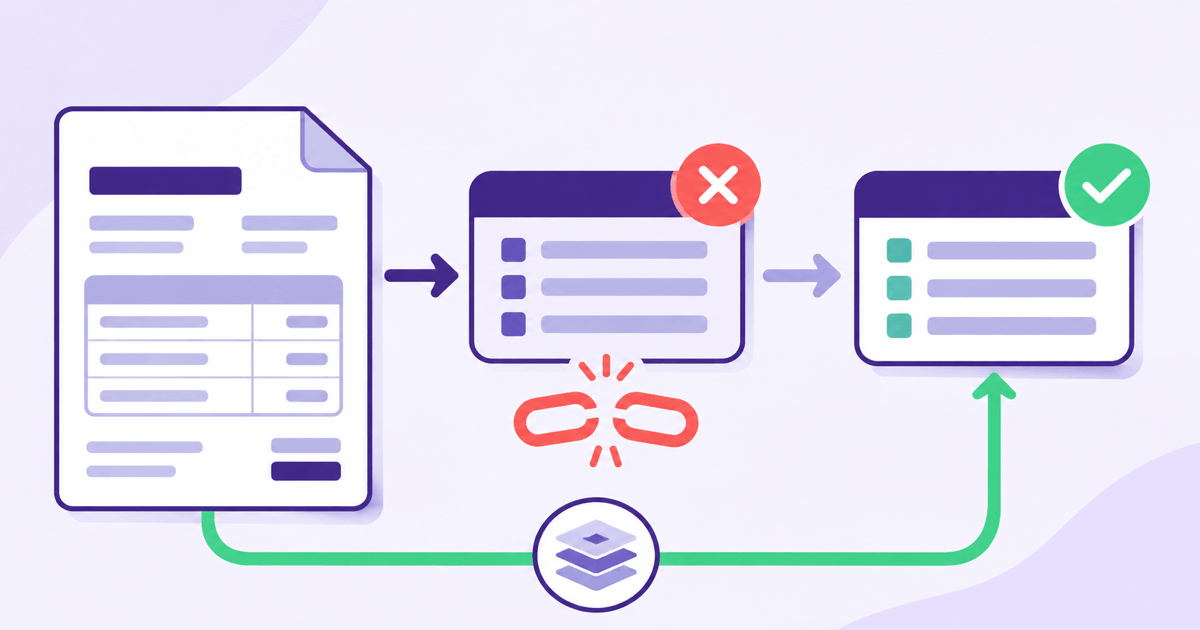
An X12 810 carries invoice data between trading partners. When a partner rejects one, the useful question is not only which segment failed. It is which source value can support a correction, and whether the re-emitted transaction can be traced back to that evidence.
Separate syntax from invoice meaning
An 810 can fail a structural check, a partner implementation guide, or a buyer's application rule. An acknowledgment such as an X12 997 or 999 can report transaction or implementation errors; it does not decide whether the invoice is commercially correct. Keep the acknowledgment beside the original interchange so the exception starts with the exact rejection and control references.
The X12 810 Invoice transaction set is the electronic document for billing goods and services. The trading partners' implementation guide and application rules determine which required values and business checks apply to their exchange. A missing or mismatched value should stay an exception until its source and the applicable rule are clear.
Use the source document to recover a field
Some invoice workflows retain a PDF or scanned invoice behind the EDI transaction. When validation fails, document parsing can recover a supported field from that source and re-emit a clean ANSI X12 transaction. The source is evidence for the field; it is not a blanket authorization to change the invoice or approve payment.
For each recovered value, keep the original 810 segment, the rejected value, the proposed value, the source document, and a page or region locator. If the document is unreadable, conflicts with another record, or does not contain the value, leave the exception open for a person to resolve.
A small 810 exception, with its evidence
Consider a fictional invoice with a rejected quantity. The EDI line says 8 units. The supplier's source PDF shows 18 units at $24.00, or $432. The table records what a reviewer would need to check before a corrected transaction is sent:
| Field | Rejected 810 | Source document | Proposed output |
|---|---|---|---|
| Invoice number | INV-0482 | Page 1, invoice header | INV-0482 |
| Purchase order | PO-7712 | Page 1, PO reference | PO-7712 |
| Line quantity | 8 | Page 2, line 2: 18 | 18, pending partner-rule check |
| Unit price | $24.00 | Page 2, line 2: $24.00 | $24.00 |
The calculation is consistent: 18 × $24.00 = $432. That arithmetic does not prove the goods were received, that the purchase order permits the price, or that the invoice should be paid. Those checks remain with the buyer's agreed workflow.
Keep the correction reviewable
A useful exception record preserves the original interchange and control numbers, the acknowledgment, the source PDF and its identity, the extracted value with its page locator, the partner rule that failed, and a before-and-after field comparison. When a corrected 810 is emitted, retain its new interchange and transaction control references and link them to the rejected version.
- Keep one source locator for each recovered field, rather than a single citation for the whole invoice.
- Record which implementation-guide or application rule caused the rejection.
- Route missing, conflicting, or low-confidence evidence to review instead of filling a plausible value.
- Keep correction and payment approval as separate decisions.
Cogneris describes EDI exception document parsing for retail: when EDI 850, 810, or 856 transactions fail validation, the underlying PDF or scanned document can be parsed to recover failed fields and re-emit a clean ANSI X12 transaction. The exception record still needs to preserve its source and the partner's rules.
Keep invoice recovery in its lane
An 810 carries an invoice. An 856 advance ship notice describes shipment contents and timing, so its reconciliation belongs to a separate workflow; see the separate 856 advance ship notice workflow. A remittance advice explains payment application and belongs with the separate cash application workflow. Linking those records can help a team investigate a discrepancy, but each transaction keeps its own purpose and evidence.
For the standard itself, consult the official X12 transaction set catalog and the trading partners' current implementation guide. This article describes an exception-handling pattern; it does not reproduce the standard or replace the partner's rules.
Correct the field. Keep the decision visible.
A clean re-emission is a corrected data exchange, not an approval. Preserve the original 810, show why each changed field is supported by the source, and leave commercial acceptance and payment authorization to the people and controls responsible for them.