
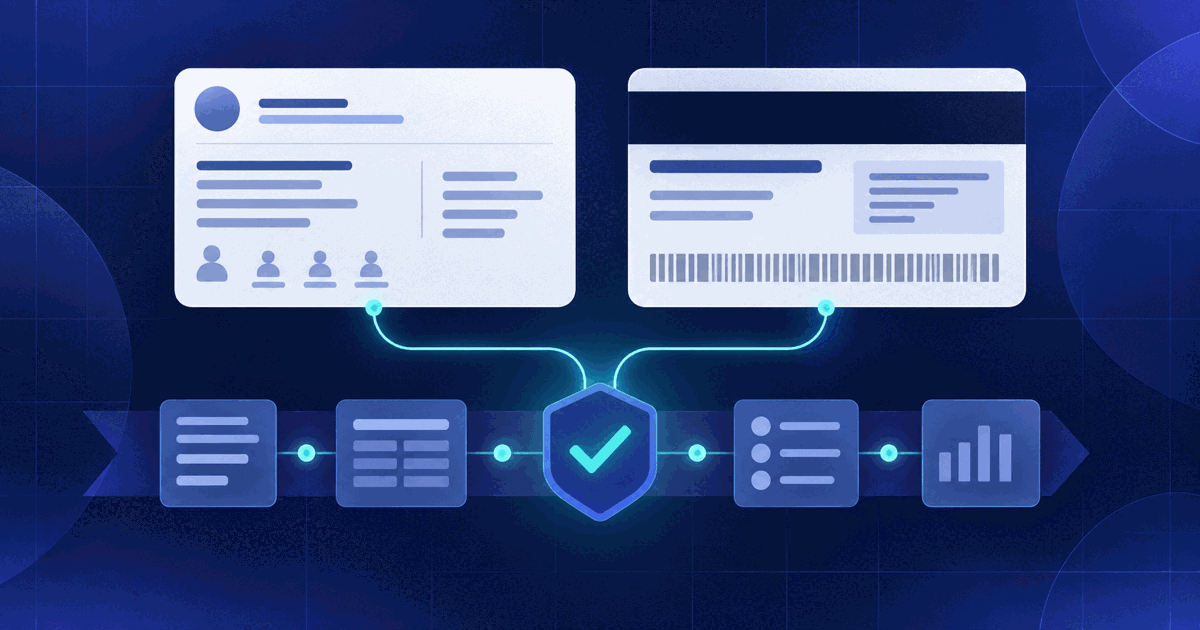
A patient uploads a photo of an insurance card during intake. The front is sharp, the back is a separate image, the member ID is readable, and the group number sits under a reflection. A dependent’s name appears on the card, but the person in the appointment is the subscriber’s child. The question that follows is simple: can this visit be checked for coverage? The evidence arriving from the card is not simple.
An insurance card is not an eligibility response. It is a compact pointer to the payer, plan and member identity that a later transaction can query. Treating the card as a flat string of text loses the relationships that make the fields useful: which ID belongs to which person, which payer route owns the group number, and which side of the card supplied the evidence.
The reliable handoff is therefore a normalized evidence bundle. Extract what the card says, preserve where it says it, distinguish subscriber from dependent, and only then send the request to the system that can answer eligibility.
The card is a key, not the decision
Cards vary by payer and plan. One front may show a member name, member ID, payer name, plan name, group number and copay values. Another may put pharmacy routing on the back, with an Rx BIN, PCN and a customer-service number. Effective dates may be printed in a corner, omitted entirely, or represented through a plan-specific label.
Those differences are not a reason to return an unstructured transcription. They are a reason to define a stable schema and allow fields to be absent without turning absence into a negative coverage decision. The health insurance card OCR page describes the field set and the front-and-back processing model; the blog article’s job is to explain what that model must preserve at intake.
| Field group | Why intake needs it | Evidence to retain |
|---|---|---|
| Member identity | Routes the lookup to the person whose visit is being scheduled, not merely the person who paid the premium. | Member name, member ID, relationship label and the card side that supplied each value. |
| Payer and plan | Chooses the payer route and the plan context for the eligibility request. | Payer name, plan name, group number and the normalized values before any lookup. |
| Coverage dates | Frames whether a date-sensitive result should be expected for the service date. | Effective and termination dates when printed, with a flag when the card does not state them. |
| Cost-share hints | Gives staff a card-level reference without pretending a printed copay is the final benefit response. | Copay labels and amounts, plus page or region evidence and confidence. |
| Pharmacy routing | Keeps Rx processing details from being confused with medical-plan identifiers. | Rx BIN, PCN and related labels, isolated in their own field group. |
The distinction matters because a field can be present and still be unusable. A group number copied into the member-ID slot is not a missing-value problem; it is a routing error. A copay printed on the card is not a guarantee for every service; it is a piece of evidence that a later response may confirm or contradict.
Make front and back one submission
Many intake failures begin before OCR. A portal accepts two images but stores them as two unrelated uploads. A scanner creates a PDF with the back page rotated. A staff member photographs the card twice and the system cannot tell whether the second image is the reverse side or a duplicate. The extraction layer can read every image correctly and still hand the eligibility workflow the wrong packet.
Represent the card as one submission with page-level evidence:
- One submission key — front and back images, scans or PDF pages belong to the same intake event even when they arrive as separate files.
- One field map — member ID, group number and payer fields are merged into one record, with conflicts kept visible rather than silently overwritten.
- One evidence trail — every extracted value points to its page, region and confidence so a reviewer can inspect the source without searching the upload history.
- One review state — a missing back side or an unreadable identifier becomes a precise follow-up task, not an opaque eligibility failure.
This is also where multi-image handling earns its place. The source page supports photo uploads, scans, PDFs and multi-image submissions; the output should preserve the fact that those pages were a single card. Without that relationship, duplicate detection and human review both become harder than the extraction itself.
Resolve identity before asking the payer
The same card may contain several names or identifiers. A subscriber can present a dependent’s card. A family plan can share a group number while each member has a different ID. A payer’s brand can differ from the network name printed elsewhere. Eligibility routing needs a sequence that makes those distinctions explicit.
1. Identify the covered person
Capture the member name and member ID as a pair, then record the relationship to the subscriber when the card states it. Do not infer a relationship from a surname. If the appointment record and the card disagree, surface the conflict before the lookup rather than selecting the closest string.
2. Separate plan routing from pharmacy routing
Group number, plan name and payer name describe the medical-plan context. Rx BIN and PCN route pharmacy transactions. They can coexist on one card, but they answer different downstream questions. A normalized record keeps them in separate namespaces so a pharmacy field cannot accidentally become the payer key.
3. Put dates and service context beside the request
A card can show effective dates, but a printed card does not answer every benefit question for every service. Carry the intended service date and the requested coverage context alongside the extracted fields. The card starts the query; the payer response is the decision artifact.
This ordering prevents a common shortcut: treating a successful OCR parse as proof that the patient is covered. Extraction answers what the document contains. Eligibility answers what the payer returns for a person, plan and service context.
Evidence is what makes the handoff reviewable
Eligibility workflows do not need another opaque confidence score. They need to show a staff member why a request was routed, which values were uncertain, and what should be corrected. A useful result has both the normalized field and the citation that supports it.
- Field value — the member ID, payer, group number or other normalized value that the next system receives.
- Source location — front or back, page number, bounding region or image reference where the value appeared.
- Confidence and conflicts — a calibrated signal for review, plus any disagreement between front and back or between duplicate submissions.
- Missingness with cause — absent on the card, outside the crop, unreadable, or not applicable are different states and should stay different.
- Audit event — who accepted, corrected or re-routed the field, with the original extraction kept available for comparison.
That evidence also changes the economics of the front desk. A reviewer can correct one low-confidence group number without retyping the whole card. A missing reverse side can trigger a focused upload request. A payer mismatch can be routed to the right queue. The workflow spends human attention on the ambiguity rather than on copying every visible character.
Where this fits in the healthcare workflow
Card extraction is useful during patient onboarding, benefits verification, claims intake, prior-authorization support, billing setup and healthcare portals. It is the document step that prepares a clean request for a coverage system; it is not a substitute for that system’s response or for clinical judgment.
That boundary keeps neighboring problems separate. Medical-record abstraction links clinical documents into an episode and preserves assertions, dates and provenance; an insurance card supplies administrative identifiers for a coverage lookup. Capture-time validation asks whether a document was captured under the right conditions; card eligibility asks whether the extracted identifiers can route a payer request. The two controls can coexist without becoming one generic “verification” score.
Privacy controls belong around the whole path. The source page describes tenant access, retention, redaction and audit controls for healthcare workflows; those controls should govern the upload, normalized record, reviewer view and downstream response. Saying the workflow is HIPAA-aware does not make a particular payer response or clinical decision compliant by itself.
What the extraction should return
A card-reading result is ready for an eligibility handoff when it gives the next system a bounded record rather than a bag of strings:
- Covered-person identity — member name, member ID and relationship data, with conflicts against the appointment record exposed.
- Plan route — payer, plan and group values kept distinct from pharmacy routing fields.
- Coverage clues — dates, copay labels, phone numbers and related text when printed, never promoted to a final benefit decision.
- Front-to-back provenance — the card side, page, region and confidence attached to every field.
- Actionable review — focused tasks for unreadable, absent, conflicting or low-confidence values.
The health insurance card OCR API is the product surface for extracting these fields, and healthcare solutions shows the surrounding workflow context. The useful promise is not that every card becomes a decision automatically. It is that the next decision starts with the right identity, the right route and evidence a person can inspect.
Eligibility starts before the query
The front desk does not need a perfect copy of an insurance card. It needs a trustworthy handoff: both sides treated as one submission, identifiers assigned to the right person, plan fields separated from pharmacy fields, and every value tied to the region that supports it.
Once that bundle exists, a payer lookup can answer the question it was actually asked. When it does not, the workflow can show whether the cause was a missing image, an unreadable identifier, a routing conflict or a coverage response. That is the difference between extracting a card and making eligibility work.