
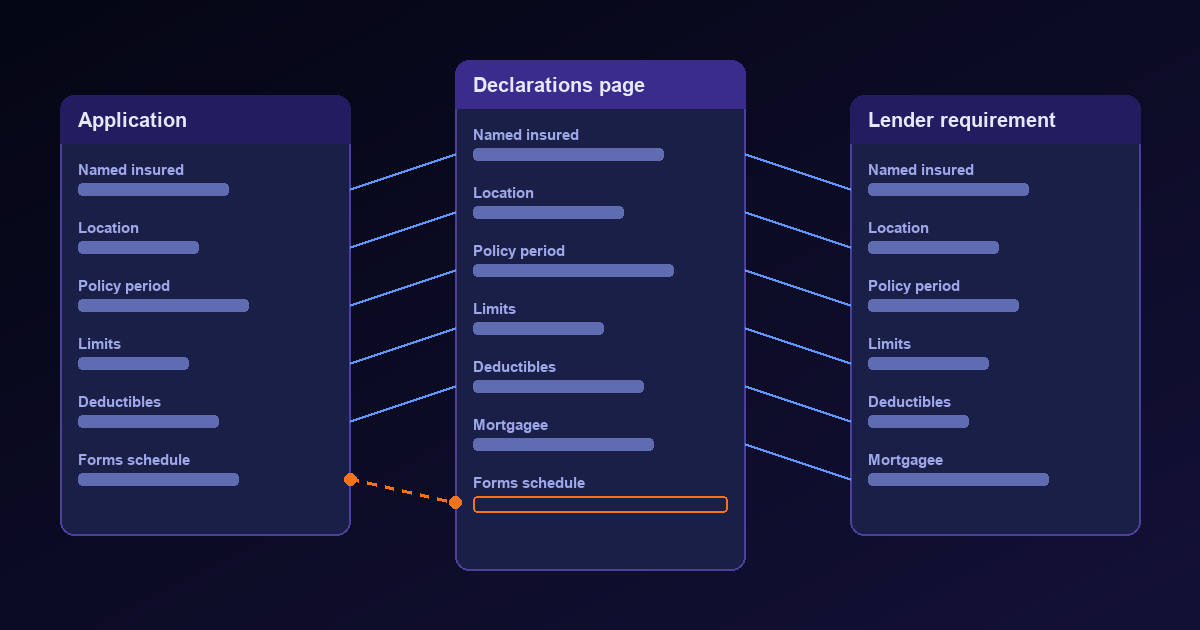
Every property and casualty policy has a page near the front that answers the questions people actually ask about it. Who is insured, what property or activity is covered, where, from when to when, for how much, with what deductible, at what premium, and under which forms. Insurers and agents call it the declarations page, often shortened to the dec page. It is usually one or two sheets, it is computer-generated from the insurer’s system, and it is the document a lender, a landlord, a contract administrator or a claims adjuster reaches for first.
That makes the declarations page the most useful single document for checking a policy, and also the easiest one to read too quickly. It is a summary, but it is not a quote, not a request and not a representation made by someone else. It is the insurer’s record of what was issued. Comparing it with what was asked for and with what other people were told is where most policy errors are caught, and where they are cheapest to fix.
This piece describes what a declarations page holds, which documents to read it against, what each kind of mismatch tends to mean and who owns it, and what an extraction has to return so the comparison can run as data. It deals with the issued policy. Intake of a new submission is covered in the submission packet article, and tracking a vendor’s certificate of insurance over time is covered in the certificate tracking article.
The declarations page is part of the contract
The clearest public definition comes from the Standard Flood Insurance Policy, which is published as a federal regulation and therefore reads the same for every insurer that writes it. The Dwelling Form, Appendix A(1) to 44 CFR Part 61, defines the declarations page in Section II.C.11 as “a computer-generated summary of information you provided in your application for insurance.” The same definition adds that it describes the term of the policy and the limits of coverage, displays the premium and the insurer’s name, and “is a part of this flood insurance policy.”
Two other definitions in the same section explain how the page relates to everything else. Section II.C.22 defines the policy as the entire written contract, made up of the printed form, the application and declarations page, any endorsements that may be issued, and any renewal certificate. Section II.C.3 says the application is the statement the insured or their agent made and signed, which the insurer uses to determine eligibility, the kind of policy and the premium. In other words, the application is what was requested, the declarations page is what was issued from it, and the printed form and endorsements are the wording that the page points to.
Other lines of business use their own forms, but most declarations pages carry the same families of fields:
- Parties — the insurer, the named insured and mailing address, the agent or broker, and any mortgagee, loss payee or additional insured.
- Policy identity — policy number, policy form or program, the effective and expiration dates with the time of day, and whether this is new business, a renewal or a revised page.
- What is covered and where — the described location or schedule of locations, vehicles or other items, with the coverage that applies to each.
- How much — limits by coverage, deductibles by peril, and any percentage deductibles together with the value they are calculated from.
- Premium — premium by coverage, fees and surcharges, and the total.
- Forms and endorsements — the schedule of the forms that make up the policy, by form number and edition date.
Read it against the documents that ask the same questions
A declarations page is rarely wrong on its own terms. It is wrong relative to something: the application that requested different coverage, the lender that requires a specific mortgagee wording, the contract that requires a minimum limit, or the certificate of insurance that told a third party something the policy does not say. Each of those documents answers some of the same questions as the declarations page, and each comparison has a different owner.
| Field on the declarations page | Read it against | What a mismatch usually means | Action |
|---|---|---|---|
| Named insured | Application; deed or title record for property policies | A title holder or an entity left off when the policy was issued | Ask the agent for an endorsement adding the missing insured |
| Described location | Application; appraisal or property record | Transposed street number, missing unit, wrong parcel | Correct by endorsement before any loss is reported |
| Policy period | Application; closing date or contract start date | Coverage starts after the date it is needed, or ends before the obligation does | Confirm the effective date with the insurer; do not rely on a binder that has expired |
| Limits by coverage | Application; lender or contract requirement | Limit issued lower than requested or below a required minimum | Route to the agent; the requirement holder decides whether the issued limit is acceptable |
| Deductibles | Application; lender or contract maximum | A peril-specific or percentage deductible the requester did not expect | Compute the percentage deductible in currency and report it as a fact |
| Mortgagee or loss payee | Lender’s required clause wording | Wrong name, missing successors wording, old address, loss payee instead of mortgagee | Request a mortgagee correction through the agent |
| Forms and endorsements | Application; certificate of insurance; contract requirement | An endorsement that was requested, or shown on a certificate, is not in the schedule | Treat the coverage as not issued until the form appears on a revised page |
| Premium | Quote and payment record | Premium differs from the quote, or was not paid in full | Route to billing; check whether coverage was reduced to what was paid |
The table is a starting set for routing, not an underwriting policy. Its point is that a mismatch is a finding about two documents, and that the finding names who has to act. An extraction that only reads the declarations page can report the limits; it cannot say whether they are wrong.
The forms schedule is where coverage is decided
The forms and endorsements schedule is the shortest part of most declarations pages and the one most often skipped. It lists form numbers and edition dates, sometimes with a short title, and it is the only place on the page that says which wording applies. Two policies with identical limits can cover very different losses if one lists an exclusion endorsement the other does not.
Three checks catch most problems in the schedule. First, every endorsement the application requested should appear by form number. A coverage that was quoted and paid for but is missing from the schedule has not been issued, whatever the quote said. Second, edition dates matter: the same form number in a different edition can carry different wording, so a renewal that changes an edition date is a change worth flagging. Third, an endorsement that a certificate of insurance mentions, such as an additional insured or a waiver of subrogation, needs to exist in the policy itself. As the certificate tracking article puts it, a checkbox on a certificate is not the endorsement; the declarations page schedule is one place to confirm that the endorsement was actually issued, and the form itself is where its wording lives.
Lenders read the declarations page as evidence
Mortgage lenders and servicers need proof that the collateral is insured on their terms, and the declarations page is the document they most often receive. Fannie Mae’s Selling Guide shows what that review checks. Section B7-3-07 requires the lender or servicer to verify that a valid policy meeting Fannie Mae’s requirements exists and to keep evidence with enough information about the policy, the property and the borrower to confirm compliance. A certificate of property insurance may be accepted in place of the full policy only if it includes all of the information needed and is signed by the insurer. The section is blunt about the failure case: if the lender cannot determine whether the policy meets the requirements, the loan is not eligible for purchase.
Section B7-3-08 then sets out what the parties on the page must say. For a one- to four-unit property, the policy must name all persons holding title to the property as named insureds. The mortgagee clause must show the lender’s name followed by the phrase “its successors and/or assigns” and a mailing address, or the servicer’s name in the same form when the lender is not the servicer. The policy must include a standard or union mortgagee clause, and a loss payable clause in its place is not acceptable.
Most of those checks are field comparisons between the declarations page and the loan file: names against the title record, the mortgagee line against the lender’s required wording, the described location against the property address, the policy period against the closing date. They are exactly the comparisons that go wrong when a person reads the page in a hurry and the names look close enough.
A worked example
A homeowners policy is issued for a purchase that closes on November 3. The application asked for the coverage in the second column, the declarations page shows the third, and the lender’s requirements are in the fourth. All names and values are invented for illustration.
| Field | Application | Declarations page | Requirement | Result |
|---|---|---|---|---|
| Named insured | Both buyers on the deed | First buyer only | All title holders | Endorsement needed to add the second buyer |
| Described location | 41 Harbor Lane | 14 Harbor Lane | Subject property address | Transposed number; correct by endorsement |
| Policy period | From November 1 | November 1 to November 1, 12:01 a.m. | In force at closing | Matched |
| Dwelling limit | $420,000 | $420,000 | Lender minimum | Matched |
| Deductibles | $1,000 | $1,000 all other perils; 2% wind and hail | Lender maximum | Report the 2% as $8,400 and let the lender decide |
| Mortgagee | Lender, successors wording, servicing address | Lender name only, old address | Name, “its successors and/or assigns”, address | Request a mortgagee correction |
| Water backup endorsement | Requested | Not in the forms schedule | None | Not issued; ask the agent before the buyers assume it |
| Premium | Quoted $2,380 | $2,380 | Paid at closing | Matched |
Four of the eight rows match and four do not, and the four findings belong to different people. The named insured and the described location are corrections the agent requests from the insurer. The mortgagee line is a correction the lender cannot close without. The percentage deductible is not an error at all: it was issued as written, and whether it is acceptable is the lender’s decision, which needs the deductible expressed in dollars rather than as a percentage of a limit printed elsewhere on the page. The missing water backup endorsement is a coverage question for the buyers and their agent, and it is the one most likely to surface only after a loss.
None of these would be visible from the declarations page alone. Each one appears only when a field on the page is put next to the same field in another document.
Corrections arrive as new pages, not edits
A declarations page is not corrected by changing it. It is corrected by an endorsement, which produces a revised page with a new issue date and, usually, an endorsement number or a “revised” marker. The flood policy states the rule plainly in Section VII.C: the policy cannot be changed, nor any provision waived, without express written consent. For a review process, that means every policy can have several declarations pages in its history, and the one that matters for a question is the one in force on the relevant date.
The flood policy also shows that the page can be overtaken by what was paid. Under Section VII.D.2, if the premium received was not sufficient to buy the kinds and amounts of coverage requested, the insurer provides only the coverage that the premium paid can buy, and the policy is reformed accordingly. A declarations page showing the requested limit is therefore only as good as the payment record behind it, which is why the table above reads premium against the payment, not only against the quote.
Renewals deserve the same care. A renewal declarations page is a new record, and comparing it field by field with the expiring one is the quickest way to see a limit that was not increased, a deductible that changed, or a form edition that was replaced.
What the extraction should deliver
For each declarations page, a useful extraction returns the page as structured fields and tables, with the evidence for each value, not as a paragraph of text:
- Page identity — insurer, policy number, page type (new business, renewal, revised), issue date and any endorsement number, so several pages for the same policy can be ordered.
- Parties as separate records — each named insured, mortgagee, loss payee and additional insured with its full name, role and address, never merged into one string.
- Schedules as tables — locations, vehicles or items as rows, with the coverages, limits and deductibles attached to each row rather than to the page.
- Deductibles with their basis — amount or percentage, the peril it applies to, and for a percentage the value it is calculated from.
- The forms schedule — every form number with its edition date and title as printed, so it can be compared with the application and with the expiring policy.
- Page and position evidence — for every value, where on which page it was read, so a reviewer of a mismatch sees the original in one step.
The comparison then runs as its own step: pair each field with the application, the loan or contract requirement and any certificate that was issued, classify each mismatch by field, and send it to the person who owns it with both sources attached. Nothing in that step changes coverage or accepts a deviation. Those stay with the agent, the insurer and the party whose requirement is involved.
The ACORD forms extraction page describes how Cogneris classifies policy declarations, endorsements and ACORD forms and extracts named insureds, limits, deductibles, coverages, premiums and dates into a reviewable record with source citations. Nothing here describes a product feature for comparing declarations pages with lender or contract requirements; the argument of this article is about the fields a declarations page has to become before that comparison can run.
Where this sits next to submissions, certificates and loss runs
The declarations page sits between documents that other articles cover. Before it comes the submission, where the ACORD application and its supporting schedules ask for coverage; the submission packet article treats that packet as one reviewable unit, and the declarations page is the answer to it. After it come the certificates of insurance that summarise it for third parties, and the certificate tracking article explains why those need their own expiry watch. And alongside it, for underwriting a renewal, sit the insured’s loss runs, whose dates are their own subject in the loss run article.
Of those documents, the declarations page is the one issued by the insurer as part of the contract. That is why it is the right anchor for the comparison: the application says what was asked, the certificate says what someone was told, the requirement says what was needed, and the declarations page says what exists.
Read the issued policy, not the request
The declarations page is the policy on one sheet: parties, location, period, limits, deductibles, premium and forms, as the insurer issued them. Its value comes from comparison. Read against the application, it shows what was requested and not issued. Read against a lender’s or a contract’s requirements, it shows what still has to be corrected before anyone relies on it. Read against a certificate, it shows whether the summary someone else received is true. The extraction’s job is to make each of those comparisons possible: every field, every schedule row and every form number as data, with the page it came from.
Sources
- 44 CFR Part 61, Appendix A(1), Standard Flood Insurance Policy Dwelling Form — definitions of application, declarations page and policy (Section II.C.3, II.C.11 and II.C.22), deductibles shown on the declarations page (VI.A), amendments and waivers (VII.C) and reformation for insufficient premium (VII.D.2).
- Fannie Mae Selling Guide, B7-3-07, Evidence of Property Insurance — what evidence a lender or servicer must keep, and when a certificate may stand in for the policy.
- Fannie Mae Selling Guide, B7-3-08, Mortgagee Clause, Named Insured, and Notice of Cancellation Requirements — named insured, mortgagee wording and the standard mortgagee clause.
This article explains document extraction and review handoffs. It is not underwriting, coverage, lending or insurance advice.