
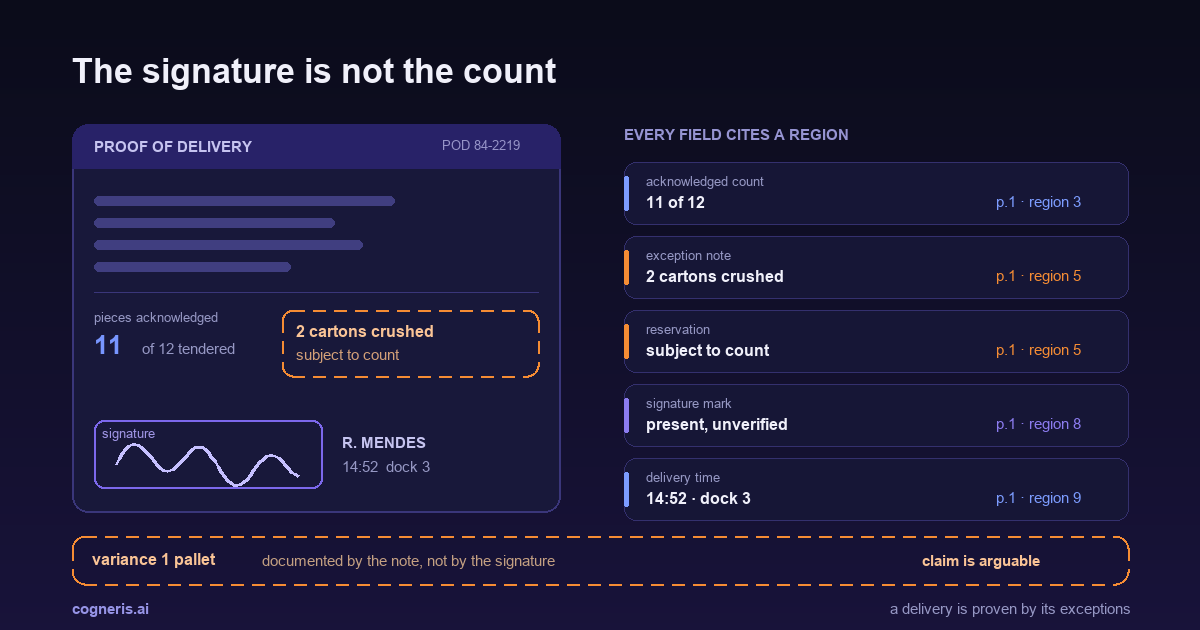
A retailer deducts four figures from a carrier’s invoice for a short shipment. The carrier answers that the load was delivered complete and signed for. Both parties then reach for the same document: a proof of delivery captured as a photo of a handheld screen, carrying a signature, a printed name, a date and two handwritten words in the margin. Whoever can read those two words settles the deduction.
A proof of delivery is usually treated as a receipt — confirmation that a stop happened. In a dispute it is something narrower and more demanding: a record of what the receiving party asserted at the moment of handover. The signature says a person accepted the delivery. It does not say how many pieces arrived, what condition they were in, or whether the receiver reserved the right to count them later.
That gap is where the claim lives. A useful extraction does not return a signature flag and a date. It returns counts, exception notes, signer details and timestamps, each tied to the region of the page that supports it, so the claim can be argued from the document instead of from a recollection of it.
A POD is a claim record, not a receipt
Proof-of-delivery documents confirm what was delivered, when, where, by whom, and whether exceptions were recorded. The proof of delivery OCR page describes the field set and the evidence model; what a blog article can add is why those fields behave differently once money is contested.
Carriers, shippers and receivers each keep a copy, and the copies do not always agree. A driver’s handheld capture, the consignee’s stamped paper copy and the carrier’s imaged PDF can describe the same stop and still disagree about the piece count. Nothing about that is unusual. The document that decides a deduction is the one whose fields can be located, shown and compared — not the one that was filed first.
What a dispute actually turns on
Freight claims are argued field by field, and the fields are not interchangeable. A POD that extracts cleanly into five strings can still be useless if the strings do not separate what was tendered from what was acknowledged.
| Field group | What the dispute turns on | Evidence to retain |
|---|---|---|
| Shipment identity | Whether this POD belongs to the load being deducted at all, rather than to an adjacent stop on the same route. | POD, bill-of-lading and purchase-order numbers, stop sequence and consignee name, each with the region that supplied it. |
| Piece and quantity counts | Shortage, overage, and the prior question of whether a count was taken at the door. | Tendered, acknowledged and recounted quantities as separate values, with “not counted” preserved rather than rendered as zero. |
| Exception and condition notes | The claim itself: damage, shortage, refusal, partial acceptance or a reservation of rights. | The literal handwritten or printed text, its position on the page, and a confidence value that reflects how legible it was. |
| Signature and signer | Who accepted the delivery, and how the receiver was identified at the time. | Signature presence, printed or typed name, the mark region, and whether the name was written by hand or entered on a device. |
| Time and place | Late delivery, detention, missed appointment windows and service failure. | Delivery date, arrival and departure times, address, and the source of each timestamp. |
The separation in the second row is the one most often lost. A single “quantity” field cannot express the situation that produces most deductions: the shipper tendered twelve pallets, the receiver acknowledged eleven, and nobody recorded whether the twelfth was missing or simply uncounted. Three distinct facts flattened into one number cannot be argued in either direction.
Every field needs a region, not just a value
The difference between a POD that supports a claim and one that merely describes it is citation. A value alone is an assertion by the extraction system. A value with the region it came from is evidence that the other party’s auditor can check without trusting the system that produced it.
- The value — the normalized count, date, name or note that the claim or freight-audit system receives.
- The region — page, coordinates and the image crop the value was read from, stored with the record rather than regenerated on request.
- The confidence — calibrated per field, because a machine-printed POD number and a handwritten count on a photographed screen are not equally readable.
- The state of absence — absent from the form, present but illegible, cropped out of frame and not applicable are four different answers, and collapsing them into one empty string destroys the distinction a claim needs.
- The correction trail — who changed a value, from what to what, with the original extraction preserved beside the corrected one.
That last item matters more here than in most document workflows. A deduction can be reopened months after the delivery, and by then the only account of what the document said is the record the extraction kept. If a reviewer silently overwrote a low-confidence count, the audit trail has to show it.
Three ways a POD stops being evidence
1. The mark is captured and the annotation is not
Handheld capture is optimized for the signature box. The crop that frames a signature neatly is often the crop that cuts off the line above it, and a receiver who writes “2 cartons crushed” there has written the most valuable sentence on the page. Extraction has to read the whole page and say explicitly when part of the form fell outside the frame. A result that reports a signature and stays silent about a missing margin is reporting the least contested fact and hiding the most contested one.
2. The exception is written where the form did not expect it
POD forms differ by carrier and by receiver. An exception may appear as a code, a checkbox, free text in a dedicated block, a note squeezed beside the address, or a rubber stamp across the middle of the page. A parser keyed to a fixed layout finds the designated box, reports no exceptions and is confidently wrong. A layout-independent read returns the note and its position even when the note sits where nothing was supposed to be written.
3. The delivery is clean but not clear
A signature is not a waiver. “Subject to count”, “STC”, “pieces not verified” and similar reservations appear precisely when a receiver accepts custody without accepting the count. An extraction that collapses the page to signed: true deletes the clause the claim depends on, and does so without any error to investigate. The output looks complete. It is the shape of the output that is wrong.
Reconcile against the shipment, not against the image
A POD is evidence only in relation to what was supposed to arrive. The acknowledged pieces have to be compared with the bill of lading, the packing list and the order — and the comparison, not the extraction, is what produces a claim position.
1. Bind the POD to the load
Match on the identifiers the document carries, and surface a conflict rather than resolving it by closest string. Two stops on the same route, or a redelivery of a previously refused load, will produce PODs that look interchangeable and are not.
2. Compare acknowledged against tendered
Hold the two counts apart and compute the variance as a separate value. A variance of zero and a variance that could not be computed are different results, and only the first one supports closing a deduction.
3. Attach the exception text to the variance
A shortage with a written note describing it is a documented claim. The same shortage with no note is an open question about whether the count was ever taken. Keeping the note attached to the variance is what lets a reviewer tell those apart at a glance.
This is a different job from the one described in air waybill reconciliation, where an air waybill, packing list, shipping label and customs declaration have to agree that they describe the same movement before cargo moves. That reconciliation runs ahead of the shipment and checks documents against each other. A POD arrives after the fact and answers a narrower question: does what the receiver acknowledged match what was tendered, and if it does not, what did the receiver write about the difference. Similar field names, opposite position in time, and it is the second one that an auditor reads during a claim. The bill of lading extraction supplies the tendered side of that comparison.
Signature capture is reading, not signing
Two things are called signature handling and they make different claims. Signature as a workflow step concerns a signature the platform produces: an envelope, an authenticated signer, a seal and a timestamp generated under controlled conditions. A POD signature is a signature the platform reads — a mark somebody else collected, on a device nobody in the claim controlled, under conditions that were never recorded.
Keeping the two apart keeps the output honest. Detecting that a mark is present, that a printed name accompanies it and that both occupy a specific region is a reading claim, and the evidence supports it. Asserting that a particular authenticated person signed at a particular moment is a signing claim, and a photographed scribble does not support it. A POD extraction that reports signer identity verified has quietly upgraded one claim into the other, and the upgrade will be found by the opposing party rather than by the system that made it.
What the extraction should return
A POD result is ready for a claim or freight-audit workflow when it hands the next system a bounded, citable record:
- A bound identity — POD, bill-of-lading and order numbers plus consignee, tied to a shipment record, with conflicts surfaced instead of settled by closest match.
- Counts as separate quantities — tendered, acknowledged and any recount kept apart, with an uncounted delivery represented as its own state.
- Exception text verbatim — the note, stamp or code exactly as written, with region and confidence, never reduced to a boolean.
- Signature evidence, scoped — presence, printed name and mark region, described as what was read rather than as proof of who was there.
- Time and place with provenance — delivery date, arrival and departure times and address, each labelled with whether it came from the form, from device metadata or from a carrier system.
The proof of delivery OCR API is the product surface for these fields, and it is worth being plain about the boundary: extraction decides what the document says, not who is right. A clean extraction of a page that records no count does not close a shortage claim. It establishes, with evidence, that no count was recorded — which is itself a usable position, and a far better one than an unsupported assertion in either direction.
The dispute is decided by what you kept
Freight disputes are rarely lost on the merits of the delivery. They are lost because the document that would have settled them was stored as an image nobody indexed, transcribed into a system that kept the signature and dropped the margin, or summarized into a status that no longer names what the receiver wrote.
Treating the POD as a claim record changes what the pipeline has to preserve: counts that stay separate, exception text that stays literal, a signature described as a mark rather than as an identity, and every one of those values pointing back at the region of the page that proves it. That is not a heavier process than the usual one. It is the same extraction, with the parts that get argued about kept intact.