
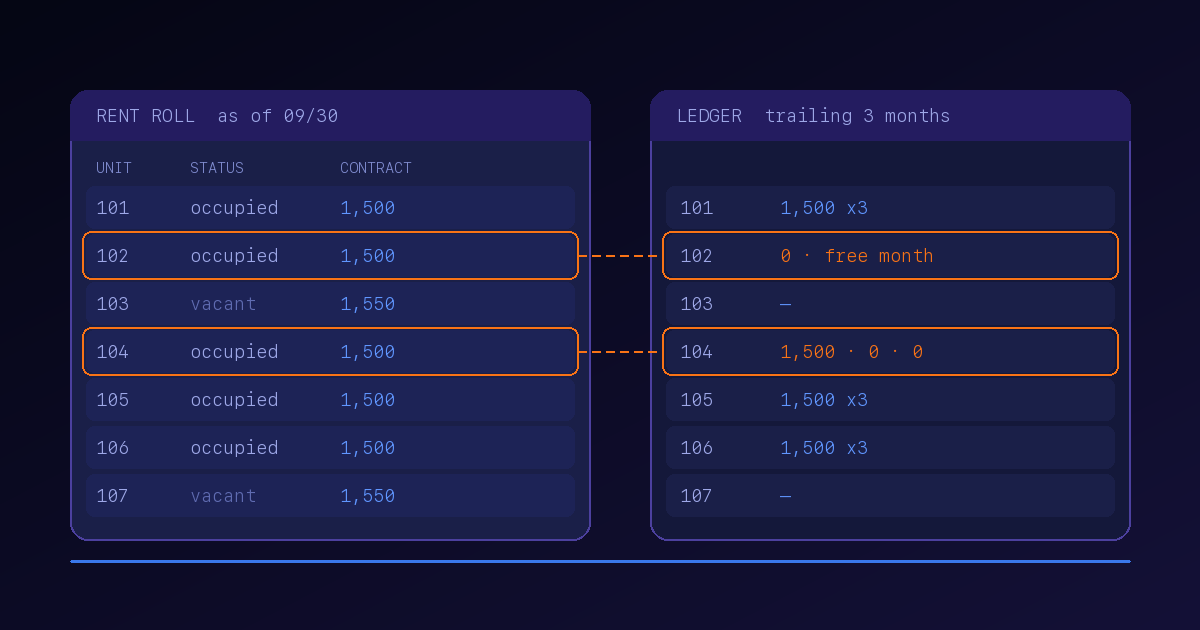
Every commercial real estate loan file has one document that everyone opens first. The rent roll is a table, one line per unit, and it answers the question an underwriter most wants answered: who lives or trades here, and what do they pay? It is compact, it is already structured, and property management software produces it in seconds. Extraction pipelines treat it as a gift. Read the columns, sum the rent, multiply by twelve, and the income side of the deal appears to be done.
That sum is not income. A rent roll is a list of contracts on a date, prepared by the borrower or the manager, and a contract states what a tenant has agreed to pay. Underwriting runs on what the property has actually collected and is likely to keep collecting. The two numbers differ on every real property, and the reasons they differ are the ones the roll is least equipped to show.
This article is about reading a rent roll for what it is: a forecast that has to be corroborated, line by line, by documents that record what happened. It walks through where the rent roll enters the lender’s arithmetic, the four divergences it hides, and what an extraction has to deliver so the corroboration is a join rather than an afternoon of spreadsheet work.
What a rent roll actually states
The layout varies by software and by asset class, but the content of a residential or mixed-use roll is fairly stable. Each line carries a unit identifier, a unit type or size, a tenant name, lease start and end dates, a contract rent, often a market rent, a security deposit, an occupancy status, and sometimes a balance or other charges. Commercial rolls add square footage, rent per square foot, rent steps and reimbursement terms.
Look at the verbs behind those columns. The contract rent is what the lease says. The market rent is someone’s opinion. The status is what the manager recorded on the report date. The dates describe an agreement, not a payment. Nearly every field is a statement about the future or about paper, and none of them is a statement about cash. The roll also carries a date of its own, the “as of” date in the header, and everything on it is true only on that date.
None of this makes the roll unreliable. It makes it a declaration, like a borrower’s application. It is the starting point of the analysis, and the analysis consists largely of testing it against evidence.
Where the rent roll enters the arithmetic
A concrete published example shows how lenders use the document. Fannie Mae’s Multifamily Selling and Servicing Guide (the edition effective September 28, 2026) sets out the required Underwritten Net Cash Flow calculation in Part II, Section 203.01. Its first line defines gross rental income as “actual rents in place for occupied units, plus market rents for vacant units based on a current rent roll (multiplied by 12).” That is the rent roll, annualized, as the top of the income statement.
The lines that follow are deductions the roll does not supply on its own. After adjustments for non-revenue units and premiums, the table subtracts physical vacancy, concessions and bad debt to arrive at net rental income. It then sets a floor on those deductions: taken together they must equal the greater of the gap between gross potential rent and trailing three-month net rental collections annualized, or 5% of gross potential rent. In other words, the lender starts from the roll and then forces the result down toward what was actually banked.
Other lenders and asset classes use different tables, and this article gives no view on what any lender should require. The shape, however, is general. The roll sets the ceiling. Collections, leases and ledgers set the number.
Four divergences the roll does not show
When the contracted figure and the collected figure disagree, the difference almost always falls into one of four buckets. Each has a characteristic appearance on the roll, and each needs a different piece of evidence to measure.
| Divergence | How it looks on the roll | What it hides | Corroborating evidence |
|---|---|---|---|
| Vacancy | Status column, occupied or vacant, on the report date | Units on notice, units that are down or unrentable, leases signed but not yet moved in, model and employee units | Physical inspection of units against the roll; move-in and move-out dates; lease files |
| Concessions | Contract rent at face value | Free months, move-in allowances and reduced first-year rent that the lease grants and the roll does not net out | The concession clause in the lease; ledger credits against rent charges; new and recently renewed leases |
| Delinquency and bad debt | An occupied line, sometimes with a balance column, sometimes without | Tenants who are in place and not paying, and balances that will never be collected | Accounts receivable or past-due report; cash ledger or receipts journal; bank statements showing rent deposits |
| Reimbursements and other income | Extra charge codes, or nothing at all | Utility billing, parking and similar charges that vary month to month, and commercial expense recoveries that depend on actual costs | Operating statement other-income lines; appraisal or third-party market data for secondary income |
Vacancy is the one people think of first, and the roll does show some of it. What it shows is physical vacancy on one day. A unit whose tenant gave notice last week is occupied on the roll and empty next month. A unit taken offline after a leak may be listed as vacant with a market rent, as if it could be leased tomorrow.
Concessions are subtler because they sit inside a lease that looks normal. A tenant who signed a thirteen-month lease with the first month free has a contract rent of 1,500 on the roll, and an effective rent closer to 1,385. Across a lease-up, those free months can be the single largest difference between the roll and the bank.
Delinquency is the purest case of the contract diverging from the cash. The tenant is present, the lease is valid, the rent is due, and nothing arrives. Some rolls carry a balance column; many do not, and those that do report a figure the manager maintains, which is exactly the figure an underwriter wants to test rather than adopt.
Reimbursements and other income are where commercial and residential rolls diverge most. On a retail or office roll, common-area and tax recoveries can be a large share of revenue, and they depend on actual expenses reconciled after the year closes. On a residential roll, utility billing and parking may not appear at all. In both cases the roll is the wrong document to read them from.
A 48-unit example
Take a 48-unit property. The roll shows 45 occupied units at an average contract rent of 1,500 and three vacant units at a market rent of 1,550. Annualized, that is 810,000 from occupied units plus 55,800 of market rent for the vacant ones: a gross potential rent of 865,800, and a physical occupancy of 93.75%.
Now read the trailing three months of collections. If every occupied tenant had paid in full, the quarter would have banked 202,500. It banked 198,000. One new tenant was in a free month, which accounts for 1,500. Another has paid nothing for two months, which accounts for 3,000. Annualized, collections are 792,000, or 91.5% of gross potential rent.
Apply the published floor. The gap between gross potential rent and annualized collections is 73,800, which is larger than 5% of gross potential rent (43,290), so the deductions must total at least 73,800. The roll accounts for 55,800 of it, through the three vacant units. The other 18,000 a year is invisible on the roll: one line reads “occupied, 1,500” and is on a concession, and another reads “occupied, 1,500” and has not paid for two months.
Nothing in this example is exotic, and nothing on the roll is false. Every line is an accurate statement of a lease. The error would lie in reading those accurate statements as a record of income.
The lease audit is a join
Lenders already know this, which is why the rent roll never travels alone. The same guide’s Section 401 requires a lease audit before commitment: reconcile the rent roll with the property’s signed leases, review a minimum number of leases scaled to property size, and include new and recently renewed leases to verify rent trends.
| Units at the property | Minimum leases reviewed (Section 401.01) |
|---|---|
| 5–9 | All available leases |
| 10–100 | The greater of 5 units or 10% of all leases |
| 101–300 | 10% of all leases |
| 301–900 | 40 leases |
| 901 or more | 50 leases |
The section goes on to require an increase in the sample when material discrepancies or missing documentation appear, and, under Section 401.03, validation of collections through a cash ledger, a receipts journal, at least three months of bank statements confirming rent deposits, or similar documents, plus an accounts receivable or past-due report from the site manager. Secondary income such as utility billing, laundry and parking is validated against the appraisal or third-party data.
Read as a data problem, every one of those steps is a join. Rent roll line to lease, on unit and tenant. Lease to ledger, on unit and month. Ledger to bank deposit, on amount and date. Roll status to inspection, on unit. The sample sizes are a floor set for a world in which each join was done by hand. When the documents arrive already extracted, with their keys and their evidence, checking every lease costs little more than checking forty, and the discrepancies that would have forced a larger sample are found on the first pass.
Dates decide what can be compared
The rent roll’s own date is a field, and a critical one. The Fannie Mae guide asks lenders to give the appraiser a rent roll dated within 60 days of the inspection, which tells you how quickly the document is expected to age. A roll dated in June compared against collections through September is not a reconciliation. It is two snapshots of different buildings.
So extract the as-of date, and align everything to it. The trailing collections window should end at or near the roll date. The inspection should be read against the roll it was meant to confirm. Leases should be checked for whether they had started by the as-of date, since a lease signed but not yet commenced makes a unit look occupied a month early. When the packet contains two rolls from different dates, which is common in a refinance, keep both and compare them. Units that change status between the two are exactly where the trend is.
What the extraction has to deliver
The output that makes this analysis cheap is not a cleaner copy of the roll. It is the roll turned into keyed, dated, cited records that can be joined to everything else in the packet.
- The as-of date — captured from the header and attached to every line, so no field is ever compared outside its own date.
- One record per unit, with stable keys — unit identifier and tenant name normalized so a line can be matched to its lease, its ledger entries and its inspection result.
- Contract and market rent kept apart — never merged into one “rent” field, since one is a fact about a lease and the other is an estimate.
- Declared status alongside observed status — what the roll says, and what the lease dates, inspection and ledger say, with the disagreement flagged rather than resolved.
- Charges by type — base rent, concessions, utility and parking charges, and recoveries as separate amounts, so each divergence can be measured on its own.
- A citable origin for each value — document, page and region under the same coordinate contract any reviewable extraction owes, so an underwriter can go from a flagged unit to the line on the roll and the clause in the lease.
The mortgage document extraction page describes the general pattern this depends on: classify a mixed packet, validate names, dates and totals across files, and route only uncertain or inconsistent fields to a reviewer, with confidence, page evidence and source citations on each field. The real estate solutions page describes the portfolio side, lease abstraction with reporting on rent roll. The underwriting judgment, what to deduct and how much, stays with the lender.
Not lease abstraction, not a credit spread
Two neighbouring problems use the same documents and answer different questions.
Lease abstraction, covered in the lease abstraction article, reads one lease deeply: critical dates, rent schedules, options, amendments. Its unit is the contract, and its output is an operating record for the owner. This article’s unit is the property, and its question is whether the income the leases promise is the income the property earns. An abstraction is one of the inputs to that test, not the test.
Financial spreading, covered in the credit spreading article, normalizes a borrower’s statements, tax returns and bank data into one period for credit analysis. The trailing operating statement of a property looks like a candidate for the same treatment, and it is related work, but the rent roll check happens a level below: unit by unit, before any line of the operating statement is trusted. For how deposit lines themselves should be read, the bank statement article covers pairing deposits and returns.
Contracted is not collected
The rent roll deserves its place at the front of the file. It is the most compact description of a property’s income that exists, and it is where every underwriting model starts. It is also a document written in the future tense by the party that benefits from the number.
So extract it for what it is, a dated declaration, and then do the work it invites. Join each line to its lease, its ledger and its unit. Measure vacancy, concessions, delinquency and reimbursements separately, from the documents that record them. The income that survives that test is the one worth underwriting, and every figure in it can point back to the page it came from.