
A packet comes back from signing and a downstream system asks one question: is it signed? The easy answer is a boolean. It is also the wrong shape. A boolean cannot say that the signature block is there but the initials on page 4 are missing, or that page 5 carries a mark nobody can read. Both of those get collapsed into signed: false, or worse, into signed: true because something was found somewhere.
Signature detection in document extraction is better treated as what it is: a field on a page, with a value, a location, and a few states a person can act on.
Three states, and a region
For each page that is required to carry a signature or initials, the field has one of three values:
- Present — a mark is in the signature or initial area. The field records that it is there, not what it says.
- Absent — the area was located and is empty. The page is in the packet; the mark is not on it.
- Illegible — something is in the area, or the area itself cannot be read: a smudge, a fold, a scan cropped through the box, a fax artifact. The pipeline cannot tell present from absent and says so.
Every value comes with the page and the region it was read from. A reviewer who opens the record should see the crop, not a verdict. This is the same discipline as any other extracted field: the value is only as useful as the evidence that lets someone check it in seconds.
“Illegible” is not a polite word for “absent.” An absent mark gets a request to the signer. An illegible one may already be fine, and a reviewer looking at the crop will usually know in a moment. Folding the two together either sends a signed page back for re-signing or lets an unsigned one through.
Presence is not verification
The field answers one question: is there a mark in the place where a mark is required? It does not answer any of these:
- Who made it. A scribble in a signature box is a mark. It is not an identified person.
- Whether the signer was authorized. Authority to sign for a company or an estate is established elsewhere, in the documents that grant it.
- Whether it is legally effective. That depends on the document, the jurisdiction, and the parties, and it is a decision for the people responsible for the file.
Keeping these apart is not caution for its own sake. A field named signature_valid invites every consumer of the data to read more into it than the extraction ever established. A field named for what was observed, signature_presence: present, with its region, cannot be misread that way. Anything stronger is a separate step, run by a person or a system built for it, and it should have its own name and its own record.
Which pages need a mark is not read from the page
The state is only meaningful against a requirement. Whether page 4 needs initials comes from the document type and the packet’s own rules, not from the pixels of page 4: an empty page and a page that never needed a mark look the same. Treat the requirement as input, and extract the state as output.
The same split keeps this article out of the neighboring problem. Whether a whole document is in the packet at all is an indexing question, covered in the loan file has an index. Here the page is present and the open question is whether it carries its mark. And a signature is one field among several on a page, so what the page says beside it is extracted on its own terms.
Document, required mark, state, routing
The table shows how the three states map to routing for a few kinds of document. The documents and rules are illustrative; your own checklist decides what is required.
| Document | Required mark | State | Routing |
|---|---|---|---|
| Equipment lease, signature page | Signature of the lessee’s signer | Present | Continue. Keep the page and region on the record. |
| Equipment lease, page with changed terms | Initials of the lessee | Absent | Create a missing-mark task for the page. Hold the packet from the next step. |
| Patient consent form | Patient or representative signature | Illegible | Send to a reviewer with the cropped region. If it cannot be resolved, request a clean copy. |
| Vendor agreement | Signature for each party | Present for one party, absent for the other | One field per party. Route the absent one, not the whole document. |
| Disclosure acknowledgment | Initials beside each item | Present for three items, illegible for one | Reviewer sees the one illegible item. The other three continue. |
Two rules fall out of the table. Routing is decided per field, not per document, so one missing mark holds only what depends on it. And no state is silently converted into another: an illegible mark stays illegible until a person decides.
A worked example: nine pages, one without initials
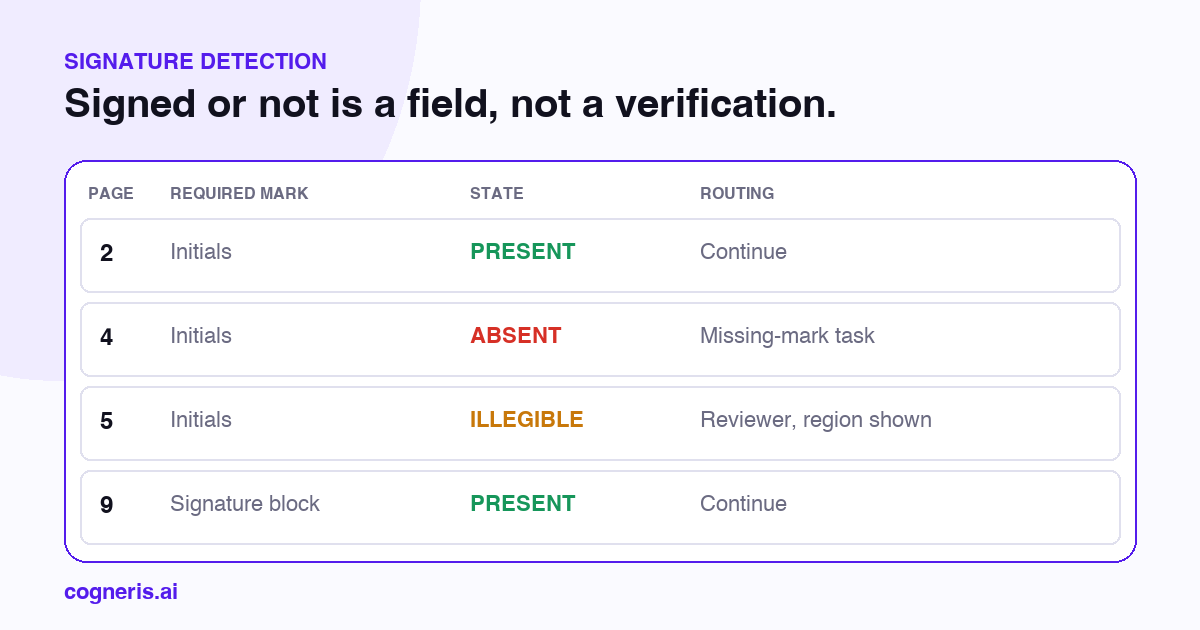
The packet below is fictional. It is a nine-page equipment lease. The checklist says initials are required at the foot of pages 2, 4, and 5, where payment terms, term length, and early-return terms appear, and a signature is required in the block on page 9.
| Page | Required mark | State | Evidence | Routing |
|---|---|---|---|---|
| 2 | Initials | Present | Page 2, initial box at the foot | Continue |
| 4 | Initials | Absent | Page 4, initial box at the foot, empty | Missing-mark task: request initials on page 4 |
| 5 | Initials | Illegible | Page 5, initial box cut by a scan fold | Reviewer, with the crop |
| 9 | Signature | Present | Page 9, signature block | Continue |
A system that reports one flag would see a mark on page 9 and call the packet signed. The three-state records tell a different story: one page is missing its initials, one needs a human look, and two are fine. The reviewer opens the page 5 crop, sees a faint but clear pair of letters under the fold, and confirms the field as present. The page 4 task goes back to the lessee’s representative. Nothing is guessed, and the lessor’s own team can see exactly which page the request is about.
The record stays honest about the order of events too. Page 5 was illegible at extraction and present after review, and both facts are kept, with who resolved it and when.
What the record should carry
- The state — present, absent, or illegible, as a closed set rather than free text.
- The page and region — coordinates the viewer can crop to, so evidence is one click away.
- The kind of mark expected — signature or initials, and for which party, taken from the checklist.
- A confidence value — so a borderline call is visible as borderline, instead of a clean-looking value hiding a guess.
- The resolution — when a reviewer changes a value, the original, the new value, and the reviewer are all kept.
None of this identifies the signer. If your process also needs the signer identified, that is a separate field with a separate source, and the presence record neither supports nor replaces it.
Where the software stops
Cogneris keeps checkboxes, selection marks, signature presence, stamps, and handwritten notes as evidence, so a reviewer can verify the field instead of re-reading the page. The OCR API page and the document extraction API page describe that behavior. What a state means for the business, what each state triggers, and what counts as acceptable for a given packet stay with the people and rules that own the process.
To test this on your own documents, take a handful of packets where you already know the answer: a few complete, one with a missing page mark, one with a poor scan. Check that each lands in the state you expected, and that each state carries a region you can open.