
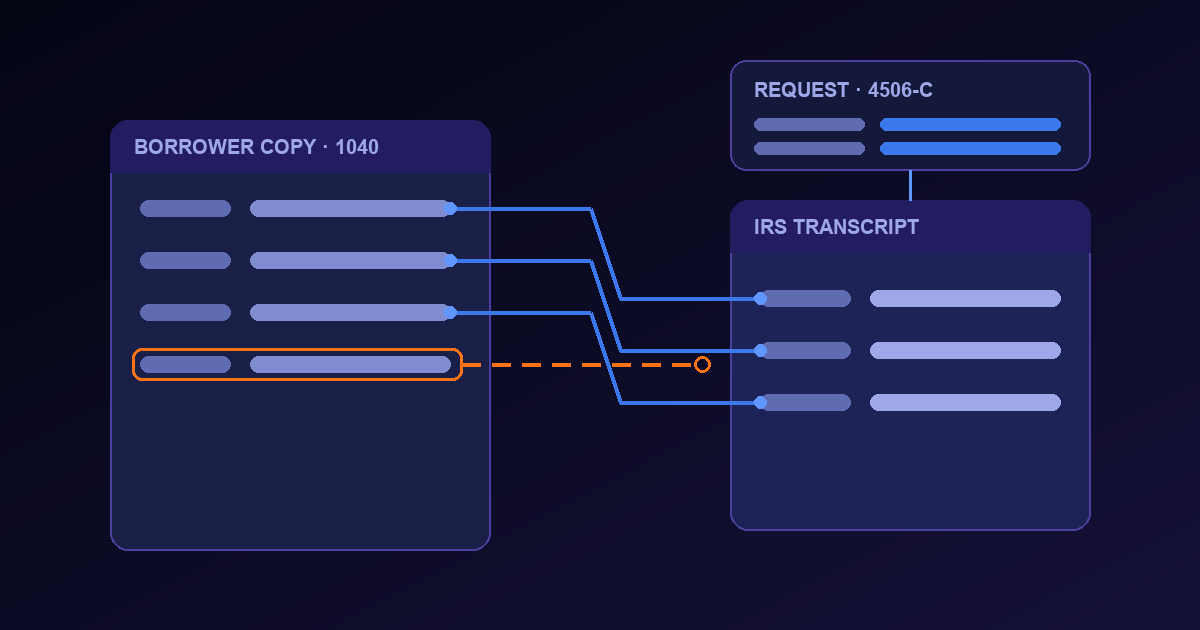
A lending file holds two kinds of document, and they look alike on the screen. Some were handed over by the borrower: a copy of last year’s Form 1040, a W-2, a paystub, a bank statement. Others were issued by a third party in answer to a request: a tax transcript from the IRS, an employer’s confirmation of employment, a bank’s confirmation of a deposit. Both arrive as PDFs. Both have fields an extraction system can read. Only one of them is a declaration.
The difference matters because the two kinds of document answer different questions. A borrower’s copy of a return says what the borrower says was filed. A transcript says what the IRS has on record. When they agree, the declaration has been confirmed. When they disagree, the file has a finding, and the finding is only useful if the system knows which side each number came from, what was actually requested, and which of several legitimate reasons could explain the gap.
This piece walks through that comparison for the most common confirming source in US lending, the tax transcript ordered with Form 4506-C. Every statement about the form and the transcripts it returns is taken from the form itself and its instructions, revision October 2022, as published by the IRS. It does not describe how to underwrite, and it is not tax advice.
Declaration and source are different records
The useful distinction is not paper versus digital, or scanned versus native. It is who produced the document and who it was produced for. A declaration is produced by the applicant, or kept by the applicant, and submitted as part of the application. A source document is produced by an institution that holds the original record, and delivered in response to a request the applicant authorized.
| Declaration | Confirming source | What the source can confirm | What it cannot |
|---|---|---|---|
| Borrower’s copy of Form 1040 | Return Transcript | Most line items of the return as filed and processed | Changes made to the account after processing |
| Borrower’s copy of a W-2 or 1099 | Wage and Income transcript | Amounts reported to the IRS on those information returns | State or local information on the W-2 |
| Paystub | Employer verification of employment | Employment and pay as the employer reports them | Anything the employer was not asked |
| Bank statement | Depository verification of deposit | The account and balance as the bank reports them | Where the money came from |
The last column is the part pipelines tend to forget. Every source answers a bounded question. A transcript that matches the borrower’s return confirms what was filed; it says nothing about whether last month’s income looks like last year’s. A bank’s confirmation of a balance says nothing about the provenance of that balance, which is the subject of the proof of funds article. Recording what a source did not cover is as important as recording what it did.
The request is a document too
A transcript is not something an extraction system finds in a file. It comes back because someone asked for it, and what comes back is determined by what was asked. Form 4506-C, titled IVES Request for Transcript of Tax Return, is that request. Its instructions describe its purpose plainly: the taxpayer uses it to request tax return information through an authorized IVES participant, designated on line 5a to receive it.
The lines of the form decide the shape of the answer:
- Lines 1a to 1c — the current name, the taxpayer identification number, and the previous name shown on the last return filed if it differs. Lines 2a to 2c repeat the same for a spouse when a joint return is requested for both taxpayers.
- Lines 3 and 4 — the current address, and the address shown on the last return filed if it differs from line 3.
- Lines 5a to 5d — the IVES participant who receives the transcript and the client company that receives it from the participant. The instructions say line 5d cannot be blank or “not applicable.”
- Line 6 — the tax form number and the transcript type. The instructions are explicit that only one tax form number may be entered per request for all line 6 transcript types.
- Line 7 — Wage and Income transcripts, with up to three information return types named; if none are named, all forms will be sent.
- Line 8 — the ending date of each tax year or period requested, in mm dd yyyy format, which may be a calendar year, a fiscal year or a quarter.
Two further rules sit beside the signature. The form tells the signer not to sign until all applicable lines are complete, and says the IRS must receive it within 120 days of the signature date or it will be rejected.
For an extraction system, this means the signed request deserves its own record, read with the same care as the transcript it produces. A request that names one form number cannot return a transcript for a second one. A request whose line 8 names the end of a calendar year will not match a business that files on a fiscal year. A request with a current name on line 1a and an empty line 1c may not match a return filed under an earlier name. None of those is a discrepancy in the borrower’s documents. Each is a property of the question that was asked, and it is visible on the page before any answer comes back.
Three transcripts answer three different questions
Line 6 offers three boxes, and the instructions define each one. They are not three levels of detail of the same thing.
- Return Transcript (6a) — includes most of the line items of a tax return as filed with the IRS. The instructions add that it does not reflect changes made to the account after the return is processed. It is available for the Form 1040 series, Forms 1065, 1120, 1120-H, 1120-L and 1120-S, for the current year and returns processed during the prior 3 processing years.
- Account Transcript (6b) — contains information on the financial status of the account, such as payments made, penalty assessments, and adjustments made by the taxpayer or the IRS after the return was filed. Its return information is limited to items such as tax liability and estimated tax payments.
- Record of Account (6c) — the most detailed of the three, as a combination of the Return Transcript and the Account Transcript, available for the current year and 3 prior tax years.
The consequence for comparison is direct. Suppose the borrower supplies a copy of a return, and the Return Transcript differs from it on income. One reading is that the copy was altered. Another is that the return was changed after it was processed, in which case the Return Transcript shows the original filing and the change appears only in account information. The two readings call for opposite actions, and the Return Transcript alone cannot separate them. The Account Transcript, or the Record of Account, is the document that can.
So the transcript type is not metadata to drop after classification. It is the scope of the confirmation. A comparison result that says “matches transcript” without saying which transcript, for which form number and which period, cannot be audited later.
The Wage and Income transcript is not a copy of the W-2
Line 7 requests a different product. According to the instructions, it includes data from information returns: Form W-2, the Form 1099 series, the Form 1098 series, and the Form 5498 series. Three details in those instructions shape how it should be read against a borrower’s documents.
First, state or local information is not included with the Form W-2 information. A borrower’s W-2 carries state and local boxes; the transcript will not confirm them, and their absence from the transcript is expected, not a mismatch.
Second, the request names up to three information return types. A request that named W-2 alone will not return the 1099 behind a borrower’s side income. The absence of a 1099 from that transcript says nothing about whether one exists.
Third, current-year information is generally not available until the year after it is filed. The instructions give the example that W-2 information for 2016, filed in 2017, will likely not be available until 2018. In a file assembled early in the year, the most recent W-2 may have no transcript counterpart yet. That is a timing fact about the source, and it should be recorded as one, not as a failed verification.
The comparison of a W-2 with the paystubs that preceded it is a separate exercise with its own expected gaps, covered in the income verification article. Here the question is narrower: does the amount the borrower’s W-2 reports match the amount the employer reported to the IRS, for the same employer and the same year.
Declaration against source, field by field
With the request and the transcript type recorded, the comparison itself becomes a set of joins. Each row below pairs a declared field with its confirming source, names the divergences that are expected by design, and says what the extraction should do with the rest.
| Declared field | Confirming source | Divergence | Action |
|---|---|---|---|
| Name and TIN on the borrower’s return | Lines 1a–1c of the request; identity on the transcript | Name differs from the last return filed, or the previous name was left off line 1c | Record both names; a missing previous name is a request defect before it is an identity finding |
| Joint filing on the borrower’s copy | Lines 2a–2c and the joint-return transcript | Spouse not listed on the request, or listed without signing | Hold the comparison open until the request covers both taxpayers |
| Income line items on the return copy | Return Transcript for the same form number and period | An amount differs | Check account information for a post-processing change before routing the copy for review |
| Business income from a partnership or S corporation | A separate line 6 request naming Form 1065 or 1120-S | No business transcript in the file | Mark as not requested, not as unconfirmed; one form number per request |
| Wages on the W-2, federal boxes | Wage and Income transcript for the year | Amount differs, or no W-2 record for that employer | Route for review with both values and the employer as printed on each |
| State and local wages on the W-2 | None on the transcript | Always absent from the transcript | Record as outside the source’s scope |
| Most recent tax year | Wage and Income transcript, when available | No record yet for the year just filed | Record as not yet available, with the request date |
| Tax year on the borrower’s documents | Line 8 end date of the request | Fiscal-year filer requested as a calendar year | Treat as a request defect and reissue |
| Address on the application | Lines 3 and 4 of the request | Current address differs from the one on the last return filed | Expected when line 4 is filled; a finding only when it is not |
Look at how many rows resolve without judging the borrower. Most divergences between a declaration and its source are explained by the request, the transcript type, or the calendar. The rows that remain after those are accounted for are the ones worth a person’s time, and they arrive with both values attached.
An empty answer has at least three meanings
The single most common error in this kind of pipeline is to treat every missing confirmation the same way. In practice a value can be unconfirmed for at least three distinct reasons, and each has a different owner.
- Not requested — the form number was not on line 6, the information return type was not among the three on line 7, or the year was not on line 8. The fix is a new request, and the owner is whoever prepared the first one.
- Not yet available — the source does not hold the record yet, as with current-year wage information. The fix is time, and the file should carry the date on which a new request becomes worth making.
- Rejected — the form says a request may be rejected if it is incomplete or illegible, and will be rejected if the IRS receives it more than 120 days after the signature date. The fix is a corrected request, and the defect is on the request, not the return.
A fourth case, a transcript that came back and disagrees, is the only one that is a finding about the borrower’s documents. Collapsing all four into a single “not verified” status sends request defects to fraud review and leaves genuine mismatches waiting behind them.
Employer and bank confirmations follow the same rule
The tax transcript is the clearest example because its scope is written on the form that orders it. The same structure holds for the other confirming sources in a lending file. An employer’s verification of employment answers the questions it was asked, as of the date it was completed. A depository’s verification of deposit reports an account and a balance as the institution holds them, as of its own date.
The extraction discipline is identical:
- Keep the request beside the answer — what was asked, of whom, for which period, and when.
- Keep the issuer distinct from the subject — the employer or bank that answered is a party to the record, not a detail of the borrower’s profile.
- Date the confirmation, not only the declaration — a confirmation and a paystub can describe different pay periods, and the comparison has to align them first.
- Record scope gaps explicitly — a field the source was not asked about is unconfirmed by design, and should say so.
Self-employed income is the case where this gets hardest, because the confirming source for the business is a business return with its own schedules. What those schedules mean, and why their bottom line is not an income figure, is the subject of the self-employed borrower article. A transcript confirms that those lines were filed. It does not turn them into income.
Transcript data carries its own handling rules
The form is also explicit about what happens to the information after it arrives. Its instructions note that section 6103(c) limits disclosure and use of return information received pursuant to the taxpayer’s consent, and holds the recipient subject to penalties for any unauthorized access, other use, or redisclosure without the taxpayer’s express permission or request.
That has a practical consequence for any system that extracts transcript data. The values should stay tied to the file and the purpose they were requested for, behind the same access controls as the rest of the borrower’s records, with an audit trail of who read them and when. A transcript value copied into a general customer profile, or reused for an unrelated workflow, has left the scope of the consent that produced it. This is not a legal opinion about any particular use; it is a reason to keep provenance on the value rather than on the document alone.
What the extraction should deliver
Put together, a verification-ready extraction of a lending file produces linked records rather than a flat list of fields:
- The declarations — each value from the borrower’s documents, with its document type, page region and tax year or pay period.
- The requests — each signed request as its own record: names, form number, transcript types, information return types, periods and signature date.
- The sources — each transcript or third-party confirmation, with its type, issuer, period and date received.
- The joins — one comparison per declared field and source, with both values, the rule applied, and the result.
- The gaps — every unconfirmed value, classified as not requested, not yet available, rejected, or outside the source’s scope.
- The findings — only the comparisons where a source answered and disagreed, routed for review with both sides attached.
Cogneris document verification compares names, addresses, dates, IDs, account numbers and document types across uploads, checks whether extracted values agree across documents, and applies review thresholds that can be set by tenant, workflow, document type and field. The structure above is what makes those checks meaningful on a lending file: a threshold on a comparison is only as good as the record of what was compared.
Not an underwriting decision, not a tax opinion
Two boundaries keep this honest. The comparison does not decide whether a borrower qualifies, how a divergence affects a credit decision, or which income counts. Those are policy decisions, and the extraction’s job is to hand them specific, sourced facts. And nothing here interprets tax law. The statements about Form 4506-C are what the form and its instructions print; how a particular lender orders or uses transcripts is set by its own policies and its IVES arrangements, not by an extraction system.
Keep the side the value came from
A number in a lending file is never just a number. It was either declared by the applicant or confirmed by someone who holds the original record, and it was confirmed only within the question that was asked. An extraction that keeps that side, that scope, and that date on every value turns verification into a set of joins a reviewer can check in minutes. One that flattens them produces a file where every mismatch looks the same, and the ones that matter are hidden among the ones the calendar explains.