
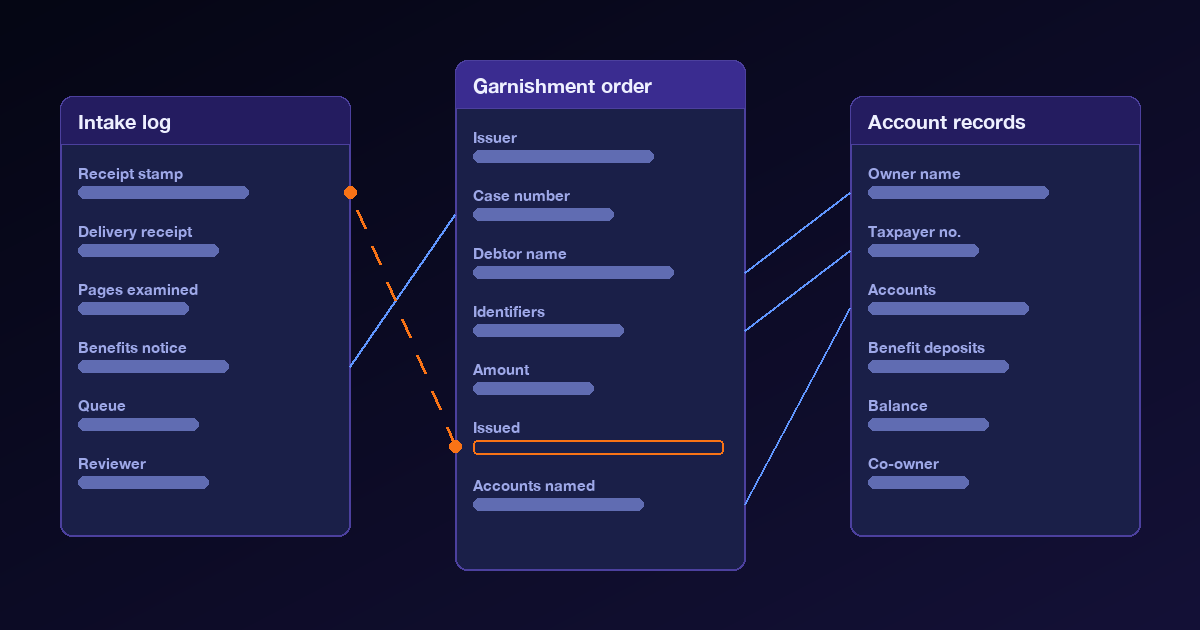
A garnishment order reaches a bank the way most legal process does: as paper, or as a PDF that started as paper. A court writ, a state agency levy, a notice of levy from the tax authority or a child support lien arrives in an operations queue, and someone has to work out who it is about, which accounts it reaches, how much it asks for and how long the bank has to act. Almost every one of those answers is printed somewhere on the document. One of the most important is not printed by the issuer at all.
That answer is the date the bank was served. The order carries the date it was issued or signed, and that date is easy to find, because it sits next to a signature. But the obligations that bind the bank run from receipt. Under the federal rule that protects benefit payments in garnished accounts, the bank has two business days from receipt to review the account. Under the federal tax levy rules, a levy on a bank deposit is made when the notice is delivered, and the bank surrenders the funds only after a 21-day holding period that starts there. A queue that sorts orders by their issue date is sorting by the wrong clock.
This piece describes what a levy or garnishment order has to become before a bank can act on it: the fields to read, where each one sits, how the debtor on the order is matched to an account holder, which clock starts at service, and what goes to legal review. It covers US federal rules with primary sources. State garnishment procedure, including the deadline to answer a writ, varies by state and is not described here.
Two dates on the page, one clock
A garnishment order usually shows at least two dates. One is the date the order was issued, signed or entered, which the issuer prints. The other is the date it was served on the bank, which is recorded by the bank or by whoever delivered it: a receipt stamp, a process server’s return, a certified-mail delivery receipt, a time-stamped upload to a legal-process portal. The two can be days or weeks apart, because orders are mailed, routed to the wrong branch, or held by a creditor and served in batches.
The federal rules key on the second date. The regulation on garnishment of accounts containing federal benefit payments, 31 CFR Part 212, starts its timing from the financial institution’s receipt of the order. The tax levy regulation is explicit about mail: under 26 CFR 301.6331-1(c), when a notice of levy is served by mail, the date and time the notice is delivered to the person served is the date and time the levy is made. If it is sent by certified mail with a return receipt, the delivery date on the receipt is treated as the date of the levy. If an officer of the bank signs the notice and notes the date and time of receipt on it, that notation is evidence of when the levy was made.
So the receipt date is not metadata about the document. It is a field, with a source, and the deadline is computed from it. An extraction that returns the issue date and leaves the receipt date to someone’s memory of when the envelope arrived has dropped the one value the calendar depends on.
What the order has to tell the bank
Part 212 defines a garnishment order broadly: a writ, order, notice, summons, judgment, levy or similar written instruction issued by a court, a State or State agency, a municipality, or a State child support enforcement agency, including a lien for overdue child support and an order to freeze the assets in an account. The documents look different, but a bank needs the same handful of things from each of them:
- Who issued it — the court, agency or creditor, the type of process, and the case, docket or levy number that identifies this order among others against the same person.
- Who it is against — the debtor’s name as printed, plus whatever identifiers the issuer supplied: a full or partial taxpayer number, a date of birth, an address, an account number.
- What it reaches — the amount demanded, and whether the order names specific accounts or reaches any account of the debtor at the bank.
- When it counts from — the issue date and the receipt date as separate values, and any return or answer date the order prints for the bank’s response.
- What came with it — any attached notices, exemption forms or instructions, and in particular whether a Notice of Right to Garnish Federal Benefits is attached or included.
- Who to answer — the creditor’s name and contact details as printed, which the bank may need to pass on to the account holder.
The last two are easy to overlook. Attachments decide which procedure applies, and the creditor contact ends up in a notice the bank has to send. Both are on the document, often on a second or third page that looks like boilerplate.
The first page that decides the procedure
Part 212 opens with a sorting step. Under Section 212.4(a), before taking any other action on the order and no later than two business days after receiving it, the bank examines the order to see whether the United States or a State child support enforcement agency has attached or included a Notice of Right to Garnish Federal Benefits, in the form set out in Appendix B to the part. If the notice is there, Section 212.4(b) says the bank follows its customary procedures for the order and does not apply the account review and protection rules in Sections 212.5 and 212.6. If it is not there, Section 212.4(c) says the bank follows them.
For an extraction, this is a presence check on an attachment, and it has to be reported as such: present, absent, or unclear, with the page where it was found or the pages that were searched. A notice that arrives as page four of a scanned bundle is easy to miss, and missing it sends the order down the wrong procedure. Reporting absence with the list of pages examined lets a reviewer confirm the result instead of redoing it.
Matching the order to an account holder
The second step is identity. Part 212 defines an account holder as a natural person against whom a garnishment order is issued and whose name appears in the bank’s records as the direct or beneficial owner of an account. The order names a debtor; the bank’s records name owners. The match between the two is the bank’s decision, and the regulation recognises that the order may not carry enough to make it. Section 212.5(a)(1) starts the account review clock at the later of receipt of the order and receipt of sufficient information from the creditor to determine whether the debtor is an account holder, if that information is not already in the order.
That clause is a reason to be precise about what the order actually supplies. A full name with a full taxpayer number and an address is a different input from a common name with no identifier at all. The extraction should return each identifier as its own field, with its exact printed form, including masking such as only the last four digits, and should not normalise a partial value into something that looks complete. The matching step can then say which identifiers agreed, which disagreed and which were absent, and a weak match goes to review instead of to a freeze.
Once the debtor is matched, the rules are deliberately mechanical. Section 212.5(f) requires a separate account review for each account in the account holder’s name, and forbids tracing benefit money that moved from one account to another. Section 212.5(d) says the review is performed without regard to the presence of other funds commingled in the account, a co-owner on the account, benefit payments to more than one beneficiary, the balance (as long as it is above zero), instructions to the contrary in the order, or the nature of the debt behind it.
Read each field against the bank’s own records
Each field on the order has a place it is found, something it is compared with, and a person who acts when the comparison fails. The table below is a starting set for routing, not a legal procedure.
| Field on the order | Where it usually is | Compared with | Clock | Action when unclear |
|---|---|---|---|---|
| Issuer and type of process | Caption, form title, agency letterhead | The bank’s list of process types and their handling | Decides which rules apply | Route to legal review before any hold |
| Notice of Right to Garnish Federal Benefits | Attached page or text included in the order | Appendix B form to 31 CFR Part 212 | Examine within 2 business days of receipt | Report pages searched; legal review confirms absence |
| Debtor name and identifiers | Debtor block, caption, schedule | Owner records on each account | Review may wait for sufficient identifying information | Weak or conflicting match goes to review, not to a freeze |
| Accounts named, if any | Body or attached schedule | Accounts in the matched holder’s name | One review per account | An account named on the order but not owned by the debtor goes to legal review |
| Amount demanded | Body of the order or levy form | Balance at the time of review | Applied at review | Amount absent or ambiguous goes to legal review |
| Issue or signature date | Signature block, entry stamp | Any earlier order with the same case number | Does not start the bank’s clock | Kept for identity and expiry, never used as the receipt date |
| Receipt or service date | Bank receipt stamp, delivery receipt, server’s return, portal log | The intake log | Starts the review clock and, for a tax levy, the 21-day hold | Missing receipt date is escalated the same day |
| Case, docket or levy number | Caption, form header | Orders already on file for the same holder | A repeat of the same order starts no new review | Near-duplicates go to review to decide new or same |
| Creditor contact | Body, footer, instructions page | Required content of the account holder notice | Notice within 3 business days of review | Missing contact is noted in the notice draft |
Two rows deserve emphasis. The receipt date is the only clock-starting value, and it often comes from the bank’s side of the transaction, not the issuer’s. The case number is what lets the bank tell a new order from the same order served twice, and the regulation treats those two situations differently.
The account review and the protected amount
When no Notice of Right to Garnish Federal Benefits is attached, Section 212.5(a) requires the bank to perform an account review no later than two business days after receipt of the order and of sufficient identifying information. Large batches of orders may get a later date if the creditor that initiated them permits it, consistent with the orders, and the bank has to keep records of those batches and permissions. Section 212.5(e) puts the review ahead of any other action on the order that may affect funds in the account.
The review looks back two months. Part 212 defines the lookback period as the two-month period that begins on the date preceding the date of account review and ends on the corresponding date two months earlier, or on the last day of that month if the corresponding date does not exist. A benefit payment, for this purpose, is not identified by reading the order at all. It is identified from the deposit itself: a federal benefit deposited by direct deposit with the characters “XX” in positions 54 and 55 of the Company Entry Description field and the number “2” in the Originator Status Code of the batch header. That is the bank’s payment data, not the document.
If the review finds a benefit payment in the lookback period, Section 212.6 applies. The bank calculates the protected amount, which the definitions set as the lesser of the sum of benefit payments posted in the lookback period and the balance when the review is performed. The account holder keeps full and customary access to that amount, without having to claim an exemption, and the bank may not charge a garnishment fee against it. Funds above the protected amount follow the bank’s customary procedures, including a freeze. Section 212.6(f) makes the review a one-time act for a given order: if the same order is served again, the bank does not repeat it, while a new or different order against the same holder gets a new review. Section 212.6(g) says the bank does not keep garnishing deposits that arrive after the review unless a new order is served.
Then there is a notice. Under Section 212.7, when a benefit payment was found, the balance was above zero and there are funds above the protected amount, the bank sends the account holder a notice within 3 business days of the account review. Its required content includes the bank’s receipt of an order, the date on which the order was served, the account subject to the order and the protected amount, any amount frozen under state law, any garnishment fee, and the name of the creditor and, if the order contains it, how to contact them. Two of those items, the service date and the creditor contact, come straight from the intake record.
A worked example
A state court enters a garnishment order against an account holder for $5,000. The order is signed on Wednesday, September 2, mailed, and stamped as received by the bank’s legal-process unit on Wednesday, September 16. No Notice of Right to Garnish Federal Benefits is attached. The bank reviews the account on Thursday, September 17. All names, dates and values are invented for illustration.
| Item | Value | Source | Result |
|---|---|---|---|
| Issue date | September 2 | Signature block | Recorded; not used for the clock |
| Receipt date | September 16 | Bank receipt stamp, page 1 | Review due by Friday, September 18 |
| Federal benefits notice | Not found | Pages 1–3 examined | Account review and protection rules apply |
| Debtor identifiers | Full name, last four of taxpayer number, address | Debtor block | Matched to one owner of one checking account |
| Date of review | September 17 | Review log | Within two business days of receipt |
| Lookback period | September 16 back to July 16 | Computed from the review date | A benefit deposit on July 15 falls outside it |
| Benefit deposits in the period | July 22 and August 26, $1,480 each | ACH batch header and entry description | Sum $2,960 |
| Balance at review | $4,100 | Core banking record | Protected amount is the lesser: $2,960 |
| Above the protected amount | $1,140 | Computed | Handled under customary procedures and state law |
| Account holder notice | Due within 3 business days of September 17 | Section 212.7(f) | Sent by Tuesday, September 22, with service date and creditor contact |
Two things in this example turn on the receipt date and nothing else. The review deadline is September 18 because the order was received on September 16; had the queue worked from the September 2 signature date, the order would have looked two weeks overdue on arrival, or the review would have been scheduled against the wrong day. And the lookback period moves with the review date, so a review run a day later would have used a different two-month window. The extraction’s contribution is narrow but load-bearing: the receipt date with its source, the attachment check with the pages examined, and the debtor identifiers exactly as printed.
A tax levy runs on a 21-day clock
A federal tax levy on a bank deposit follows a different rule with the same shape. Under 26 U.S.C. 6332(c), a bank surrenders deposits, including interest, only after 21 days after service of the levy. The regulation at 26 CFR 301.6332-3(c) sets out the mechanics: the bank surrenders the deposits only after 21 calendar days after the date the levy is made; during that period no withdrawals may be made from the levied deposits; and if the bank has not been notified of a release, it surrenders the deposits, with interest up to the amount of the levy, on the first business day after the holding period ends. The examples in that section use a levy served on April 2 and a surrender on April 24.
The same section answers the question of what the levy reaches. Under Section 301.6332-3(c)(3), a levy on deposits applies to the funds on deposit at the time the levy is made, up to the amount of the levy. Section 301.6331-1 says a levy on a bank account is satisfied by surrendering the balance at the time the levy is made and has no effect on later deposits, which can be reached only by a later levy. The time of service therefore fixes two things at once: the start of the 21 days and the balance the levy attaches to.
The depositor can waive the holding period by notifying the bank, and where an account has more than one owner, all of them must agree. That is one more field a legal-process workflow has to capture as a document with a date, not as a note.
What the extraction should deliver
For each order, a useful extraction returns structured records with the evidence for each value, not a summary:
- Order identity — issuer, type of process, case or levy number, issue date, and the creditor’s name and contact, each as its own field.
- Service evidence — the receipt date and time and where it came from: the stamp on page one, the delivery receipt, the server’s return or the portal log.
- Debtor identifiers as printed — name, partial or full taxpayer number with its masking preserved, date of birth, address and any account numbers, without filling in what the issuer left out.
- Reach and amount — the amount demanded and whether the order names accounts or reaches any account of the debtor.
- Attachments — each attached notice or form identified by title, with an explicit present, absent or unclear result for the federal benefits notice and the pages examined.
- Page and position evidence — for every value, where on which page it was read, so a reviewer of an exception sees the original in one step.
Everything after that belongs to the bank. Matching the debtor to an account holder, running the account review, calculating the protected amount, deciding what to freeze and drafting the notice are decisions made against the bank’s own records and payment data, by people accountable for them. The extraction’s job is to hand those people the order as data, with the receipt date first.
The banking solutions page lists court order processing among the use cases: levies, garnishments and subpoenas parsed with key dates and obligated-account identifiers surfaced for legal review and timely response. Nothing here describes a product feature for running account reviews or computing protected amounts; the argument of this article is about the fields an order has to become before those steps can run.
Where this sits next to other banking documents
Garnishment orders are one part of what a bank reads about its customers. The account itself is described by statements, and the bank statement categorisation article explains why the transaction lines, not the closing balance, carry the information. Liens also turn up in property transactions, where a recorded judgment is an exception on a title commitment; the closing disclosure and title commitment article covers how those exceptions are read against the closing figures. That is a question about real property at closing. This one is about funds on deposit, and about the day the bank was told.
Read the order from the day it arrived
A levy or garnishment order is a short document with an unforgiving calendar. The issuer prints who it is against, what it asks for and when it was signed. The bank’s obligations run from a date the issuer did not print: the day the order was served. Read that way, intake is not filing. It is the moment that fixes the review deadline, the lookback window and, for a tax levy, the balance the levy reaches and the start of the 21 days. An extraction that returns the receipt date with its source, every identifier as printed and an explicit answer about the federal benefits notice gives the people who make those decisions what they need, on the day they need it.
Sources
- 31 CFR Part 212, Garnishment of Accounts Containing Federal Benefit Payments — definitions of garnishment order, account holder, lookback period, protected amount and benefit payment (212.3), initial examination for the Notice of Right to Garnish Federal Benefits (212.4), account review timing and rules (212.5), protection of benefits, one-time review and fees (212.6), notice to the account holder (212.7), and the examples in Appendix C.
- 26 U.S.C. 6332, Surrender of property subject to levy — the special rule for banks, surrender only after 21 days after service of levy (6332(c)).
- 26 CFR 301.6332-3, The 21-day holding period applicable to property held by banks — holding period, interest, transactions affecting accounts, waiver and examples.
- 26 CFR 301.6331-1, Levy and distraint — when a levy served by mail is made (301.6331-1(c)) and the rule that a levy reaches the balance at the time it is made, not later deposits.
This article explains document extraction and review handoffs. It is not legal advice, and it does not describe state garnishment procedure.