
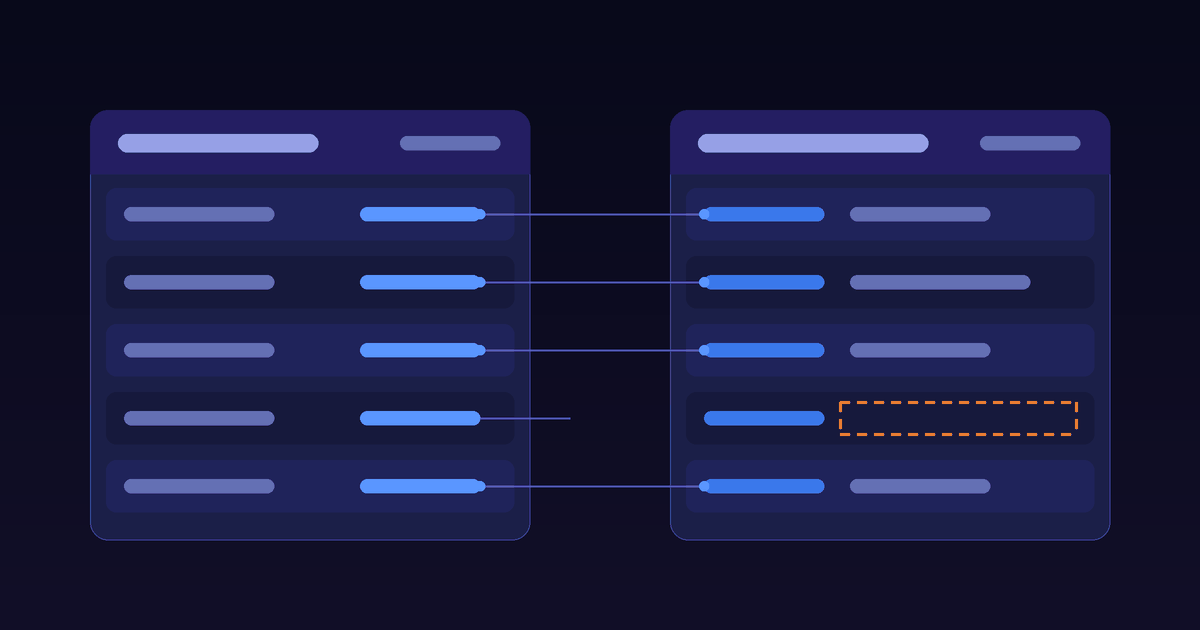
A residential closing produces two documents that describe the same transaction from opposite sides. The Closing Disclosure describes the money: who pays what, to whom, and how much changes hands at the table. The title commitment describes the land: who owns it, what is recorded against it, and what has to happen before an insurer will stand behind the new owner and the new lender.
Most document pipelines extract them separately. The Closing Disclosure goes to a loan system, the commitment goes to a title workflow, and each extraction is judged on whether its own fields came out right. That is necessary, and it is not where closings go wrong. The fee lines usually balance, because the form is built to balance. The risk sits where the two documents have to agree and do not, and in the exceptions on the commitment that are written as paragraphs rather than fields.
This piece is about reading the two documents against each other. It quotes the federal rule that defines the Closing Disclosure, Regulation Z at 12 CFR 1026.38 and the timing rules in 1026.19(f), and the 2021 ALTA Commitment for Title Insurance form. It describes how to structure the comparison. It does not tell anyone whether a title is insurable or a loan should close. Those are decisions for the title examiner, the underwriter and counsel.
Two documents, two authorities
The Closing Disclosure is a federal form. Section 1026.38 lists what it must contain, field by field, and gives most fields a fixed label. Three groups matter for the comparison:
- Closing information — under 1026.38(a)(3), the closing date, the disbursement date, the settlement agent, the settlement agent’s file number, the property, and the sale price, or the appraised value when there is no seller.
- Transaction information — under 1026.38(a)(4), the borrower’s and, where applicable, the seller’s name and mailing address, and the lender.
- Summaries of transactions — under 1026.38(j) and (k), the borrower’s and the seller’s side of the ledger, including payoffs of existing loans and the prorated taxes and assessments each side owes the other.
The title commitment is a contract form. The ALTA Commitment for Title Insurance, 2021 version 01.00, has a Schedule A that identifies the commitment date, each policy to be issued with its proposed insured and proposed amount of insurance, the estate or interest in the land, who title is vested in, and the land description. Schedule B has two parts: Part I lists the requirements that must be met, and Part II lists the exceptions the policy will not insure against.
The commitment also says, in capitals on its first page, what it is not. It is not an abstract of title, a report of the condition of title, a legal opinion or an opinion of title. It is the insurer’s promise to issue a policy to the proposed insured once the requirements are met, subject to the exceptions. That framing matters for extraction: every field on the commitment is a condition or a carve-out, not a fact about the land.
Where the two documents must agree
The useful question for each comparison is which field on one document the other document is checking, and what a divergence most likely means. The table below covers the pairs that every residential purchase with a loan produces.
| Closing Disclosure field | Commitment field | What a divergence usually means | Action |
|---|---|---|---|
| Property, 1026.38(a)(3)(vi) | Land description, Schedule A item 5 | A street address on one side and a legal description on the other, or a parcel added or left out | Match through a parcel identifier or the legal description, never by string similarity of the address |
| Seller, 1026.38(a)(4)(ii) | Vesting, Schedule A item 4 | The seller on the contract is not the person title is vested in: an estate, a trust, a former spouse, an entity | Route to review with both names and the vesting text as printed |
| Borrower and lender, 1026.38(a)(4) | Proposed insured, Schedule A item 2 | The owner’s or loan policy names a different party, or the lender’s name differs from the policy to be issued | Flag the mismatch on the policy it affects |
| Sale price and loan amount | Proposed amount of insurance, per policy | The amounts were set from an earlier version of the deal | Compare each policy to its own figure and record which document moved |
| Payoff of first and second mortgage, 1026.38(k)(2)(v) and (vi) | Recorded mortgages in Schedule B and the release requirements in Part I | A recorded lien has no payoff line, or a payoff line has no recorded lien behind it | Link each payoff to an exception and its requirement, and list the unlinked on both sides |
| Prorated city, county taxes and assessments, 1026.38(j) and (k) | Tax and assessment exceptions in Part II | The proration covers a period the exception treats as unpaid, or the reverse | Keep the period with the amount on both sides and compare periods, not totals |
| Charges labelled “Title —” | Premiums, fees and charges for the policy, Part I | A title charge on the commitment is missing from the disclosure, or a policy premium appears under another label | Match on the policy type and the payee, not on the label wording |
| Closing and disbursement dates | Commitment date | The commitment is old relative to closing, which widens the gap the insurer excepts | Record the interval and whether a later-dated commitment exists |
None of the rows needs a judgment about the title. Each one is a join between two extracted fields, with a rule for what counts as agreement and a destination for what does not. The extraction’s job is to make the join possible, which means both documents have to come out with the identifiers that join them.
The address is not the land
The disclosure identifies the property by the address or location required on the Loan Estimate. The commitment describes the land with a legal description, which can be a lot and block in a recorded plat, a metes and bounds description running for a page, or a reference to a prior deed. They are both correct and they will never be the same string.
Matching them by text similarity produces two kinds of quiet error. A condominium unit and the building it sits in can share an address while being different land. A purchase that includes a second parcel, a garage lot or a strip of easement land, shows up on the commitment and not in the address line. The extraction should keep the legal description whole, extract the parcel identifiers it contains when they are printed, and compare on those. When the commitment covers more than one parcel, each parcel is a separate item to account for.
- Keep the description verbatim — a legal description is a recorded text, and a paraphrase of it is not the same land.
- Extract identifiers alongside it — lot, block, plat reference, unit number and tax parcel number when printed, each with the place on the page it came from.
- Count parcels on both sides — a parcel on the commitment with no counterpart in the transaction is a finding even when the addresses look identical.
The seller is not always the owner
Schedule A item 4 states the person or entity title is vested in at the commitment date. The disclosure names the seller. In a plain resale those are the same person, written slightly differently. In other transactions they are not: an heir selling out of an estate, a trustee selling trust property, a company selling property titled in a predecessor’s name, a couple where only one spouse appears on the contract.
Each of those has a legitimate path to closing, and that path usually appears on the commitment as a requirement in Schedule B Part I: a recorded affidavit, a court order, a trust certificate, a deed from the vested owner. The extraction should not normalize the two names into one record. It should keep the seller as printed on the disclosure, the vesting as printed on the commitment, and the result of the comparison, so a reviewer can see in one place whether a requirement already accounts for the difference.
The same applies on the buyer’s side. The proposed insured on the owner’s policy should be the buyer who takes title, and on the loan policy, the lender. A disclosure that names a buyer who does not appear as a proposed insured is the kind of divergence that is cheap to catch from two extracted fields and expensive to discover after recording.
Schedule B is where the risk is written in prose
Part II of Schedule B begins with standard language and ends with the exceptions specific to this land, each written as a paragraph. A typical specific exception names a recorded instrument, its date, its recording reference and, sometimes, its amount. Some are routine, such as utility easements shown on a plat. Some are the reason the closing exists in its current form, such as an existing mortgage that has to be paid off.
The 2021 form also carries the gap exception, in square brackets as an optional item 1: any defect, lien, encumbrance, adverse claim or other matter that appears for the first time in the public records, or is created, attaches or is disclosed, between the commitment date and the date on which all of the Schedule B Part I requirements are met. It is a reminder that the commitment speaks as of a date, and that the public record keeps moving after it.
Reading an exception as text is not enough to reconcile it. The extraction should decompose each specific exception into a record:
- The type — mortgage or deed of trust, judgment, tax lien, easement, covenant, lease, or other, as the text states it.
- The parties — the holder or beneficiary and, where printed, the grantor, so a payoff or release can be matched to it.
- The recording reference — instrument number, book and page, and recording date, which are the keys a release or satisfaction will cite.
- The amount — the stated principal or judgment amount when printed, with no inference when it is not.
- The disposition — whether a Part I requirement addresses it, and which one, or whether it is expected to remain on the policy.
The disposition is the field that turns a list of paragraphs into something a closing team can work. The commitment conditions say the deletion or modification of a Part II exception does not by itself create coverage beyond the commitment or the policy, and that removing an exception requires the company’s written consent. So the record should say what the commitment says, not what the closing team hopes: an exception is cleared when the insurer says it is, through a satisfied requirement or a later commitment, and not when a payoff line appears on the disclosure.
Requirements are a checklist with evidence
Schedule B Part I on the 2021 form opens with four standard requirements. The proposed insured must notify the company in writing of any party not named in the commitment who will obtain an interest in the land or make a loan on it. The agreed amount for the estate or interest must be paid. The premiums, fees and charges for the policy must be paid. Documents that convey the title or create the insured mortgage must be properly authorized, executed, delivered and recorded. Additional requirements specific to the transaction follow, by number.
Each requirement points at evidence that lives elsewhere in the closing package: a payoff statement, a release, a deed, an affidavit, a corporate resolution, a recorded instrument. The commitment conditions add a deadline. If the Part I requirements are not met within the period stated in the commitment, the commitment terminates and the company’s liability and obligation end.
That structure maps directly onto a reconciliation record:
- One record per requirement — its number and text as printed, the exception it clears when there is one, and the document type that would satisfy it.
- A link to the evidence — the document in the package that satisfies it, with the page, or an explicit marker that no such document has arrived.
- The money side of it — for payoffs and releases, the matching line in the seller’s summary under 1026.38(k)(2), so a requirement to pay off a mortgage and the disclosure’s payoff line are one item, not two.
- The clock — the commitment date and the period for meeting the requirements, so a file that is drifting toward termination is visible before it gets there.
A requirement with no evidence and no matching money line is the strongest single signal in the comparison. It means either a document is missing from the package or the closing is about to fund without satisfying a condition the insurer set.
Both documents change, and on different clocks
Neither document is final the first time it arrives. The extraction will see versions, often out of order, and has to know which version governs.
On the disclosure side, 1026.19(f)(1)(ii)(A) requires that the consumer receive the Closing Disclosure no later than three business days before consummation. If it becomes inaccurate before consummation, 1026.19(f)(2)(i) requires corrected disclosures received at or before consummation. Three kinds of change restart the three-day waiting period under 1026.19(f)(2)(ii): the annual percentage rate becomes inaccurate, the loan product changes, or a prepayment penalty is added.
On the commitment side, the conditions allow the company to amend the commitment at any time. An amendment can add a defect, lien, encumbrance, adverse claim or other matter, and the conditions limit the company’s liability for matters recorded before the commitment date that are added later. An amended commitment can therefore carry new exceptions and new requirements that the first version did not.
- Version both documents — the disclosure by its issue date and the commitment by its commitment date and any revision marker, with each extracted field tied to the version it came from.
- Reconcile latest against latest — comparing a corrected disclosure to the first commitment, or the reverse, produces divergences that no longer exist and hides ones that do.
- Diff each document against its own prior version — a new exception or requirement on an amended commitment is a change the closing team needs to see as a change, not as one more line in a list.
This is the same discipline the contract precedence article describes for agreements and amendments: the value that governs is the one in the latest document that controls, and the extraction has to know which that is.
Names, payoffs and periods need rules, not similarity
Three kinds of field cause most false matches between the two documents, and each needs an explicit rule rather than a fuzzy score.
Names first. Vesting language carries marital status, tenancy, trustee capacity and entity suffixes. A disclosure carries a mailing name. A rule that strips those words to make the names match will also erase the reason they differ. Keep the printed forms, compare a normalized form, and keep the difference as a field.
Payoffs second. The disclosure states a payoff amount for a first or second mortgage. The commitment states a recorded instrument, often with its original principal. Those amounts are not expected to be equal, because a loan balance is not its original principal. The match key is the holder and the instrument, not the number. The number is evidence that the payoff letter, not the commitment, has to support.
Periods third. Prorations on the disclosure are amounts with a time period attached, by rule: 1026.38(j) and (k) require the period alongside each prorated city or county tax and assessment. Tax exceptions on a commitment typically refer to a tax year or an installment and state whether it is paid or a lien not yet due. Comparing the two means comparing periods. A total that matches can still cover the wrong half-year.
What the extraction should deliver
Put together, a closing extraction built for reconciliation produces linked records rather than two independent forms:
- The transaction — closing date, disbursement date, settlement agent and file number, sale price and loan amount, from the disclosure version that governs.
- The parties — seller, buyer and lender as printed on the disclosure, the vesting and proposed insureds as printed on the commitment, and the result of each comparison.
- The land — the legal description verbatim with its parcel identifiers, linked to the property line of the disclosure.
- The exceptions — one structured record per specific Part II exception, with type, parties, recording reference, amount and disposition.
- The requirements — one record per Part I requirement, linked to the exception it clears, the evidence that satisfies it and the payoff or charge line it corresponds to.
- The open items — every unlinked payoff, unlinked lien, unmet requirement, name mismatch and parcel without a counterpart, each with the fields on both sides.
Each value should carry its confidence and the page region it came from, so a closer can check one exception without rereading the whole commitment. When a link cannot be made with confidence, the item should be routed for review instead of being matched on a guess. The real-estate extraction page describes how Cogneris structures closing packages and decomposes Schedule B exceptions into records of this kind.
Not a title opinion, not an underwriting decision
Two boundaries keep this kind of extraction honest. First, it does not decide whether a title is insurable or whether an exception is acceptable. The commitment itself disclaims being an opinion of title, and clearing an exception is the insurer’s act. The extraction surfaces what the documents say and where they disagree, and people with authority decide.
Second, it does not replace the rest of the file. Whether the buyer’s funds to close are what they appear to be is the question the proof of funds article covers. Whether an income property will carry its debt is a question for the rent roll and the leases behind it. The comparison here is narrower: two documents about the same closing, read against each other.
The fees are the easy part
The Closing Disclosure is engineered to add up, and a good extraction of it will mostly confirm that it does. The title commitment is engineered to say what the insurer will not cover until something happens. Reading them separately confirms that each is well formed. Reading them together shows whether the closing that the money describes is the closing that the title allows: the same land, the same owner, every recorded lien with a payoff and a release behind it, and every requirement met before the clock runs out. That second reading is the one worth automating, and it only works if the exceptions come out of the paragraphs and into fields.