
Every hotel or venue event ends with a final invoice, and that invoice is usually checked against the wrong thing. Someone opens the sales contract, finds the food-and-beverage minimum, confirms the total clears it and approves. The minimum answers one question: whether the group spent enough. It does not say whether the venue charged the right people count, the right price per head, or the right service charge on the right base.
Those answers live in a different document: the banquet event order, or BEO. The BEO is the sheet the venue and the planner sign for each function. It names the room, the times, the menu, the price per person and the guaranteed number of guests. Kitchen, banquet captain and accounting all work from it. When the final invoice disagrees with the signed BEO, the BEO is the expected source of truth, and the line that disagrees is the one to question.
This piece describes what a BEO fixes, which of its fields carry money, how the guarantee works, why the service charge is not a tip, and what a document workflow should return when it compares a final invoice to the BEOs behind it.
What a BEO fixes
A group sales agreement is signed months ahead. It sets the room block, the food-and-beverage minimum, attrition and cancellation terms. It rarely says what will be served at the Tuesday lunch, for how many people or at what time. The BEO does. One event usually has one BEO per function: a breakfast, a morning break, a lunch, a reception, a dinner. A large conference can have dozens.
Each BEO is a short form, often a single page, and it is operational before it is financial. The kitchen orders from it, the banquet team sets the room from it, and the venue bills from it. Indiana University’s catering guidelines put the status plainly: a BEO must be signed and reviewed and approved before services are finalized. Most venues work the same way. Unsigned, the BEO is a proposal. Signed, it is the agreed order for that function.
That is why the title of this article calls the BEO the contract of the event. Legally, the sales agreement and the BEO usually work together, and the agreement says how they rank. Operationally, the BEO is the document that fixes the numbers each charge is built from.
The fields that carry money
A BEO has many fields, and most are instructions: linen colour, room setup, audiovisual, signage. A handful decide what the invoice should say. Those are the fields an extraction has to get right, with the location on the page each value came from.
| BEO field | What it fixes | What to check on the invoice |
|---|---|---|
| Function, date and times | Which meal or break, on which day, in which room | One invoice line per function, on the right date, with no function billed twice |
| Guaranteed count | The number of guests the group pays for at minimum | Covers billed are the guarantee, or the actual count when it was higher |
| Expected or set count | How many places the venue prepares, usually a little above the guarantee | The set count is not billed on its own |
| Menu and price per person | The unit price for each menu item or package | Unit prices match the signed BEO, not a later price list |
| Service charge and tax | The percentage added and the base it applies to | Rate, base and tax treatment match the BEO or the agreement |
| Room rental and extras | Meeting-room fee, audiovisual, labour, bartender fees | Only extras that appear on a signed BEO or a signed change |
| Signature and revision | Which version both sides approved, and when | The invoice is checked against the latest signed version |
The last row matters more than it looks. BEOs are revised. Menus change after a tasting, counts change after registration closes, a break moves by an hour. Each revision may carry a new number or date. A workflow that reads the first version it finds, or the most recent file in a shared folder, will compare the invoice against an order nobody signed.
The guarantee is a floor, not a forecast
The guaranteed count is the field most often misread. Planners treat it as an estimate. Venues treat it as a commitment. Indiana University’s guidelines ask for the final count by 10 a.m. five business days before the event, and bill on that guarantee unless more guests are served. Boston University’s catering policy asks for the guarantee four full business days ahead, and bills on that number or on the actual count if it is higher. Hotels often ask for 72 hours. The deadline differs; the logic is the same.
That gives one billing rule for most BEOs: the venue charges the greater of the guarantee and the number actually served. If 112 people come to a lunch guaranteed at 120, the group pays for 120. If 131 come, it pays for 131, often at the same price, sometimes with a surcharge the BEO or agreement names.
The set count sits between the two. Venues prepare a margin above the guarantee so a few extra guests can eat. Indiana University prepares about 5% more food than the guaranteed count and says service beyond that margin is not guaranteed. That margin is the venue’s preparation, not the group’s order. A final invoice that bills the set count when fewer people came has charged for plates the group never committed to.
The guarantee also has a deadline that changes its meaning. Before the deadline, a lower count is a revision. After it, a lower count is attendance, and the guarantee stands. An extraction should capture the deadline next to the count so a reviewer can tell which case applies. A count change dated after the deadline is a reason to look at the venue’s response, not to rebill automatically.
The service charge is not a tip
Almost every BEO adds a percentage on top of food and beverage. Indiana University lists a 20% service charge plus applicable taxes. Hotel rates are often higher. The label varies: service charge, banquet fee, administrative fee, gratuity. Two questions decide whether the invoice is right: what the percentage is applied to, and how it is taxed.
The base is a contract question. A service charge may apply to food and beverage only, or also to room rental, audiovisual and labour. The BEO or agreement says which. An invoice that applies the percentage to every line, including the room fee, may be charging service on items the agreement leaves out. That is worth catching, because the service charge is large enough that a wrong base changes the total by real money.
The label matters for a different reason. In the United States, the IRS treats a mandatory amount added by the venue as a service charge, not a tip, even when the bill calls it a gratuity. Its 2017 fact sheet lists automatic gratuities and banquet event fees among service charges, and service charges paid to staff are wages for the venue. For the group paying the invoice, the practical point is narrower: a mandatory charge can be subject to sales tax in places where a voluntary tip would not be. Whether it is depends on the state and on how the charge is stated. The extraction should keep the label, the rate, the base and the tax applied, exactly as the document shows them. It should not decide the tax treatment.
A worked example
The following example is illustrative. The prices, rates and counts are invented to show the arithmetic, not taken from any venue.
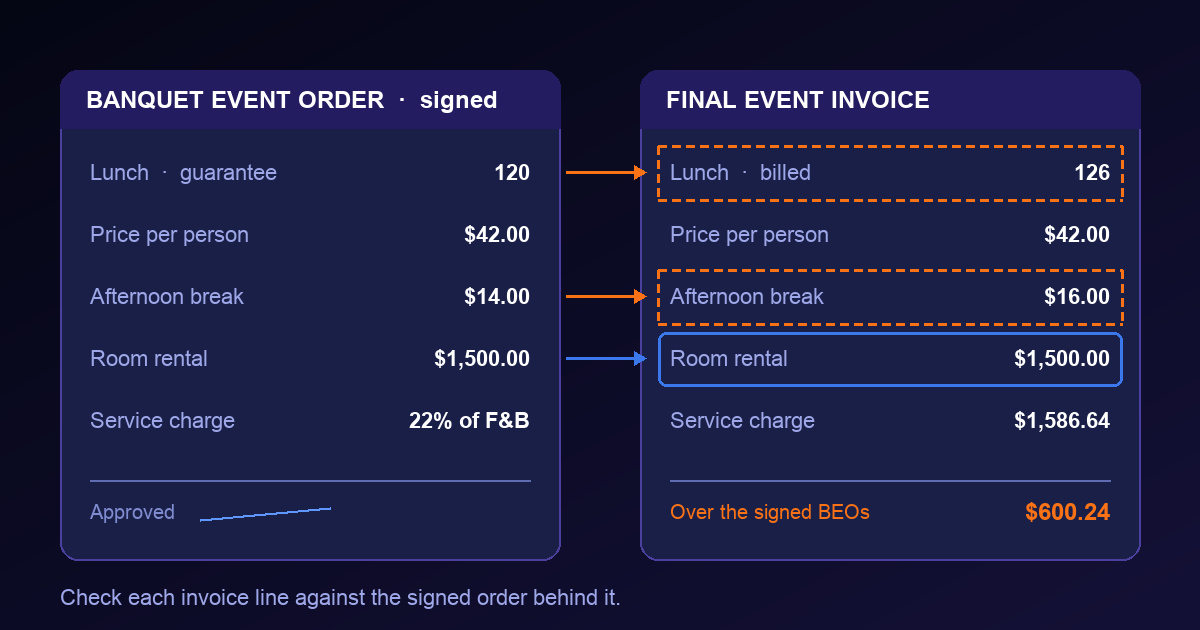
A one-day meeting has three signed BEOs. The lunch BEO guarantees 120 guests at $42.00 per person, with a set count of 126. The afternoon break BEO is $14.00 per person for 120. The room BEO is a flat $1,500.00 rental. The agreement applies a 22% service charge to food and beverage only. On the day, 112 people attend lunch.
| Line | Signed BEO | Final invoice | Difference |
|---|---|---|---|
| Lunch | 120 × $42.00 = $5,040.00 | 126 × $42.00 = $5,292.00 | $252.00 |
| Afternoon break | 120 × $14.00 = $1,680.00 | 120 × $16.00 = $1,920.00 | $240.00 |
| Room rental | $1,500.00 | $1,500.00 | $0.00 |
| Service charge, 22% of F&B | $1,478.40 | $1,586.64 | $108.24 |
The invoice is $600.24 higher than the signed BEOs support, before tax. Two causes explain it. The lunch was billed at the set count of 126 instead of the guarantee of 120. Attendance of 112 was below the guarantee, so 120 is the right number. The break was billed at $16.00, a price that appears on the venue’s current menu but not on the signed BEO. The service charge difference follows from both: 22% of the $492.00 extra food and beverage.
Neither error shows up against the food-and-beverage minimum. If the agreement set a $6,000 minimum, both totals clear it. The invoice looks fine at the contract level and is wrong at the BEO level. That is the gap this check closes.
Two cases in the example would not be errors. If 131 people had come to lunch, billing 131 would be correct. If the break price had been changed on a revised BEO that the planner signed, $16.00 would be correct, and the extraction should point at that revision.
Where the minimum fits
The food-and-beverage minimum belongs to the group sales agreement, not the BEO. Our article on hotel group contract attrition covers how that minimum is defined, what it usually excludes (service charges, taxes, audiovisual and parking are common exclusions) and how a shortfall becomes a charge. The BEO check and the minimum check use the same invoice but answer different questions.
The order matters. Check each invoice line against its BEO first. Only then add up eligible food and beverage and compare it to the minimum. A minimum measured on an inflated invoice can look met when it is not, or mask overcharges as harmless because the group was going to pay the minimum anyway. If the group fell short, overcharged lines may also be what made the shortfall look smaller than it was.
The guest folio is a third document. The hotel folio shows charges posted to a guest or master account, line by line. A banquet charge on the master folio should trace back to a BEO and to a line on the final event invoice. When it does not, the folio is often where a duplicate shows up.
What the extraction should return
The useful output is not a summary of the event. It is one record per BEO and one comparison per invoice line, each with the page and region it came from. For each BEO:
- Identity — BEO number, revision, function name, date, start and end times, room.
- Counts — expected, guaranteed and set counts, the guarantee deadline and any count received after it.
- Prices — each menu item or package with unit price and unit (per person, per dozen, per gallon, per hour).
- Charges — service charge label, rate and base; tax lines as written; room rental and labour fees.
- Approval — signature or approval mark, who signed and when, so the latest signed revision can be found.
For the invoice comparison, each line gets the BEO it matches, the billed count and price, the BEO count and price, and a status: match, explained difference (actual count above guarantee, or a signed revision), or unexplained difference. Unexplained differences go to a person with both documents open at the right place. The output should not adjust the invoice. It should show the evidence and the arithmetic so the reviewer can decide in minutes.
Some cases should always route to review rather than resolve automatically: two signed versions of the same BEO, a count change dated after the guarantee deadline, a service charge applied to a line the agreement excludes, a BEO with no signature, and any invoice line with no BEO behind it.
Read the order before the bill
A final event invoice is built from many small promises: a count here, a price there, a percentage on a stated base. The sales contract holds the large promises. The BEOs hold the small ones, and that is where most invoice errors live. Checking the invoice against the minimum alone confirms that the group spent enough. Checking it against the signed BEOs confirms that it was charged for what it ordered.
This article describes how to read and compare event documents. It is not legal or tax advice. Venue terms differ, and the signed agreement and its BEOs control what a specific group owes.
Sources
- Indiana University Catering, Guidelines — BEO signature and approval before services are finalized; final guarantee due by 10 a.m. five business days before the event; billing on the guarantee unless more guests are served; about 5% additional food prepared; 20% service charge plus applicable taxes.
- Boston University Catering, Catering Policies — final guarantee four full business days before the function; final bill on the guarantee or on the actual count if higher.
- IRS, FS-2017-08, Tips versus service charges — the four factors for a tip; automatic gratuities and amounts imposed by the employer are service charges; banquet event fees listed as an example. The IRS marks the page as historical content.