
A ceramics studio ships 60 mugs, 12 vases and no bowls to a home-goods store in October. The store does not buy them. It puts them on the shelf, sells what it can, and at the end of the month sends a consignment statement: units sold, gross sales, its commission, and a payout. The studio has to decide whether that payout is right.
The shipment does not answer that question. On consignment, the store owes money only for what it sold, at the price the agreement allows, minus the commission the agreement sets. Everything still on the shelf belongs to the studio. So the statement has two jobs: it is a bill for the sold units and an inventory report for the unsold ones. A reconciliation that checks only the payout arithmetic misses half of it.
This piece walks through what a consignment statement has to tie to, shows a fictional statement with two exceptions, and lists what extraction should return. The companies, products and figures are invented. The legal and tax references describe published US rules and are not legal or tax advice.
Shipped is not owed
In an ordinary wholesale sale, the invoice follows the shipment: 60 mugs delivered, 60 mugs billed. Consignment breaks that link on purpose. The consignor delivers the goods, the consignee holds and sells them, and the consignor is paid after the end customer pays. Unsold units can come back.
That changes what the paperwork means. The packing slip says what left the studio. The statement says what the store says it sold. The difference between the two is not a debt. It is stock that still belongs to the consignor, sitting in someone else’s store.
US federal tax rules say this directly. The inventory regulation at 26 CFR 1.471-1 tells the seller to include “goods out upon consignment” in its own inventory, and to include merchandise only when title is vested in the taxpayer. The vases on the store’s shelf are on the studio’s books, not the store’s.
Why the unsold units need watching
Goods in someone else’s possession are exposed to that someone’s creditors. Under the Uniform Commercial Code, § 9-102(a)(20) defines a consignment for Article 9 purposes: goods delivered to a merchant for sale, where the merchant deals in goods of that kind under its own name, is not an auctioneer, and is not generally known by its creditors to be selling the goods of others. Each delivery has to be worth $1,000 or more, and the goods cannot be consumer goods immediately before delivery.
When a transaction fits that definition, § 9-319(a) treats the consignee, for the claims of its creditors and buyers, as having the same rights and title the consignor had while the goods are in its possession. In practice, that is why consignors commonly file a financing statement: an unrecorded interest can lose to the consignee’s creditors.
The legal consequence is for counsel. The operational consequence is simple: the consignor needs to know, every period, how many of its units are on the consignee’s shelf. The statement is usually the only document that says so.
Two equations every statement has to satisfy
A consignment statement can be read against two equations. The first is about units and runs per SKU. The second is about money and runs per line.
| Check | Equation | Where each term comes from |
|---|---|---|
| Unit roll-forward | Opening on hand + received + customer returns − sold − returned to consignor − damaged or written off = closing on hand | Opening: last period’s closing. Received: the consignor’s packing slips, confirmed by the consignee’s receipts. Returns to consignor: return authorizations. The rest: the statement |
| Payout | Units sold × allowed price = gross sales; gross sales − commission − agreed deductions = payout | Allowed price and markdown rules: the consignment agreement. Commission rate: the agreement, including any tiers. Deductions: only those the agreement lists |
Neither equation can be checked from the statement alone. The opening balance comes from the previous statement, the receipts from the shipping documents, and the price and commission from the contract. A statement that is internally consistent can still fail both checks, because its numbers are only compared against each other.
The roll-forward also has a direction. Closing on hand this month has to be the opening on hand next month. A statement that starts from a different number has either lost units or found some, and either one needs an explanation.
A worked example
The fictional studio, Larkspur Ceramics, consigns three SKUs to the fictional Hollow Oak Home. The agreement sets a fixed retail price per SKU, a 35% commission on gross sales, and requires written approval from Larkspur before any markdown. Units lost or damaged in the store’s custody are the store’s responsibility. October’s statement reports 66 units sold, gross sales of $1,982.80 and a payout of $1,288.82.
| SKU | Opening | Received | Customer returns | Sold | To consignor | Damaged | Closing (computed) | Closing (statement) |
|---|---|---|---|---|---|---|---|---|
| Mug, retail $24 | 40 | 60 | 0 | 52 | 6 | 2 | 40 | 40 |
| Bowl, retail $38 | 24 | 0 | 1 | 9 | 0 | 0 | 16 | 16 |
| Vase, retail $90 | 10 | 12 | 0 | 5 | 0 | 0 | 17 | 14 |
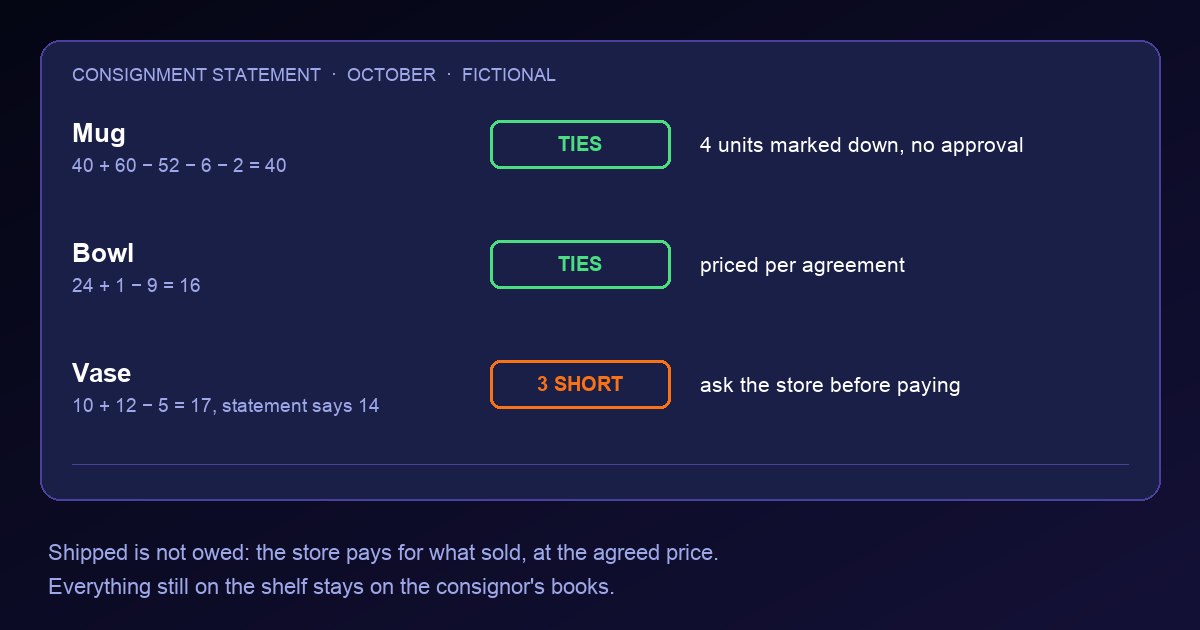
The mug and bowl lines roll forward. The 60 mugs received match Larkspur’s two packing slips of 36 and 24, and the six mugs sent back match a return authorization. The vase line does not: 10 opening plus 12 received minus 5 sold is 17, and the statement reports 14 on hand. Three vases are neither sold, returned nor written off.
The money side has its own exception. The statement prices 48 mugs at $24 and 4 at $19.20, a 20% markdown. There is no markdown approval on file.
| Line | Statement | Per agreement | Difference |
|---|---|---|---|
| Mugs, 52 sold | $1,228.80 | $1,248.00 | −$19.20, markdown without approval |
| Bowls, 8 net (9 sold, 1 returned) | $304.00 | $304.00 | None |
| Vases, 5 sold | $450.00 | $450.00 | None on the sold units |
| Gross sales | $1,982.80 | $2,002.00 | −$19.20 |
| Commission, 35% | $693.98 | $700.70 | −$6.72, lower because the gross is lower |
| Payout | $1,288.82 | $1,301.30 | −$12.48 |
The statement’s own arithmetic is correct: $1,982.80 less 35% is $1,288.82. A check that stops there passes it. Read against the agreement, the payout is $12.48 short because of an unapproved markdown, and three vases worth $270 at retail are unaccounted for. Under this agreement those three units are the store’s responsibility, but the statement does not say whether they were stolen, broken, miscounted or sold without being recorded. That is a question for the store, not something extraction can answer.
The numbers that stay on Larkspur’s books are just as important. The statement reports 70 units on hand at Hollow Oak. The roll-forward says 73. Until the vase gap is resolved, Larkspur’s inventory of goods out on consignment is uncertain by three units.
Where this sits next to other reconciliations
Consignment shares parts with two other checks, and keeping them apart avoids double counting. Our piece on advance ship notice reconciliation covers the receiving side: whether the pallets and cartons that arrived match what the shipper said it sent. In a consignment flow, that check confirms the “received” term of the roll-forward. It does not say anything about what sold.
The piece on vendor statement reconciliation covers a statement of account: open invoices, payments and credits between a buyer and a supplier. A consignment statement runs in the other direction. The consignee reports sales to the consignor, and there is no invoice for the unsold units, so open-item matching against invoices does not apply until the payout is settled.
What extraction should return
Consignment statements arrive as retailer-specific PDFs and spreadsheets, often with one layout per store chain. The extraction step cannot decide who owes what for a missing vase. It can return a statement that is ready for both equations.
- Every term of the roll-forward, per SKU — opening, received, customer returns, sold, returned to consignor, damaged and closing, kept as separate fields even when the statement prints only some of them.
- The price actually charged — each sold line with its unit price and any markdown or promotion code, not just the extended total, so it can be compared with the agreement.
- Commission and deductions as printed — rate, base and amount for the commission, and each other deduction named as the statement names it.
- The period and the links to other documents — statement period, store, and any packing slip or return authorization numbers the statement cites, so receipts and returns can be matched.
- Gaps flagged, not filled — a closing balance that does not roll forward, or an opening balance that does not match last period’s closing, routed to review with both numbers shown.
For the Larkspur statement, that output is two SKUs that roll forward, one vase line with a three-unit gap, and a mug price that differs from the agreement on four units. A person decides what to ask the store. They start from the exact lines that disagree, not from a payout that only looks right.
The short version
On consignment, what was shipped is not what is owed. The consignee pays for units sold, at the price the agreement allows, minus the agreed commission, and everything unsold stays the consignor’s inventory.
Each statement should satisfy two equations: a unit roll-forward per SKU that ties to last period and to the shipping documents, and a payout that ties to the agreement. A statement whose arithmetic adds up can still fail both. Extraction should keep every term separate and send the lines that disagree to a person.
Sources
- UCC § 9-102(a)(20) — definition of consignment for Article 9 (Legal Information Institute, Cornell Law School).
- UCC § 9-319 — rights and title of the consignee with respect to creditors and purchasers.
- 26 CFR 1.471-1 — need for inventories, including goods out upon consignment.