
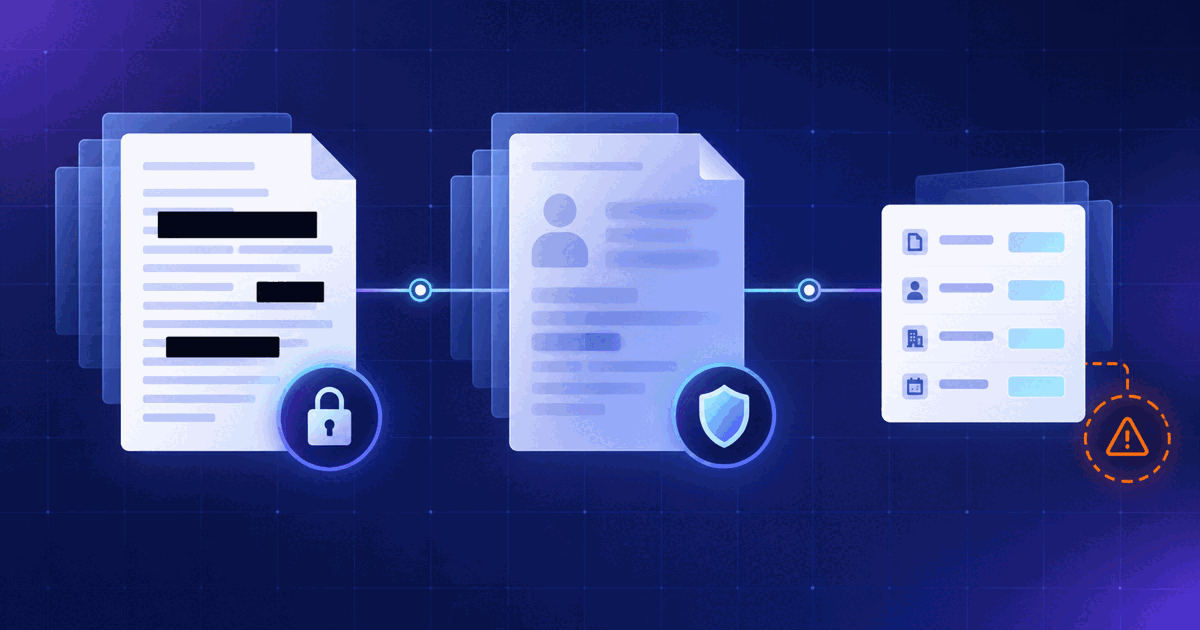
“Anonymize the documents before you share them” sounds like a complete instruction. It is not. A black rectangle over a name, a stable replacement for a customer ID, and an output that contains only an approved total all reduce exposure in different ways. They preserve different evidence, fail in different ways, and create different obligations for the team that receives them.
The useful question is not which label sounds safest. It is what information must survive this step, who needs it next, and what residual risk is acceptable when the document leaves its current boundary.
Start with the value that must survive
Document workflows usually have at least three consumers: a machine that extracts fields, a system that acts on those fields, and a person who investigates an exception. They do not need the same representation of the source document.
- Extraction — the model may need the original pixels and surrounding layout to read a value correctly.
- Decisioning — the downstream system may need only a small set of validated fields, not the source file or every value on it.
- Review — an investigator may need to inspect the evidence, but access to that evidence can be narrower and more deliberate than access to the derived result.
If all three consumers receive the same full document, convenience has become a data policy. Design the representation per consumer instead. The choice determines whether you need redaction, pseudonymization, selective extraction, or a combination.
Redaction changes the picture
Redaction removes or obscures content in a derived document. It is useful when the layout, scan noise, stamps, tables, or page structure must remain available but a value must not be visible to the next reader.
The important distinction is between a visual mark and a content removal. A black rectangle drawn over a PDF can leave the underlying text layer intact. Search, copy, accessibility tools, or an extraction service can still recover the value. A redaction workflow therefore needs a verification step: render the result, inspect the text layer, search for the removed value, and test the output with the same tools that will consume it.
Redaction also removes evidence. If a reviewer must decide whether the original value was captured correctly, a redacted file cannot answer that question. Keep the original behind a controlled review path when accuracy or dispute handling requires it; do not pretend that a redacted copy can prove what it no longer contains.
Pseudonymization preserves a link
Pseudonymization replaces an identifying value with a substitute while keeping a separate means of linking the substitute back to the person or record. That link is the feature, not an implementation detail. It lets a workflow correlate events without distributing the direct identifier to every participant.
The link also means the substitute is not automatically anonymous. The General Data Protection Regulation defines pseudonymisation as processing in which data can no longer be attributed to a specific data subject without additional information, provided that information is kept separately and protected. Article 4(5) of the GDPR is the primary text; the operational test is whether someone with access to the additional information can reconnect the record.
That makes the custody of the mapping table part of the control. Separate storage is not enough if the same operators, service account, logs, or export bucket can reach both sides. Set a different access path, avoid putting the original identifier in debug output, and decide how long the mapping must exist before you create the pseudonym.
Least-data extraction changes the output
Sometimes the safest derived document is no document at all. If a workflow only needs an invoice total, a claim date, and a policy number, send those validated fields rather than a copy of the invoice. The source can remain in the controlled processing boundary while the next system receives a small, explicit contract.
This is the pattern the Document Anonymization API page calls least-data extraction: define the minimum field set, validate it, and keep the evidence behind access controls. It is not a promise that the source contains no sensitive information. It is a decision that downstream systems do not need to inherit every value the extractor saw.
Least-data output has a failure mode of its own. A field can look harmless while carrying identifying context: a rare address, a free-text note, an account number embedded in a description, or a combination of dates and amounts that singles out one record. Review the field contract as a set, not one key at a time. “Only the fields we asked for” is not the same as “no identifying information.”
Residual risk lives outside the value
Removing visible names is only one part of reducing exposure. Documents carry structure around the values, and that structure can identify a source or reveal information that the field list did not mention.
- Layout — a rare form, signature position, or handwritten annotation can identify an organization even after named fields are hidden.
- Metadata — author names, revision history, embedded thumbnails, filenames, and PDF properties can survive a visual edit.
- Derived fields — a normalized address, an extracted diagnosis category, or a confidence explanation can disclose what the original value was meant to hide.
- Linkability — stable pseudonyms, timestamps, and repeated document shapes can allow records to be joined across exports.
Test the representation at the boundary where it is consumed. A redacted PDF should be tested as a PDF, not only as an image. A JSON response should be reviewed with the logs, trace attributes, and retry payloads that accompany it. A pseudonym should be tested against the actual access model, including support and analytics paths.
Minimization is a decision, not a slogan
The GDPR describes personal data as adequate, relevant, and limited to what is necessary in relation to the purposes for which it is processed. That is the data-minimization principle in Article 5(1)(c). It does not prescribe one technical method for every document pipeline. It gives the team a purpose against which to test the fields, evidence, and access it is keeping.
Write that purpose before choosing the transformation. “Train the extractor” may require representative layout and noise, while “route a payment exception” may need a total, a supplier reference, and a link to a controlled review record. “Share a dataset with an analyst” may need a pseudonym and coarse dates, but no raw document. Different purposes should produce different outputs.
The product page describes tenant-specific retention, access, validation, and review rules for sensitive workflows. Those controls help enforce the choice, but they do not choose the purpose for you. A setting cannot turn an unnecessary field into a necessary one.
Use controls in layers
Real pipelines rarely choose one transformation for the entire lifecycle. A practical sequence can combine them:
- Process the source in the narrowest tenant and region that fit the use case.
- Extract and validate only the fields required for the next decision.
- Redact a derived document when layout or visual evidence must travel without direct values.
- Pseudonymize the remaining identifier when correlation is required but direct identity is not.
- Keep the original and any mapping material behind a separate review path, with an explicit retention date.
The order matters less than the contract at each boundary. State what is copied, what is transformed, who can reverse or join it, and which test proves that the control worked. If nobody can answer those questions, the pipeline is moving data by habit.
Test the transformation, not just the intent
A checklist that says “PII removed” is not a test. Build cases that exercise the residual risks:
- Hidden content — search and copy from redacted PDFs, inspect annotations, attachments, thumbnails, and alternate text layers.
- Re-identification — try to join pseudonymized records with the mapping store and with the other exports available to the recipient.
- Context leakage — combine the allowed fields and ask whether their pattern identifies a person, customer, or organization.
- Operational leakage — inspect logs, error payloads, traces, caches, backups, and retry queues for the original value.
- Review recovery — confirm that an authorized reviewer can reach the evidence when the validation rule escalates, while an ordinary consumer cannot.
Keep expected results with the test corpus. Synthetic values are enough for plumbing and field-contract tests. A small, approved real or verified-redacted sample may be necessary to test layout and capture behavior. The article on test data for document AI explains why those samples need their own approval and deletion plan.
Choose the smallest representation that still works
Redaction is right when the next consumer needs the document’s shape but not its values. Pseudonymization is right when a workflow needs continuity without distributing direct identifiers. Least-data extraction is right when the next step needs a small, validated contract and not the source itself.
None is a universal synonym for anonymous. The honest control is the one whose remaining information, access path, and test evidence match the purpose. Start with the decision the document must support. Then let the smallest representation that can support it cross the boundary.