
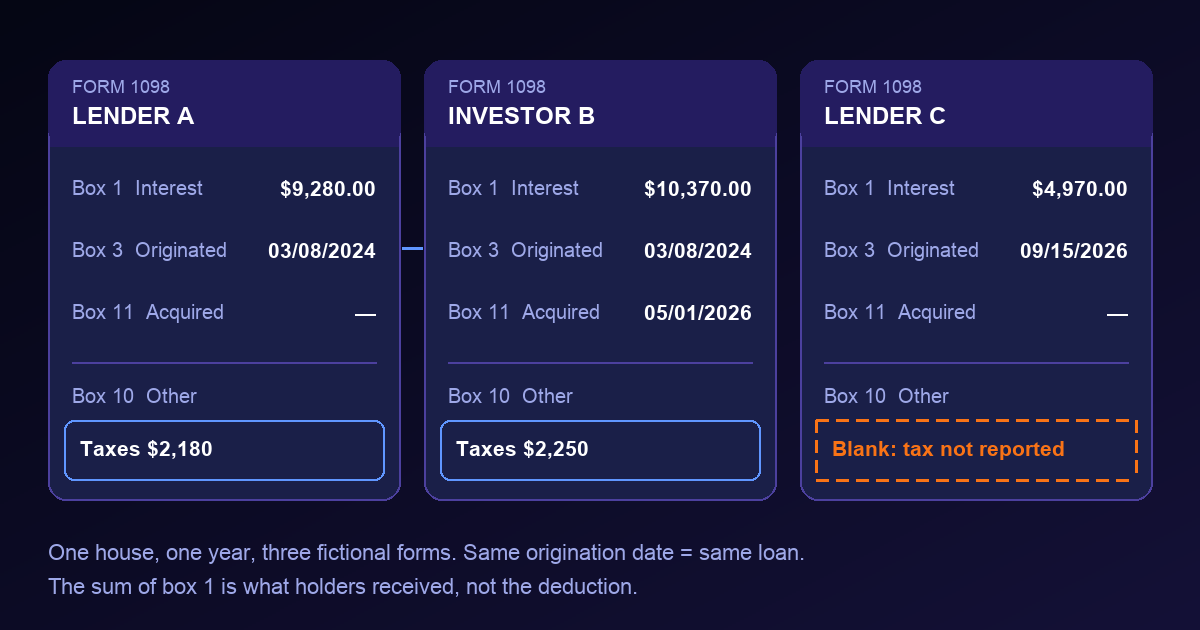
A tax preparer opens a client packet in February and finds three Form 1098s for one house. One comes from the lender that made the loan, one from a company the client has never heard of, and one from a new lender. The client did not buy a second home. The loan was sold in the spring and refinanced in the fall, and each of those events produced its own form.
None of the three forms is wrong. Each reports what one holder received on one mortgage. The trouble starts when someone adds the three box 1 amounts, enters the sum on the return and calls it the deduction. The form reports interest received. Whether that interest is deductible, and how much of it, is worked out on the return under rules the form does not show.
This piece maps the boxes of Form 1098 to what they do and do not say, follows a fictional year through three forms, and lists what a document workflow should flag before a preparer picks up the file. It explains IRS forms and publications. It is not tax advice for any particular return.
One form per mortgage, per holder
The IRS instructions for Form 1098 (revised December 2026) say it plainly: “File a separate Form 1098 for each mortgage.” The $600 reporting threshold also applies to each mortgage separately. A borrower with two loans on one property can get two forms, or one, or none, depending on how much interest each loan earned.
The filer is whoever received the interest in the course of a trade or business. That is not always the lender. A servicing bank that collects payments for a lender files the form in its own name, and may name the lender in box 10. When a loan is sold during the year, the buyer reports the interest it received after the purchase and enters the date it acquired the mortgage in box 11. When the loan is refinanced, the new loan is a new mortgage with its own form.
So the number of forms in a packet says how many holders received interest that year, not how many loans the client has. A sale and a refinance in the same year turn one loan into three forms.
What each box holds
The current form has eleven numbered boxes plus the filer, borrower and account number areas. The instructions describe what goes in each. The right-hand column is what the box does not settle.
| Box | What the filer enters | What it does not tell you |
|---|---|---|
| 1. Mortgage interest received | Interest received during the calendar year, not including points; includes prepayment penalties and most late charges | Whether the interest is deductible, or what share belongs to each co-borrower |
| 2. Outstanding mortgage principal | Principal as of January 1, or as of origination or acquisition if that happened during the year | The balance at any other point in the year |
| 3. Mortgage origination date | The date the original lender made the loan, even when the filer bought it later | Who held the loan in between |
| 4. Refund of overpaid interest | Refund or credit of interest overpaid in an earlier year | Which earlier year it relates to |
| 5. Mortgage insurance premiums | Qualified premiums of $600 or more, only if section 163(h)(3)(E) applies for the year | Whether the premiums can be deducted on this return |
| 6. Points paid on purchase of principal residence | Points that meet the reporting conditions, including seller-paid points | Points on a refinance, a second home or a home equity loan, which do not go here |
| 7, 8. Property address | A check if the property address matches the mailing address; otherwise the address or a parcel description | Whether the property is the client’s main home |
| 9. Number of mortgaged properties | The count, if more than one property secures the loan | The other addresses |
| 10. Other | Anything the filer chooses to report, such as real estate taxes or insurance paid from escrow | Anything, if it is blank: the box is optional |
| 11. Mortgage acquisition date | The date the filer acquired the loan, if that happened during the year | The interest paid to the previous holder |
Interest, points and property taxes sit in three different places, and only the first two have boxes of their own. Real estate taxes appear only if the filer decides to use box 10, and they arrive as free text. A blank box 10 does not mean the client paid no property tax. It means this filer did not report it.
A year with three forms
Here is the fictional client from the opening, with made-up figures. The loan was made on March 8, 2024. The original lender sold it on May 1, 2026, and the client refinanced with another lender on September 15, 2026.
| Field | Form from Lender A | Form from Investor B | Form from Lender C |
|---|---|---|---|
| Box 1, interest | $9,280.00 | $10,370.00 | $4,970.00 |
| Box 2, principal | $412,300.00 (Jan 1) | $410,880.00 (May 1) | $406,000.00 (Sep 15) |
| Box 3, origination | 03/08/2024 | 03/08/2024 | 09/15/2026 |
| Box 6, points | Blank | Blank | Blank |
| Box 10, other | Real estate taxes $2,180.00 | Real estate taxes $2,250.00 | Blank |
| Box 11, acquisition | Blank | 05/01/2026 | Blank |
Read across, the forms tell a consistent story. Lender A and Investor B show the same origination date, so they describe the same loan; Investor B’s box 11 says when it took over, and its box 2 is the balance on that day. Lender C shows an origination date inside the year and no acquisition date, so it is a new loan. Its box 2 is slightly lower than the old balance, which fits a refinance where the client paid some principal down at closing.
Box 1 across the three forms comes to $24,620.00. That figure is a fact about the documents: it is what three holders say they received. It is a starting point for the return, and the next section is about why it may not be the final number.
Box 6 on Lender C’s form is blank even if the client paid points at closing. The instructions tell filers not to report points on a refinance in box 6. Those points are on the refinance’s closing documents, and IRS Publication 936 says points paid to refinance “aren’t deductible in full in the year you pay them” as a general rule. Either way, the form has nothing to say about them.
Box 10 is blank on the third form too. Lender C may have paid the property tax installment from escrow in December and simply not reported it. The file needs the escrow statement or the tax bill, not a zero.
The form reports. The return decides.
Publication 936 (the 2025 edition is current) explains how home mortgage interest is deducted. Several of its rules change the number that goes on the return without changing anything on the form. In each case the 1098 is correct and incomplete at the same time.
| Situation | What the 1098 shows | What the preparer still needs |
|---|---|---|
| Debt above the limit | All interest received on the loan | Balances and loan dates. Pub 936 limits the deduction to interest on the first $750,000 of home acquisition debt ($375,000 if married filing separately), with higher limits for debt incurred before December 16, 2017 |
| Home equity loan or line of credit | Interest in box 1, like any other mortgage | How the money was used. Pub 936 says that interest is not deductible if the proceeds were not used to buy, build or substantially improve a qualified home |
| Prepaid interest in December | Box 1 may include interest that accrues by January 15 | The amount that belongs to next year, which Pub 936 says cannot be deducted this year |
| Points | Generally only points that can be fully deducted in the year paid | A check anyway: Pub 936 warns the form may report points that can’t be deducted, and may leave out points that can |
| Two or more borrowers | Total interest, on a form issued only to the payer of record | Who paid what. The instructions require the form only for the payer of record, showing the total interest received |
| Interest paid to a seller who financed the sale | Usually no form at all | The seller’s name, address and taxpayer identification number, which Pub 936 says go on the return |
That last row matters for document collection. The instructions only require a form from someone who received the interest in the course of a trade or business. A former homeowner who financed the buyer’s purchase usually sends nothing. The absence of a 1098 does not mean no mortgage interest was paid.
Refunds work the other way. Box 4 reports interest the borrower overpaid in an earlier year and got back this year. The instructions say the earlier form is not corrected. The refund shows up on the current form, so the effect lands on the current return, and how it is treated is again a question for the preparer.
Fields that are easy to misread
A few rules in the instructions explain amounts that look odd on the page.
- Seller-paid interest — when a builder or seller funds a buy-down, the interest paid from that money is kept out of box 1. A filer may mention it in box 10.
- Government subsidies — interest paid by a government unit, such as housing assistance, is not reported as received from the borrower.
- Mortgage insurance — box 5 depends on whether section 163(h)(3)(E) applies for the year, so the same loan can show premiums one year and none the next.
- The property — if box 7 is checked, the property address is the mailing address. A different property, or several, means box 8 and box 9 need reading before deciding which home a form belongs to.
- The account number — it is required when a filer sends more than one 1098 to the same borrower, and it is often the only thing that tells two forms from the same lender apart.
What extraction should hand the preparer
A document workflow cannot decide the deduction, and it should not try. It can make sure the preparer starts from a clean set of forms and sees the questions the forms raise. That begins with keeping each form as its own record, not merging them into a single number.
- One record per form — filer name and TIN, borrower, account number, each box as a typed field, and box 10 kept as text with any labeled amounts parsed out.
- Forms linked into loans — group forms by property address and origination date. Same origination date and an acquisition date means a sold loan. An origination date inside the year means a new loan.
- Gaps called out — a loan that starts in May with no earlier form, a blank box 10 on a loan with escrow, a refinance with no closing documents in the packet.
- Flags, not answers — box 4 above zero, more than one property, a borrower name that differs from the client, a December payment that may include next year’s interest.
For the fictional client, that output is three records, two loans, one open question about property tax and one about points on the refinance. The preparer still decides what goes on Schedule A. They just do not have to rebuild the year from three PDFs first.
The same forms reach the IRS too. As we noted in the piece on tax transcripts, the Wage and Income transcript includes data from the Form 1098 series. When a lender or a verifier compares a return with the transcript, each 1098 in the file should trace to a filer, an account and a year.
The short version
A Form 1098 is a statement from one holder about one mortgage: interest received, principal at a given date, points if they qualify, and whatever else the filer chose to add in box 10. A sale or a refinance creates another form. The origination and acquisition dates are what tie the forms back into loans.
The deduction is a separate calculation, made on the return under the limits and rules in Publication 936. Read each form for what it reports, link the forms into loans, and leave the deduction to the person signing the return.