
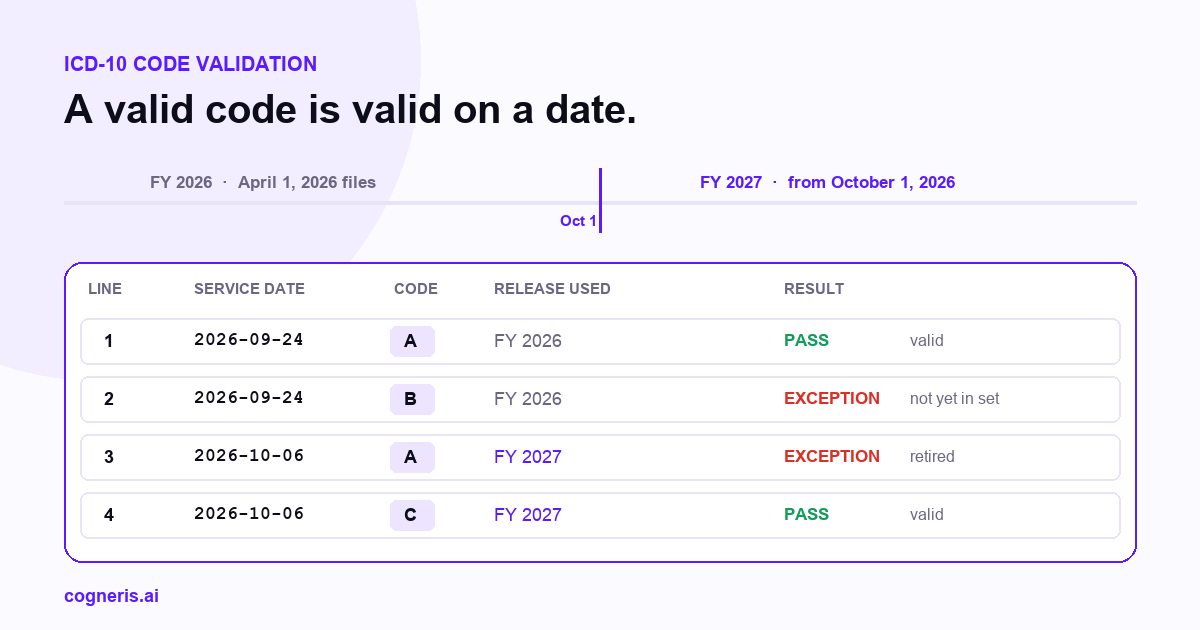
A medical bill that arrives in November can describe a visit from September. If its diagnosis codes are checked against the ICD-10 code set that is current on the day the bill is processed, the check is answering the wrong question. The question is whether each code was valid on the date of the service it describes, and that date is printed on the document.
The code set has a release date
ICD-10-CM (diagnoses) and ICD-10-PCS (inpatient procedures) are revised on a schedule. CMS publishes each release with the period it covers. On its ICD-10 page, the FY 2027 ICD-10-CM files are for discharges and patient encounters from October 1, 2026 through September 30, 2027. The fiscal year starts on October 1, so the new codes take effect on that date.
October is not the only boundary. CMS also published April 1, 2026 files for FY 2026, so one fiscal year can contain two releases. A code can be added, deleted, or replaced by more specific codes at either point. The practical consequence is simple: the same code on two claims can be valid on one and invalid on the other, depending only on the date.
Checking against today fails two ways
Documents do not arrive on the day of service. Itemized bills, claim forms, and records reach a payer, an auditor, or a claims team weeks or months later, and some are reopened years later. A check that uses the current release makes two opposite mistakes on that backlog:
- It flags a code that was valid. A code deleted on October 1 was correct for a September visit. Flagging it sends a clean line to review and invites someone to “fix” it to a code that did not exist yet.
- It passes a code that was not valid yet. A code added on October 1 looks fine today, but it could not have been billed for a September visit. A current-release check lets that line through.
The second mistake is the expensive one, because nothing in the pipeline raises it. The first at least produces a review item.
Which date picks the release
CMS describes each release by the events it applies to. ICD-10-CM files are for discharges and patient encounters in the period, and the ICD-10-PCS files are for discharges. In practice that gives two rules a pipeline can implement:
- Inpatient stays are matched on the discharge date. A stay that starts on September 28 and ends on October 3 falls under the release in force on October 3.
- Encounters and service lines are matched on their own dates. A bill with lines on both sides of October 1 needs two releases, one per line, not one per document.
Payers can add their own edits on top of the code set. Those belong in your rules, next to the release check, and the release check still comes first: a code that was not in the code set on that date is an exception before any payer edit applies.
A worked example
The example below uses no patient data. Codes are labelled A to C instead of real values, because the point is the shape of the check, not any particular code. The bill has four lines and is processed in November 2026, when the FY 2027 release is current.
| Line | Service date | Code | Release in force on that date | Status in that release | Result |
|---|---|---|---|---|---|
| 1 | 2026-09-24 | A | FY 2026, April 1, 2026 files | Valid (deleted in FY 2027) | Pass. A current-release check would flag it. |
| 2 | 2026-09-24 | B | FY 2026, April 1, 2026 files | Not in the set (added in FY 2027) | Exception: code not yet effective on the service date. A current-release check would pass it. |
| 3 | 2026-10-06 | A | FY 2027 | Deleted | Exception: retired code. |
| 4 | 2026-10-06 | C | FY 2027 | Valid | Pass. |
Against the current release alone, lines 1 and 3 would both be flagged and line 2 would pass. With the date attached, the results are line 2 and line 3 as exceptions, for two different reasons, and line 1 as a pass.
What extraction has to return
The release check can only be as good as the record it reads. For each code on the document, the extraction should return:
- The code and its code system. ICD-10-CM and ICD-10-PCS are different sets with different rules, and CPT or HCPCS codes on the same bill are checked elsewhere.
- The line it belongs to. A diagnosis pointer or a line number keeps the code tied to the service it supports.
- The date that picks the release. The line’s service date for encounters, the discharge date for an inpatient stay. When a line has no date of its own, say which date was inherited and from where.
- A citation. The page and region where the code and the date were read, so a reviewer can confirm both without reopening the file.
- The release used for the check. Stamp it on the record. When CMS publishes the next release, you can tell which results were computed against which set.
A missing or unreadable date is not a reason to fall back to today. It is a review item, because any release chosen without the date is a guess.
On the Cogneris healthcare page, CPT, ICD-10-CM, ICD-10-PCS, and HCPCS Level II codes are validated against current CMS code sets, and mismatches and retired codes are flagged for review before downstream adjudication. For a claim whose services fall before the latest release, keep the service or discharge date on the record next to each code, so the reference used for the check can be the release in force on that date.
Stamp the release, as you would a form revision
The same pattern applies to tax forms, where a box can change meaning between revisions and the template has to follow the tax year. The form revision article covers that case. Fee schedules work the same way: the PIP medical bill article shows how the date of service picks the price table. In each case the document carries the date, and the date decides which reference applies.
What this does not decide
A release check tells you whether a code existed in the code set on a date. It does not tell you whether the code is the right one for the encounter. That is a coding decision, made by people qualified to make it, under the official coding guidelines. The check routes the line to them with the evidence attached. It does not choose a replacement code.
Test the check on de-identified documents first. Pick a handful of bills with service dates on both sides of the last October 1, and confirm that each line was checked against the release for its own date.