
A physical therapy clinic treats a driver hurt in a rear-end collision and bills the driver’s auto carrier under personal injury protection. The bill arrives on a CMS-1500 with four lines and a total of $635.00. The carrier’s job is not to decide whether $635.00 sounds reasonable. It is to work out what each line is worth under the state’s rule, on the date the service was given, and pay that.
Those two numbers are rarely the same. In a state with a PIP fee schedule, the charge on the bill is an upper bound and a piece of evidence. The amount owed comes from a table, and which table depends on the code, the place of service and the date. A bill that straddles the start of a new schedule year can need two tables for one patient.
This piece uses Florida’s PIP statute as the worked example, because its schedule is written into the statute and is short enough to follow line by line. It shows how a fictional bill gets priced, where the common mistakes are, and what extraction has to return for the pricing to work. The clinic, the codes’ dollar amounts and the claim are invented. Other no-fault states set reimbursement through their own rules, and the rule for the state on the claim has to be read on its own terms. None of this is legal or claims-handling advice.
What the statute actually limits
Florida’s section 627.736 sets PIP medical benefits at 80% of reasonable expenses for medically necessary care, up to a $10,000 limit. Subsection (5) then gives the insurer a way to define “reasonable” without arguing each bill: it may limit reimbursement to 80% of a schedule of maximum charges written into the statute. Most of that schedule is a multiple of Medicare:
- Emergency transport — 200% of Medicare, for providers licensed under chapter 401.
- Hospital emergency services — 75% of the hospital’s usual and customary charges.
- Hospital inpatient and outpatient services — 200% of the applicable Medicare Part A payment for that specific hospital, outside emergency care.
- All other medical services, supplies and care — 200% of the allowable amount under the Medicare Part B participating physicians fee schedule, with separate Part B schedules for ambulatory surgical centers, clinical labs and durable medical equipment.
The last bullet covers most office and therapy bills, so it is the one in the example. Two more rules shape the arithmetic. A provider’s charge may not exceed what it customarily charges for the same service. And if the provider bills less than the schedule allows, the statute says the insurer may pay the amount of the charge submitted. So in the simple case each line is worth 80% of the lower of the charge and the schedule limit.
The schedule is optional for the insurer, and conditional. Subsection (5)(a)5 lets an insurer use it only if the policy gave notice, at issuance or renewal, that payment may be limited this way. That notice is a document too, and a claim file that prices bills by the schedule should be able to point to it.
The date picks the table
Medicare publishes a new physician fee schedule every year, and its rates can change during the year. Florida does not let the insurer chase those changes. Subsection (5)(a)2 fixes the applicable schedule as the one “in effect on March 1 of the service year” for the area where the care was given. It defines the service year as March 1 through the end of the following February, and it sets a floor: the amount may not be less than the 2007 Medicare Part B allowable.
That puts two lookups on every line, the date of service and the location, before any price is read. A visit on February 20 belongs to the service year that started the previous March. A visit two weeks later, on March 5, belongs to a new one. A bill covering both needs both schedules, and a reviewer who prices the whole bill with one table will be wrong on some lines, sometimes in the provider’s favor and sometimes not.
The location matters because Medicare’s physician amounts vary by payment locality. The place of service and the service facility address on the claim form are what tie a line to its locality. If those are blank or disagree, the line cannot be priced yet.
A bill priced line by line
Here is the clinic’s bill with made-up figures. The “Medicare amount” column stands in for the participating physician allowable for the clinic’s locality on the applicable schedule. It is illustrative, not a published rate.
| Line | Date | Code × units | Charge | Schedule | Medicare amount | 200% limit | Basis | Payable at 80% |
|---|---|---|---|---|---|---|---|---|
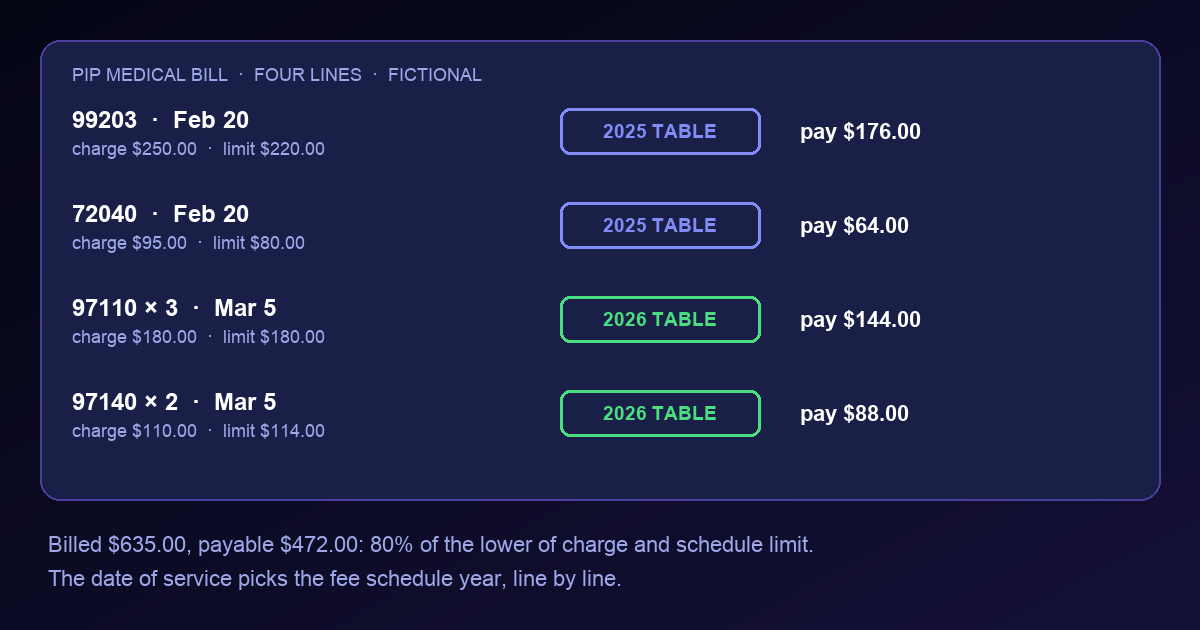
| 1 | Feb 20, 2026 | 99203 × 1 | $250.00 | Mar 1, 2025 | $110.00 | $220.00 | Limit | $176.00 |
| 2 | Feb 20, 2026 | 72040 × 1 | $95.00 | Mar 1, 2025 | $40.00 | $80.00 | Limit | $64.00 |
| 3 | Mar 5, 2026 | 97110 × 3 | $180.00 | Mar 1, 2026 | $30.00 per unit | $180.00 | Equal | $144.00 |
| 4 | Mar 5, 2026 | 97140 × 2 | $110.00 | Mar 1, 2026 | $28.50 per unit | $114.00 | Charge | $88.00 |
| Total | $635.00 | $594.00 | $472.00 | |||||
Lines 1 and 2 are the February visit, priced from the schedule in effect on March 1, 2025. Lines 3 and 4 are the March visit, priced from the 2026 one. Line 4 is the case the statute handles explicitly: the clinic billed $110.00 against a limit of $114.00, so the charge is the basis. The carrier pays $472.00 against a bill of $635.00, before any deductible or coinsurance on the policy, which this example leaves out.
The $163.00 between the bill and the payment splits into two amounts with different rules. Under subsection (5)(a)4, a provider paid under the schedule may not bill the insured above those limits, except for amounts PIP does not cover because of the coinsurance or the policy limits. The basis for the four lines is $590.00, so $118.00 is the 20% coinsurance the benefit leaves uncovered. The other $45.00 is charge above the limits, and the clinic may not pass it to the patient. That makes the pricing worth getting right line by line: the number the carrier computes also sets what the patient can be asked for.
Three mistakes the table invites
The arithmetic above is easy. The errors come from inputs, and three of them are worth checking for on every bill.
One table for the whole bill. Suppose a reviewer prices line 1 from the 2026 schedule because the bill arrived in March, and the 2026 amount for 99203 is $113.50. The limit becomes $227.00, and the payable amount $181.60 instead of $176.00. The $5.60 is small. The pattern is not: a pipeline that keys the schedule on the bill date, the received date or the payment date will misprice every visit near a boundary, consistently, and nobody will notice from the totals.
A utilization rule that is not allowed. Medicare and workers’ compensation programs often limit how many units or visits they pay for. Florida’s subsection (5)(a)3 says the schedule does not let the insurer apply those limits. It may use Medicare coding policies and payment methodologies, including modifiers, as long as they do not act as a utilization limit. A pricing rule that caps 97110 at two units because another program would is outside what the statute allows. Medical necessity is a separate question, with its own process.
A bill priced before it is a bill. Subsection (5)(d) requires bills on a properly completed CMS-1500, UB 92 or other approved form, coded with the CPT, HCPCS and ICD versions in effect for the year of service. Providers other than hospitals must put their professional license number in the signature box for the physician or supplier. Until a bill complies, the insurer is not considered to have been furnished notice of the amount for the 30-day payment clock in subsection (4)(b). A bill with no license number, or with a code that did not exist in the service year, should go back to the provider with the reason, not into pricing.
When Medicare has no price
Some services are not reimbursable under Medicare Part B at all. Florida’s answer is a fallback, not a negotiation: for those, the insurer may limit reimbursement to 80% of the maximum reimbursable allowance under the state’s workers’ compensation rules in effect when the care was given. Services reimbursable under neither Medicare nor workers’ compensation are not required to be paid.
That turns “no price found” into three different outcomes, and the pipeline should say which one applies. A code missing from the loaded Medicare table may be genuinely unpriced by Medicare, which sends it to the workers’ compensation schedule. It may also be a code from the wrong year, a typo, or a valid code the table load skipped. Those are data problems, and treating them as the statutory fallback would underpay a valid line. Each of the three should reach a person as its own case.
The limit is per person, not per bill
Pricing one bill correctly does not finish the job, because the benefit has a ceiling that spans every bill on the claim. Under subsection (1)(a), medical reimbursement runs up to $10,000 if a qualifying provider has determined the injured person had an emergency medical condition, and is limited to $2,500 if a provider determines there was none. Subsection (4)(j) requires the insurer to keep a log of PIP benefits paid for each insured.
So each priced bill has to land against a running total, and the total needs the emergency medical condition determination behind it, with the document and provider that made it. A $472.00 payment is routine when the log shows $900.00 paid. It needs a second look when the log shows $2,300.00 paid and the file has no determination either way.
Timing has its own rule. Subsection (5)(c) generally bars charges for services rendered more than 35 days before the postmark date of the statement, outside certain hospital and emergency services. The window extends to 75 days if the provider sent a notice of initiation of treatment within 21 days of the first visit. That makes the postmark, and any notice of initiation, fields to capture rather than envelopes to discard.
What extraction has to return
Most of this is table work, and the tables are only as good as what is read off the bill. As we described in the piece on CMS-1500 and UB-04 extraction, a professional claim is a set of service lines with their own dates, codes and units. For PIP pricing, each line needs:
- Date of service — per line, not per bill, because it selects the service year.
- Code, modifiers and units — the code as billed, every modifier, and units as a number, so the limit can be computed per unit.
- Charge — per line, so the lower-of comparison runs line by line.
- Place of service and facility address — to resolve the payment locality, and to separate office care from hospital care, which uses another part of the schedule.
- Diagnosis pointers — the ICD codes each line points to, checked against the version in effect for the service year.
- License number and provider identifiers — the license number in the signature box, plus the rendering and billing NPIs.
- Postmark and notice of initiation — for the 35-day and 75-day windows, captured from the envelope or the cover letter when they arrive.
Each priced line should then carry its provenance: which schedule year was used, which locality, which part of the statute set the basis, and whether the charge or the limit won. When an institutional bill is involved, the itemized bill has to tie to the UB-04 before any of this starts. When the carrier later seeks recovery from an at-fault party, the subrogation demand package needs these paid amounts with their sources attached.
Where review still sits
A fee schedule removes one argument from the bill, the price of a service that was given. It leaves the others: whether the care was related to the accident, whether it was medically necessary, whether it was lawfully provided, and whether a code was upcoded or unbundled. The statute gives the insurer a process for that last question, including a requirement to contact the provider and discuss the reasons before changing codes, or to make a documented good-faith effort to do so. That conversation is a person’s job.
Cogneris parses medical bills to CPT-code level with charges, allowed amounts and provider taxonomy, and its fee-schedule comparison is configurable per state PIP, UM and MedPay rules. Each extracted value stays linked to the region of the page it came from. Lines that cannot be priced, or that do not agree with the claim file, go to a reviewer with the reason attached. Extraction makes the table possible. It does not decide coverage, necessity or what to say to a provider.
The clinic billed $635.00 and the carrier owes $472.00. If each of those four lines shows its date, its schedule and its basis, the provider can see why, the patient knows what they can be asked for, and the next bill on the claim starts from a correct running total.
Sources
- Fla. Stat. § 627.736 (2026) — required PIP benefits and limits in (1)(a), payment timing in (4)(b), benefits log in (4)(j), schedule of maximum charges, service year, utilization limits, balance billing and policy notice in (5)(a), billing windows in (5)(c), and billing form and coding requirements in (5)(d) (The Florida Senate).
The clinic, the bill and every dollar amount above, including the Medicare amounts, are invented for illustration. This article is general information about document handling, not legal, medical billing or claims-handling advice.