
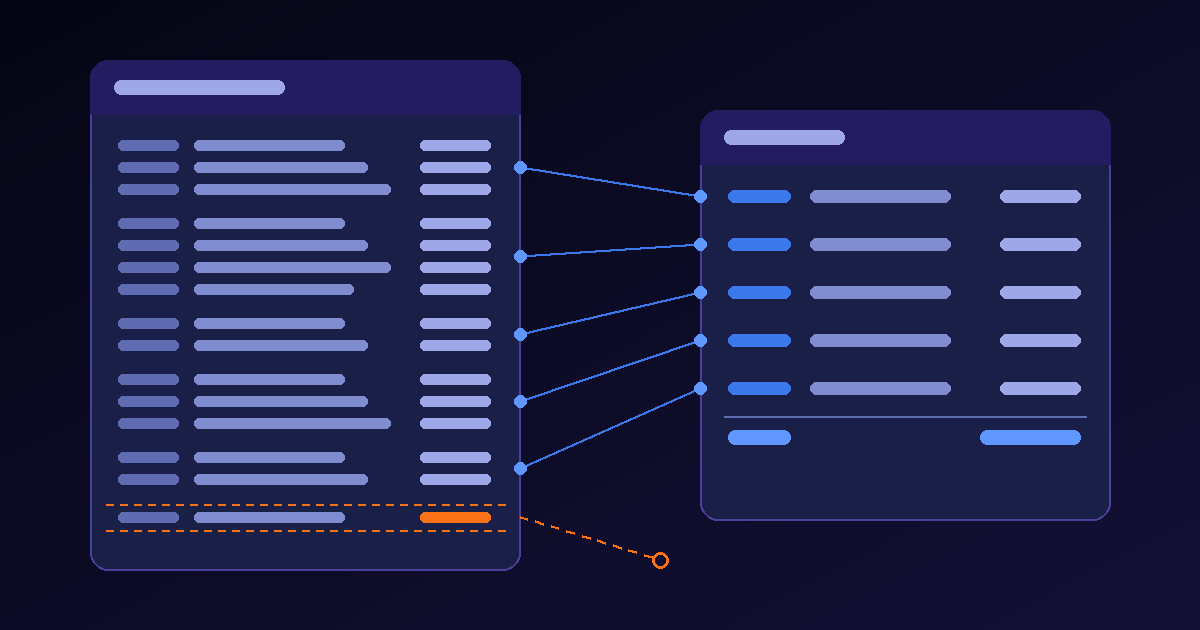
A hospital stay produces two documents that describe the same charges at different resolutions. The UB-04 is the claim: one line per revenue code, each with a total for the billing period, and a final line carrying the grand total. The itemized bill is the detail behind it: one line per item or service, with a date, a charge code, a description, a quantity and an amount. A payer reviewing a high-dollar claim, an auditor, a patient advocate and a self-funded employer’s claims team all end up holding both and asking the same question: does the detail add up to the claim?
That question is arithmetic, and it is rarely answered as arithmetic. The itemized bill arrives as a long PDF, sometimes forty pages for a short surgical stay, and is read by eye for anything that looks odd. The UB-04 is read as the authoritative version because it is the one that was adjudicated. Differences between them surface late, usually when someone asks why the amount on a statement does not match the amount on an explanation of benefits.
This piece describes how to make the two documents meet: what each one states, how the claim form itself defines the roll-up from lines to revenue codes, where the totals legitimately diverge and where they should not, and what an extraction has to deliver so that every difference can be routed with both sources attached. The structure of the UB-04 itself, box by box, is covered in our comparison of the CMS-1500 and the UB-04; this piece starts where that one ends, at the join between the claim and its detail. It makes no judgment about coding, medical necessity or whether a charge is reasonable.
Two documents, one set of charges
The UB-04 charge area is defined in the Medicare Claims Processing Manual, Chapter 25. Form locator 42 carries a revenue code “to explain each charge in FL 47,” and FL 47 is where the provider “sums the total charges for the billing period for each revenue code.” There is no fixed total row. Instead, the last revenue code is 0001, and the amount beside it is the grand total of all charges billed. Non-covered charges for each revenue code go in FL 48, and their sum sits on the same 0001 line.
There is no standard federal form for the itemized bill. Its lines come from the hospital’s charge description master, which the hospital price transparency rule at 45 CFR 180.20 defines as “the list of all individual items and services maintained by a hospital for which the hospital has established a charge.” The same section defines a gross charge as the charge for an item or service reflected on that chargemaster, absent any discounts. An itemized bill is, in effect, a dated extract of chargemaster lines posted to one patient account, priced at gross charge.
Each chargemaster line is mapped to a revenue code inside the hospital’s billing system. Some itemized bills print that revenue code on every line. Many print only the internal charge code and a description, and leave the mapping implicit. That difference decides how much of the reconciliation can be done from the documents alone:
- Revenue code printed on each line — the roll-up can be computed directly and compared with FL 47 code by code.
- Revenue code printed on department subtotals only — lines inherit the code of the section they sit in, and the section subtotal is a third value to check.
- No revenue code anywhere — only the grand total and the date span can be compared, and the per-code check needs the hospital’s mapping or a request for a statement that includes it.
The roll-up rule is written on the claim
Chapter 25 does more than name the boxes. It tells the provider how lines become revenue code totals, and those instructions are the rules the reconciliation has to reproduce. The provider must list revenue codes in ascending numeric sequence and not repeat them on the same bill to the extent possible, and, to limit the number of line items, it should sum revenue codes at the “zero” level to the extent possible.
The zero-level instruction is the first thing that breaks a naive comparison. A pharmacy department may post IV solutions under a subcode ending in 8 and other drugs under the general code ending in 0. If the claim sums them at the zero level, the UB-04 shows one pharmacy total while the itemized bill shows two groups. Comparing code by code reports two mismatches that are the same money. The roll-up has to group itemized lines by revenue category first, compare category totals, and only then look at subcodes.
The second rule depends on the bill type. On outpatient bills, FL 45 requires a line item date of service, and the manual says that if a service is rendered five times during the billing period, the revenue code and HCPCS code must be entered five times, once for each date. On those claims the comparison key is revenue code plus date, not revenue code alone. On inpatient bills the line covers the whole stay, and FL 44 carries the accommodation rate rather than a procedure code, so the room line is checked as days times rate.
The third rule is about units. FL 46 quantifies services by revenue code category, such as days in a type of accommodation, and equals the number of times a procedure was performed only when HCPCS codes are required. An itemized bill counts items. Summing itemized quantities and comparing them with FL 46 compares tablets with days. Units are checked only where both sides count the same thing; everywhere else the comparison is on amounts.
Where the totals stop matching
Once lines are grouped the way the claim groups them, most revenue codes agree to the cent. The ones that do not tend to fall into a short list of causes, and each cause has a different owner. The table below is a starting set for routing, not a coding rule.
| Difference | Typical cause | How it shows in the documents | Action |
|---|---|---|---|
| Subcode totals differ, category total agrees | Claim summed at the zero level | Two itemized groups, one UB-04 line, same combined amount | Close as matched; keep the mapping as evidence |
| Itemized line dated after the bill | Charge posted after the claim was produced | Posting date later than the claim date; amount missing from FL 47 | Route to billing: candidate for a replacement or late-charge bill |
| Professional fee on the itemized bill, absent from the claim | Physician component billed separately | Line for a physician service with no matching UB-04 line | Match against the professional claim before treating it as an error |
| Itemized line outside the statement period | Pre-admission testing or a later visit on the same account | Service date before FL 6 start or after its end | Check whether it belongs on this claim or another |
| Same item, same date, posted twice | Duplicate posting | Identical charge code, date, quantity and amount on two lines | Route for review even when the totals agree |
| Charge and reversal on the itemized bill | Correction inside the account | A negative line that cancels an earlier line | Net the pair; keep both lines in the evidence |
| Non-covered amount differs | Items flagged non-covered on the claim but not on the statement | FL 48 amount with no counterpart on the itemized bill | Route to billing with both values |
| Grand totals differ by an unexplained amount | Missing pages, or a bill for a different account or period | Page numbering gap, account number or statement dates disagree | Request the complete statement before any line review |
Two rows in that table deserve a caution. The professional fee row is about billing structure, not error: Chapter 25 notes that the physician component of some services is billed to the Part B contractor, so it legitimately appears on a different claim. And the last row should be checked first. A forty-page statement with a missing page produces a long list of line mismatches that are all one problem.
A worked example
Consider a three-night inpatient surgical stay. The UB-04 and the itemized statement for the same account were both received. The values below are invented for illustration.
| Revenue category | Itemized bill | UB-04 FL 47 | Result |
|---|---|---|---|
| 0121 Room, semi-private | 3 days × $2,450.00 = $7,350.00 | $7,350.00, 3 units | Matched |
| 025X Pharmacy | $1,284.60 general + $312.00 IV solutions + $142.30 posted after discharge | $1,596.60 at 0250 | $142.30 late charge not on the claim |
| 0272 Sterile supply | $2,145.75 | $2,145.75 | Matched |
| 0300 Laboratory | $986.40, including one blood count posted twice at $68.00 | $986.40 | Totals agree; duplicate line flagged |
| 0360 Operating room | $9,870.00 | $9,870.00 | Matched |
| 0370 Anesthesia | $2,310.00 | $2,310.00 | Matched |
| 0710 Recovery room | $1,640.00 | $1,640.00 | Matched |
| Surgeon’s fee | $3,200.00 | Not on the UB-04 | Match against the professional claim |
| Grand total | $29,241.05 | $25,898.75 at 0001 | $3,342.30 explained by the two rows above |
Read as two totals, the file shows a $3,342.30 discrepancy and invites a phone call. Read as categories, it resolves into three separate findings. The pharmacy difference is a charge posted after the claim was produced, which is a billing question. The surgeon’s fee is a different claim, which is a matching question. The laboratory duplicate is invisible at the total level, because the same duplicate was carried into the claim; only the line-level check finds it.
The example also shows why the zero-level rule matters. Compared code by code, the pharmacy row would have produced a $312.00 mismatch at 0258 and a further mismatch at 0250 before the late charge was even considered. Grouped by category, it produces exactly one difference, and that difference has a date that explains it.
Duplicates and reversals are line-level questions
Federal law already treats the itemized statement as an audit instrument for Medicare items and services. Under 42 U.S.C. 1395b-7(b), a beneficiary may request an itemized statement from a provider, which must furnish it within 30 days. The beneficiary may then ask the Secretary to review it within 90 days, identifying items or services not provided as claimed or any other billing irregularity, and the statute names duplicate billing explicitly.
A duplicate is not the same as a repeated line. A blood count drawn twice on the same day is two services; a blood count posted twice from one order is one service billed twice. The documents can separate some of those cases and not others:
- Same charge code, date and time, quantity and amount — the strongest duplicate signal an itemized bill can carry, and still a candidate for review rather than an automatic finding.
- Same charge code and date, different times — often a legitimate repeat; worth noting only when the quantity already covers it.
- A positive line and a later negative line for the same code — a reversal, which should be netted, with both lines kept so the correction is visible.
- A credit with no matching charge — a sign that the statement is incomplete or that the credit belongs to another account.
None of these checks is possible from the UB-04, which carries one amount per revenue code. And none of them is possible from an extraction that kept only the itemized bill’s total. They need every line, with its date, code and sign, as data.
What the extraction should deliver
For each itemized statement, a useful extraction returns the bill as a table of lines with its own header and its own printed totals, not a summary:
- Header fields — facility, patient account number, statement period, admission and discharge dates, statement date and page count as printed.
- Every line as a row — service date and, where printed, posting date; charge code; description; revenue code and HCPCS code when present; quantity; unit price; amount; and whether the line is a charge or a credit.
- Printed subtotals and totals as their own fields — department subtotals and the statement total as the document states them, so the extraction can be checked against its own arithmetic before it is checked against the claim.
- Page and position evidence — for every line and total, where on which page it was read, so a reviewer resolving a mismatch can see the original line in one step.
The UB-04 side comes from the claim extraction: type of bill, statement period, and one row per revenue code with units, total charges and non-covered charges, plus the 0001 line. The reconciliation then runs as a separate step: group itemized lines by revenue category, apply the zero-level and date rules, compare, and turn each difference into an exception that names both values, both documents and the rule that was applied. Nothing in that step decides whether a charge is payable.
Where this sits in a claim file
The itemized bill is rarely alone. A claim review file usually holds the UB-04, the itemized statement, the medical record excerpts that support the stay and the explanations of benefits from each payer. Reading the adjustment codes on the EOB tells you what the payer did with the claim; reconciling the itemized bill tells you whether the claim matched the account it was built from. When a second payer is involved, the secondary EOB is reconciled against the same totals. And when the question becomes whether a service was documented at all, the line moves to the episode record, which is a different review with a different owner.
Add the lines before reading the claim
An itemized bill and its UB-04 are two summaries of the same account, and the claim form says exactly how one becomes the other: lines summed by revenue code over the billing period, grouped at the zero level, dated per service on outpatient bills, with the grand total on the 0001 line. Reproducing that roll-up turns a long statement into a short list of differences, each with a cause that someone owns. The extraction’s job is to make that possible: every line, every printed total and every date as data, with the page it came from.