
A merchant application arrives with a coffee roaster’s details, an owner’s ID and one number that will shape the whole account: expected card volume of $85,000 a month. The registration checks out. The owner is who they say they are. The beneficial ownership form is complete. The application moves toward approval with that $85,000 still resting on nothing but the merchant’s word.
Verifying who a merchant is and verifying how much it sells are two different questions. The first is answered by registries, IDs and ownership records. The second is answered by documents that carry money: statements from the merchant’s current processor, bank statements and, for merchants that sell to other businesses, invoices. When those documents disagree with the application, the disagreement usually has one of three shapes: the period, the amount or the payer.
This piece separates the two questions, walks a fictional merchant through three months of documents, and lays out how to classify each gap before an underwriter decides what it means. It describes published bank supervisory guidance and regulations. It is not legal or compliance advice for any particular program.
Identity and volume are separate questions
The customer identification rules are about identity. Under 31 CFR 1020.220, a bank’s program must let it “form a reasonable belief that it knows the true identity of each customer.” The beneficial ownership rule in 31 CFR 1010.230 extends that to the people who own or control a legal entity customer. Neither rule asks how much the business sells.
Customer due diligence goes one step further. 31 CFR 1020.210 requires procedures for understanding the nature and purpose of customer relationships to build a customer risk profile, and for ongoing monitoring. Expected activity is part of that profile. It is still a profile, not proof.
Proof of sales lives in the underwriting guidance for card acceptance. The OCC’s Merchant Processing booklet of the Comptroller’s Handbook says the underwriting policy should require a background check that supports “the validity of the business, creditworthiness of the merchant, and sales history.” Its list of minimum standards includes financial statements or credit reports on the business and an analysis of the merchant’s activity based on recent monthly statements from its current or most recent processor, if available.
Our piece on KYB document verification covers the first question: whether the registration number, the legal name and the owners match across every document. This piece starts where that one stops. A merchant can pass every identity check and still declare a volume no document supports.
Which documents carry the number
Each document type sees a different slice of the merchant’s sales. None of them sees all of it, which is why a single document rarely settles the question.
| Document | What it says about volume | What it cannot say |
|---|---|---|
| Processor monthly statement | Gross card sales, transaction count, refunds, chargebacks and fees for one statement cycle | Sales taken by cash, transfer or another processor |
| Bank statement | Every deposit that reached the account, with the payer as the bank recorded it | Whether a deposit is a sale, a loan, a transfer or owner money, unless the description says so |
| Counterparty invoice | What the merchant billed a named customer, for what, on what date | Whether the invoice was paid, or whether the customer is independent of the merchant |
| Financial statements | Revenue for a fiscal period, as the merchant or its accountant reports it | Which part of that revenue will run through the new card account |
The processor statement is the closest match to a declared card volume, because it measures the same thing. The bank statement is the broadest, and that breadth is the trap: it shows more money than the merchant’s card sales, not less.
A fictional merchant, three months of documents
The merchant is Pier Nine Coffee, a fictional roaster with a café and a small wholesale line. Every name and number below is invented. The application declares $85,000 a month in card sales. The file holds processor statements and bank statements for July, August and September, plus the wholesale invoices.
| Month | Processor gross sales | Refunds | Fees | Net settled |
|---|---|---|---|---|
| July | $78,240 | $1,180 | $2,270 | $74,790 |
| August | $81,610 | $960 | $2,370 | $78,280 |
| September | $74,930 | $1,410 | $2,170 | $71,350 |
| Quarter | $234,780 | $3,550 | $6,810 | $224,420 |
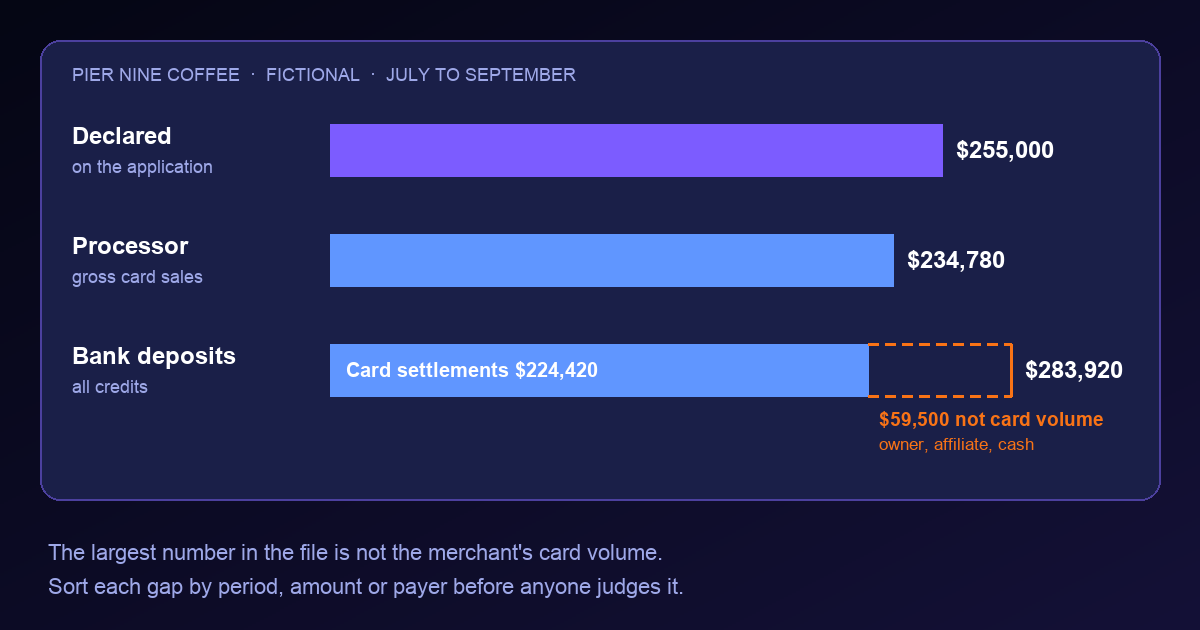
Gross card sales average $78,260 a month, 7.9% below the declared $85,000. The bank statements for the same three months show $283,920 in deposits, which is above the declared volume for the quarter ($255,000). Read on its own, the bank statement says the merchant undersold itself. Read line by line, it says something else.
| Deposits on the bank statements | Amount | Card volume? |
|---|---|---|
| Processor settlements | $224,420 | Yes, net of refunds and fees |
| Transfer from the owner’s savings account (August) | $40,000 | No: owner money |
| Wire from Harbor Roast Holdings, against wholesale invoices | $15,000 | No: invoiced sales, and the payer shares an owner with the merchant |
| Cash deposits | $4,500 | No: not card sales |
| Total | $283,920 |
The settlements tie to the processor statements to the dollar, which is the strongest evidence in the file. The other $59,500 is real money, but none of it is card volume. An underwriter who took the bank total as the merchant’s sales would have overstated them, and the overstatement would have come from the very document meant to check the claim.
This is the same point our piece on bank statement categorization makes for lending: the questions live in the lines, not in the balance. For merchant onboarding, the line that matters is who paid.
Three kinds of divergence
Every gap between the application and the documents in the example falls into one of three classes. Naming the class first keeps the review from turning into a single “numbers don’t match” flag that nobody can act on.
| Class | What it looks like | Often innocent because | What the review needs |
|---|---|---|---|
| Period | Statement cycles that do not match calendar months; a missing month; a declared monthly figure built from peak months | Processors cut statements on their own cycle, and many businesses are seasonal | The dates each document covers, the months that are missing, and whether the declared figure is an average or a peak |
| Amount | Declared gross compared with deposited net; a declared figure that differs from observed sales by more than the program allows | Fees, refunds and chargebacks come out before settlement, and applicants often round up | Gross and net side by side, the percentage gap, and the tolerance the program sets |
| Counterparty | Deposits from the owner, an affiliate, a lender or another processor counted as sales; invoices to a related customer | Owners fund their businesses, and affiliates do trade with each other | Each deposit or invoice tied to a payer, with any payer that also appears in the ownership records called out |
In the Pier Nine file, observed gross card sales sit 7.9% below the declared figure. Whether that is acceptable is a program decision, not something the documents can settle. The period question is whether July to September, in a coffee business on a pier, is a fair base for a year. The counterparty question is the $15,000 wire. The invoices are genuine, but Harbor Roast Holdings shares an owner with the merchant, which the KYB file already shows. That link is what turns an ordinary wholesale sale into a review item.
The declared figure becomes the baseline
Approval does not end the comparison. The same OCC booklet says a bank “should verify a merchant’s projected volume and average ticket size shortly after processing begins and periodically thereafter.” It describes exception reports that track variances from parameters set at account setup, including daily sales volume and average ticket size.
The interagency guidance points the same way for banks whose customers are payment processors. The FDIC’s revised guidance on payment processor relationships (FIL-3-2012) says an assessment should identify the major lines of business and volume for the processor’s customers, and that monitoring should cover merchant data, transaction volume and chargeback history. The OCC’s Bulletin 2008-12 makes the same point about monitoring processor information.
That is why the declared number deserves more care than it usually gets. Whatever figure enters the account at onboarding becomes the yardstick for every later alert. An inflated figure hides real growth in risky activity. A deflated one fills the queue with alerts that are not problems. A figure traced to documents, with its period and payers recorded, gives monitoring something it can measure against.
What extraction should hand the underwriter
A document workflow cannot decide whether a merchant’s volume is good enough. It can make sure the underwriter starts from figures that are already tied to their sources, with the gaps sorted by kind.
- One record per document — document type, issuer, the period it covers, and each amount as a typed field, so a statement cycle never gets mistaken for a calendar month.
- Gross and net kept apart — processor gross sales, refunds, chargebacks and fees as separate fields, so the declared gross is compared with gross and the deposits with net.
- Every deposit tied to a payer — processor settlements matched to their statements, and everything else labeled by source: owner, affiliate, lender, cash, other processor.
- Payers checked against the ownership file — any payer or invoiced customer that shares a name, address or owner with the merchant, flagged with the link that matched.
- Divergences, not verdicts — each gap classed as period, amount or counterparty, with its size and the documents behind it. The tolerance and the decision stay with the program.
For Pier Nine, that output is observed gross card sales 7.9% below the declared figure, a three-month base taken from the busiest season, $59,500 in deposits that are not card volume, and one wholesale customer that shares an owner with the merchant. The underwriter still decides whether to approve and at what volume. They just do not have to rebuild the quarter from a stack of statements first.
The short version
Identity checks tell you who the merchant is. They do not tell you how much it sells. Declared volume needs its own evidence: processor statements first, bank statements read line by line, and invoices with their payers named.
When the documents disagree with the application, sort the gap before judging it. A period gap asks which months the number came from. An amount gap asks whether gross is being compared with gross. A counterparty gap asks who paid, and whether that payer is really someone else.