
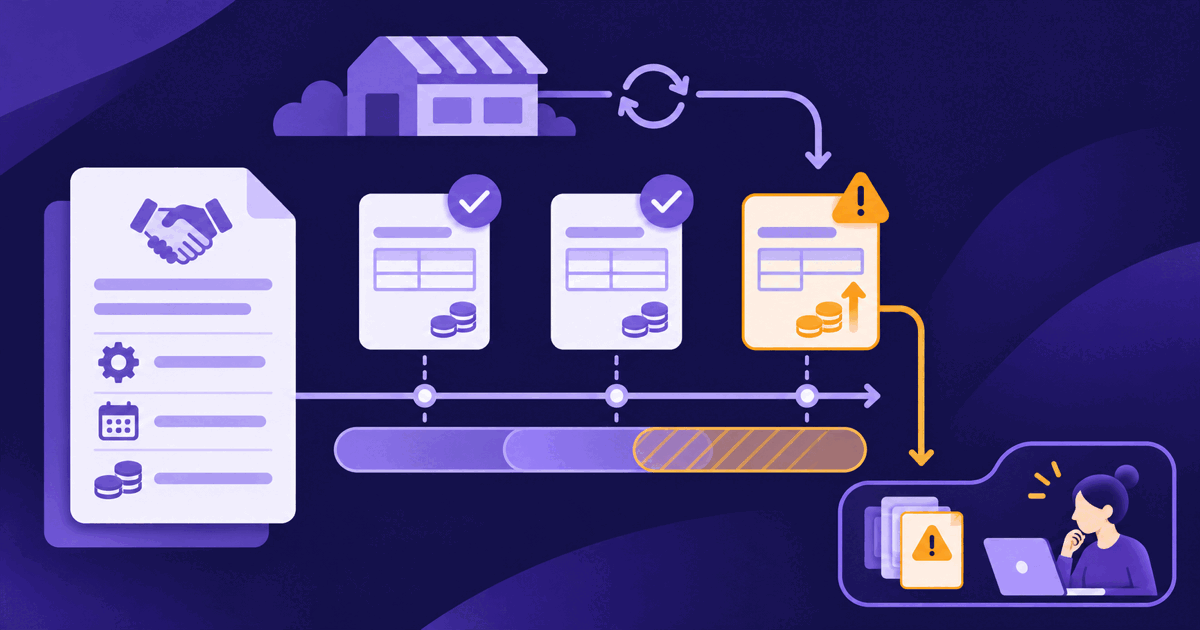
A monthly software or facilities invoice can look routine right up to the month it changes. Without a purchase order, accounts payable still needs a reference for what was agreed and which dates the supplier billed. The contract is that baseline; the last accepted invoice is useful context, not permission to pay the next one.
Consider a fictional support contract billed monthly. It sets a fee of $1,200 through May 31 and a new $1,320 rate from June 1. The May invoice is for $1,200, but an invoice arriving in May asks for $1,320. The amount is plausible, yet the effective date has not arrived. That difference deserves review against the signed terms.
Compare the period before comparing the total
A recurring invoice check starts with what dates each document covers. Two invoices can have different numbers and totals while charging for some of the same service days.
| Record | Service period | Amount | What the comparison shows |
|---|---|---|---|
| March invoice | Mar 1–31 | $1,200 | Matches the contract rate through May |
| April invoice | Apr 1–30 | $1,200 | Same monthly baseline |
| May invoice | May 1–31 | $1,200 | Still within the original rate period |
| Unexpected May invoice | May 1–31 | $1,320 | Increase begins before the contract’s June 1 effective date |
| Additional May invoice | May 16–31 | $600 | Dates overlap the full-month May invoice; determine whether it is a correction, separate service, or duplicate billing |
These invented records illustrate two different exceptions: a rate change that appears before its effective date, and an additional charge whose service dates overlap another invoice. Neither proves misconduct or a duplicate on its own. A credit, corrected invoice, usage charge, or contract amendment could explain the difference. Preserve the documents and ask the contract owner or supplier to resolve it before posting.
Build a comparison that can be reviewed
- Service dates — capture the billed-from and billed-through dates, including partial periods, and compare them with the contract term and earlier invoices.
- Rate and effective date — compare the line rate with the contract schedule, amendment, currency, unit and date the change takes effect.
- Amount and adjustments — account for quantity, usage, credits, proration and tax before calling a variance unexplained.
- Overlap and provenance — show which earlier document covers the same dates and retain the source page and field used for each comparison.
Route the exception with the exact difference and its source: “$120 above the contracted May rate” is actionable; “amount mismatch” is not. If the contract or service evidence is missing, record that gap rather than treating a prior invoice as a substitute approval.
Where document AI fits
Invoice extraction can identify supplier, invoice number, dates, line descriptions, amounts and the page regions that support them. Those fields make a comparison easier to assemble. The contract terms, service evidence and payment decision still require the organization’s records and review rules.
That is distinct from three-way matching, which compares an invoice with a purchase order and receipt. It is also distinct from GL coding, which suggests accounting categories, and from prepayment handling, which tracks an advance against a later bill. Duplicate detection is a separate check too; a date overlap is a signal for investigation, not a duplicate verdict.
Cogneris extracts invoice fields and source evidence for downstream workflows. As the product page explains, purchase-order and goods-receipt matching require access to those records and customer-specific rules. Extraction does not establish that matching ran, approve a changed rate, or release a payment.
For the fictional May example, the useful result is a review queue with the contract’s $1,200 rate, the $1,320 billed amount, the June 1 effective date, and the overlapping May 16–31 period visible beside their sources. A person with the contract and service records can decide what should happen next.
The supplier, contract terms, dates and amounts above are invented for illustration. This article describes a document review workflow, not accounting or legal advice.