
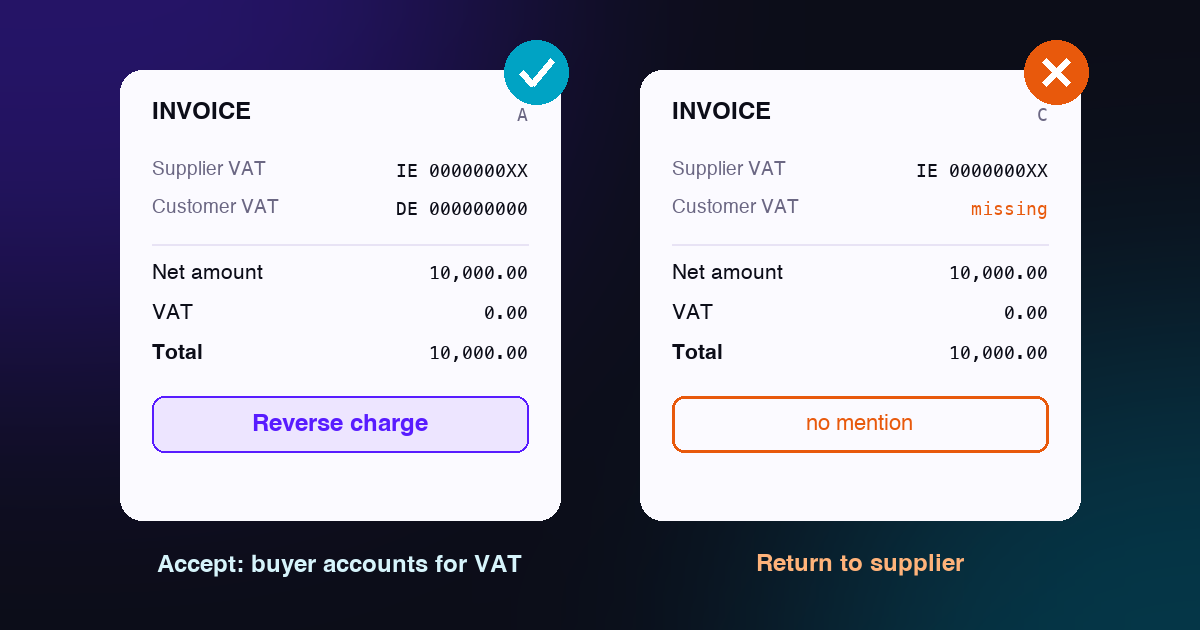
Accounts payable sees two kinds of invoice with a VAT line of zero. One is correct: the supplier is not supposed to charge VAT because the buyer must account for it. The other is wrong: the supplier left the tax off, or applied a treatment the transaction does not qualify for. On the page they can look almost identical. A net amount, a tax line that reads 0.00 or is missing, and a total equal to the net.
The difference is not in the numbers. It is in a few words and two identifiers that the law requires on the first kind of invoice. In the EU VAT system the words are the mention “Reverse charge”, and the identifiers are the VAT number of the supplier and the VAT number of the customer. An extraction that reads the amounts and skips those fields cannot tell the two invoices apart. Neither can the person who approves them from a summary screen.
This piece describes what a reverse charge invoice has to show, how it differs from an exempt invoice and from a plain mistake, and what a pipeline should do when the mention is missing. It is about reading the document, not about deciding a company’s tax position. Whether a given purchase falls under the reverse charge is a question for the tax team and its advisers. What the document says, and whether it says enough, is a question extraction can answer.
What the reverse charge moves
Normally the supplier charges VAT on the invoice, collects it from the customer and pays it to the tax authority. The reverse charge moves that liability to the customer. The supplier invoices the net amount. The customer works out the VAT on that amount and declares it in its own return. Where the customer is entitled to deduct the tax, it usually recovers the same amount in the same return, so no cash changes hands. The tax is still accounted for. It is accounted for by the other party.
The most common case in cross-border trade is a business-to-business service. Under Article 44 of the EU VAT Directive, the place of supply of a service to a taxable person acting as such is, as a general rule, where that customer has established its business. When the supplier is not established in that Member State, Article 196 makes the VAT payable by the customer. A software company in Ireland that invoices a business customer in Germany for a general service is in this position: the supply is taxed in Germany, and the German customer pays the German VAT.
Countries also apply domestic reverse charges inside their own borders, usually to sectors where fraud was common. The United Kingdom applies one to many building and construction services, under section 55A of the VAT Act 1994. The mechanism is the same. The supplier does not collect the VAT; the customer accounts for it. What changes from one regime to another is the scope and the exact wording each tax authority accepts on the invoice.
What the invoice has to say
Article 226 of the VAT Directive lists the details required on an invoice. Most of them apply to every invoice: date, sequential number, names and addresses, the nature of the supply, the taxable amount. A few apply specifically when the customer is the one liable for the tax, and these are the ones that separate a valid reverse charge invoice from an invoice with the tax left off.
| Field | Article 226 point | What to check on a reverse charge invoice |
|---|---|---|
| Supplier VAT number | (3) | Present, in the supplier’s own Member State format, and the same number as on the supplier record |
| Customer VAT number | (4) | Present, and it is the buyer’s number under which it received the supply and is liable for the VAT |
| Taxable amount and unit price exclusive of VAT | (8) | The net amount the customer will compute VAT on |
| VAT rate and VAT amount | (9), (10) | No VAT charged to the customer; the total equals the net amount |
| Mention | (11a) | The words “Reverse charge”, or the national-language equivalent the Member State accepts |
| Date of supply | (7) | Where it differs from the invoice date, because it decides the period in which the customer accounts for the tax |
Point (4) is worth reading closely. The customer’s VAT number is required on the invoice when the customer received a supply in respect of which it is liable for the VAT, and also when it received goods in an exempt intra-Community supply under Article 138. A domestic invoice to a customer that pays VAT normally does not need the customer’s VAT number at all. On a reverse charge invoice it does. Its absence is not a formatting slip: it removes the identifier that ties the liability to a specific registered buyer.
The registration side matches. Article 214 requires Member States to identify, by an individual number, every taxable person who receives services for which it is liable to pay VAT under Article 196, and every taxable person established in their territory who supplies such services in another Member State. Both parties to a cross-border reverse charge service are expected to have a VAT number. The invoice is where those two numbers meet.
Zero VAT is three different things
A tax line of zero has at least three explanations, and each one requires a different reference on the document. Reading the amount alone collapses them into one.
| Situation | Who accounts for VAT | What the invoice must carry | Typical example |
|---|---|---|---|
| Reverse charge | The customer | The mention “Reverse charge” (226(11a)) and the customer’s VAT number (226(4)) | Cross-border B2B service under Article 196; UK construction service under section 55A |
| Exempt supply | Nobody on this supply | A reference to the exempting provision, or another reference indicating the supply is exempt (226(11)) | Intra-Community supply of goods under Article 138, which also requires the customer’s VAT number |
| Missing VAT | The supplier, who has not charged it | Nothing that explains the zero | A domestic invoice where VAT should have been charged |
The first two are both legitimate, and both rely on the customer being a registered business in the right place. They are still different treatments. Under the reverse charge the customer owes VAT and declares it. Under an intra-Community supply of goods the supplier’s sale is exempt and the customer accounts for an intra-Community acquisition on its side. Coding one as the other produces a return with the right total in the wrong boxes. The reference printed on the invoice is what tells the two apart, which is why it has to be extracted as text, not inferred from the fact that the tax is zero.
The third case is the one the check exists for. An invoice that should have carried VAT and did not is a supplier error. Paying it as presented and assuming the buyer will self-account turns the supplier’s mistake into the buyer’s liability, without the document that would support it.
The rejection rule
The rule that follows from Article 226 is simple to state and easy to automate, because it depends only on what is printed.
- Tax is zero or absent — read the whole invoice for a reason before doing anything else. Check the footer, the tax summary block and any notes column, because that is where the mention usually sits.
- A reverse charge mention is present — require the supplier’s VAT number and the customer’s VAT number. If either is missing, the invoice is incomplete for this treatment, even though the mention is there.
- An exemption reference is present instead — record the cited provision as written and route the invoice to the exemption path, not the reverse charge path.
- Neither is present — the invoice goes back to the supplier for a corrected invoice, with the reason stated. It does not go to approval with a tax code filled in by default.
- The customer VAT number is not the buyer’s — a number that belongs to another entity in the group, or to no one, is a finding in its own right. The supply may have been made to someone else.
Step four is the one most systems get wrong. The obvious shortcut is to see a foreign supplier, a service description and no VAT, and conclude that the reverse charge must apply. Often it does. But the conclusion is the buyer’s inference, not the supplier’s statement, and the invoice is the supplier’s statement. The GL coding piece makes the same point about accounts: a system that applies a default tax code can post a record that reads cleanly and says something the invoice did not.
Validating the VAT numbers themselves is a separate step from reading them. The European Commission’s VIES service checks whether a VAT number issued by a Member State is valid. The check confirms that the number exists and is active. It does not confirm that the supply was within the scope of the reverse charge.
The wording varies by regime
The EU text requires “the mention ‘Reverse charge’”. Invoices in practice carry it in the supplier’s language, with an article reference, or as a sentence that names who pays. A pipeline that searches for one English phrase will miss most of them.
HMRC’s technical guide to the UK domestic reverse charge for construction gives a useful example of how a tax authority describes the requirement. Under that regime the supplier must show all the information required on a VAT invoice, add a note making clear that the domestic reverse charge applies and that the customer must account for the VAT, and state the amount of VAT due under the reverse charge, without including it in the amount charged. If the amount cannot be shown, the rate is stated instead. HMRC lists wording that meets the legal requirement, including “S55A VATA 94 applies” and “Customer to pay the VAT to HMRC”.
That is an important difference from many cross-border invoices. A UK construction invoice under the domestic reverse charge may show a VAT figure that is not added to the total. An extraction that reads “VAT 20%: 2,000.00” and adds it to the payable amount has read the number correctly and the invoice incorrectly. The extracted record needs two separate fields: VAT charged to the customer, which is zero, and VAT stated for reverse charge, which is the amount the customer will self-account.
Credit notes follow the same logic in reverse. HMRC’s guide asks the supplier to note on the credit note that the reverse charge applies and to show the reduction in the VAT the customer has to pay. A credit note against a reverse charge invoice that carries no such note is the same problem as the original invoice without a mention.
A worked example
A German buyer receives three invoices in one week from suppliers in other Member States. Each shows a net amount of 10,000.00 and no VAT charged.
| Invoice | Text near the totals | Supplier VAT no. | Customer VAT no. | Finding |
|---|---|---|---|---|
| A · consulting service | “Reverse charge” | Present | Buyer’s DE number | Reverse charge, complete. Buyer accounts for German VAT on 10,000.00 |
| B · machine parts | “Exempt intra-Community supply, Art. 138 Directive 2006/112/EC” | Present | Buyer’s DE number | Exempt supply of goods. Route to the intra-Community acquisition path, not reverse charge |
| C · software licence | Nothing | Present | Missing | No reason for zero VAT and no customer VAT number. Return to supplier for a corrected invoice |
A check on the amounts passes all three: net equals total, tax is consistent with a zero rate, and the arithmetic adds up. The document check separates them. A and B are valid and land in different parts of the buyer’s return. C may well be a reverse charge supply in substance, but the invoice does not say so and does not identify the buyer as the liable party. The fix belongs with the supplier, and the reason for returning it is one sentence long.
Where this sits next to e-invoicing
Structured e-invoices make several of these fields easier to read, because the VAT category and the identifiers arrive as data rather than as text on a page. They do not make the treatment correct. The e-invoicing exceptions piece puts it directly: a tax value can be correctly encoded while the tax treatment still needs review. That piece is about the exception path a structured invoice still needs. This one is about one of the checks that sends invoices into it. The same rule applies whether the invoice arrived as a PDF, a scan or an XML file: zero VAT needs a stated reason, and the reason needs its identifiers.
The check also comes before matching. The three-way match piece compares the invoice with the order and the receipt line by line. A reverse charge invoice can match perfectly on quantity and price and still be unpayable as presented, because the tax content is incomplete. Treating the tax check as part of the match result keeps that from being lost behind a green status.
What the extraction should return
- Both VAT numbers as printed — supplier and customer, each with its country prefix and the page region it came from, kept separate from the tax registration on the supplier record.
- The tax reason as text — the reverse charge mention, the exemption reference or the national wording, exactly as written, with its location on the page.
- A treatment class — reverse charge, exempt, VAT charged or no reason stated, derived from the text above rather than from the amounts.
- VAT charged and VAT stated separately — so that a domestic reverse charge invoice that shows the self-accounted VAT is never totalled as payable tax.
- The date of supply — where it differs from the invoice date.
- A finding per gap — missing mention, missing customer VAT number, customer number that is not the buyer’s, or an exemption cited where a service was invoiced, each with the reason it goes back to the supplier.
Read the reason before the number
A reverse charge invoice is the rare document where a correct amount of tax is zero. That makes the amount the least informative field on it. The supplier’s statement of why there is no tax, and the two VAT numbers that make that statement meaningful, carry the whole treatment. Extract them first, classify from them, and send an invoice back when it does not say enough. Inferring the reverse charge from a foreign address and a blank tax line saves a day on one invoice and leaves an unsupported entry in the VAT return.
This article describes document requirements and how to check for them. It is not tax advice. Rules differ by country and change over time, and whether a particular supply falls under the reverse charge depends on facts the invoice does not contain.
Sources
- Council Directive 2006/112/EC, Article 226 — required invoice details, including the supplier’s VAT number (3), the customer’s VAT number (4), the reference for an exemption (11) and the mention “Reverse charge” where the customer is liable (11a). Text as published on legislation.gov.uk, which reproduces the Directive as it stood at the end of 2020; check the current consolidated text on EUR-Lex before relying on it.
- Article 44 and Article 196 — the general place-of-supply rule for B2B services and the customer’s liability when the supplier is not established in that Member State.
- Article 138 and Article 214 — the exempt intra-Community supply of goods and the VAT identification of parties to Article 196 services.
- HMRC, VAT domestic reverse charge technical guide — section “Invoices and other VAT documents”: what the invoice must show, accepted wording such as “S55A VATA 94 applies”, and credit notes.
- European Commission, VIES VAT number validation — validity check for VAT numbers issued by Member States.