
A carrier pays a repair claim for a collision its insured did not cause. The file closes on the claims side and opens on the recovery side, where somebody has to ask the other carrier for the money back. The demand letter is the part that gets sent first, and it is one page. The rest of the package is what decides whether the page holds up.
The other carrier owes nothing because a letter states a number. It will want to see what was paid, why its insured answers for it, and that the policy behind the payment was in force. Those three answers live in different documents, written by different people, at different points in the claim.
This piece walks through what a subrogation demand package has to prove, tracing one fictional auto claim from each amount to the document behind it. It also covers the state rules that put the insured’s deductible inside the demand, and where document extraction helps. Who was at fault, and whether to pursue the recovery at all, stay with the people who handle recovery.
What the package has to prove
Subrogation is one party taking over the legal rights of another. Cornell’s Legal Information Institute uses this exact case as its example: when an insurer compensates a policyholder, the policyholder’s right to sue the person responsible may pass to the insurer. So the carrier arrives holding a right it acquired by paying, and its package has to show the payment and the right.
That splits the work into three questions:
- Payment — what did the carrier pay, to whom and on what date, and what did its insured pay out of pocket?
- Responsibility — what in the file connects the loss to the other party, and what does it say about shared fault?
- Coverage — was the policy in force on the loss date, with the coverage the payment was made under, and is the right to recover still intact?
The first question is arithmetic with a paper trail. The second is a judgment supported by evidence. The third is mostly lookup, with one trap in it. They fail in different ways, so it is worth checking them separately.
Every amount has an origin
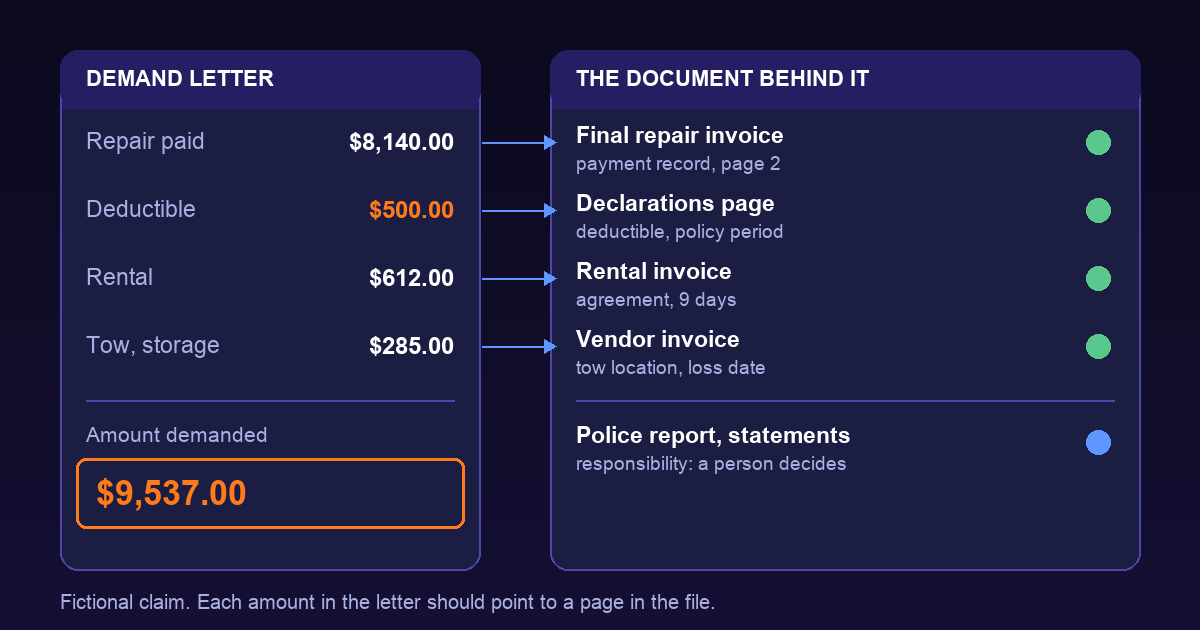
Here is a partial-loss claim with made-up figures. The shop’s final invoice is $8,640.00. The policy carries a $500.00 collision deductible, so the carrier pays the shop $8,140.00 and the insured pays the rest. The carrier also pays for a rental and a tow.
| Item | Amount | Document that proves it | What it has to tie to |
|---|---|---|---|
| Repair paid to the shop | $8,140.00 | Final repair invoice and the carrier’s payment record | Base estimate plus every approved supplement |
| Deductible paid by the insured | $500.00 | Declarations page, and the invoice total minus the amount paid | $8,640.00 − $8,140.00 |
| Rental | $612.00 | Rental agreement and invoice | Rental days against the coverage on the policy |
| Tow and storage | $285.00 | Vendor invoice | Loss date and the location on the police report |
| Demand total | $9,537.00 | Demand letter | The carrier’s payments of $9,037.00 plus the deductible |
The last row is the one to automate first. A demand total should equal the sum of its lines, and each line should resolve to a document in the package. If the letter says $9,537.00 and the ledger and invoices support $9,037.00, the $500.00 gap has an obvious explanation in this example. In a real file with four supplements and two rental extensions, a gap may not explain itself.
The repair line depends on claim history. As we described in the piece on documents after first notice, estimates and supplements revise each other, and the final invoice records what was actually billed. A package built from the first estimate can understate the loss by a whole supplement. One built from the base estimate plus an invoice can count the same repair twice.
The deductible belongs in the demand
The insured’s deductible is the line a carrier has no payment record for, which makes it easy to leave out. Some states do not leave that to the carrier. California’s Fair Claims Settlement Practices Regulations, 10 CCR § 2695.7(q), says every insurer that makes a subrogation demand “shall include in every demand the first party claimant’s deductible.” Washington’s WAC 284-30-393, written for motor vehicle claims, has the same requirement.
The two rules divide the money differently. Washington allocates recoveries first to the insured for the deductible, less applicable comparable fault. California requires recoveries to be shared on a proportionate basis, unless the insured has otherwise recovered the whole deductible. It also carves out cases such as disability and health insurance, and some multi-policy losses whose contracts prescribe other rights.
Run the example with 20% of the fault on the carrier’s insured, so the recovery is 80% of the demand:
| Step | Washington (first to the deductible) | California (proportionate) |
|---|---|---|
| Recovery | $9,537.00 × 80% = $7,629.60 | $9,537.00 × 80% = $7,629.60 |
| To the insured | $500.00 less 20% = $400.00 | $7,629.60 × ($500.00 ÷ $9,537.00) = $400.00 |
| To the carrier | $7,229.60 | $7,229.60 |
The answers match here because comparative fault is the only reduction. They can part ways when a recovery falls short for another reason, such as thin policy limits at the other carrier or a compromise. Applying either rule to a real file is a question for counsel or the recovery team, and other states have their own text. What the package has to supply either way is the same set of inputs: the deductible, who paid it, whether it was waived, and any fault percentage that has been established.
Expense deductions are limited too. Both rules bar taking expenses from the deductible recovery unless an outside party was retained to collect it, and then only as a pro rata share of allocated loss adjustment expense. California’s text names an outside attorney or collection agency, while Washington’s names an outside attorney. That makes the collection fee invoice one more document with a job to do.
The rules also create dates
The same two sections put obligations on the calendar and in the correspondence file. California, in subsection (p), requires written notice to the first-party claimant about whether the insurer intends to pursue subrogation. If it elects not to, or stops, the notice has to say that any recovery to be pursued is the claimant’s responsibility. Subsection (p) lists exceptions, for example when the deductible was waived. Washington requires the insurer to contact its insured within 60 calendar days after the start of the subrogation process and at least every 180 days until the insured’s interest is resolved. That is the rule’s current text, last amended effective October 18, 2026.
So the correspondence is evidence as well. Each letter to the insured has a date, a recipient and a subject, and a reviewer can check those against the required intervals if they are captured as fields rather than left in a folder of PDFs.
Recovery also has its own deadline. The time limit depends on the state, the type of claim and the facts, and counsel sets it. The file can at least put the inputs in front of them: loss date, payment dates and the date the subrogation file opened. If a demand moves on to inter-company arbitration or suit, that forum’s rules govern what has to be filed and when. This piece does not cover those rules.
Responsibility is evidence, not a field
The package usually carries a police report, statements, photos and sometimes a repair shop’s damage notes. These are the documents where it is most tempting to let a model summarize, and where a summary does the least good. A recovery specialist deciding whether to demand 100% or 80% needs to read what the report says, with the page in view. A generated sentence saying the other driver was at fault gives them nothing to check.
Extraction can fairly pull the concrete facts: the parties and their vehicles, the other carrier and policy number, citations issued, the date, time and location, and the narrative text with its page. Comparing those across documents is useful too. A location on the tow invoice that disagrees with the police report, or a statement that gives a different time of day, is a reason for someone to look. Whether it matters is their call. Nothing in the pipeline should assign fault.
A waiver can end the demand before it starts
Coverage is mostly a lookup. The declarations page gives the policy number, policy period, coverages and deductible, and the loss date has to fall inside the period. The trap is that the right to recover may already have been given up.
A waiver of subrogation can sit in an endorsement or in a contract between the insured and the other party. Our piece on tracking certificates of insurance looks at that question from the other side, before any loss: a mark in the waiver column of a certificate is where the inquiry starts, and the policy is where it gets answered. On the recovery side, the same language can stop a demand, so the endorsement schedule belongs in the check. A release the insured signed with the other party after the loss raises a similar question. If either turns up, send it to counsel before any letter goes out.
Checks that run before the letter goes out
None of the checks below decide anything about liability. They catch a package that does not agree with itself, which the other carrier would otherwise find first.
| Check | What to compare | When they disagree |
|---|---|---|
| Total ties out | Demand total against the sum of payment lines plus the deductible | Hold the demand and show the line with no support |
| Billed, not estimated | Repair amount against the final invoice, base estimate and approved supplements | Request the final invoice, or flag the line as estimate-based |
| Same claim | Claim number, policy number, loss date and VIN on every document | Pull the document for review; it may belong to another file |
| Paid once | Invoice numbers across payments | Show both payments and ask for an explanation or a credit |
| Deductible | Declarations page against the invoice math and the demand line | Route to the recovery specialist; check for a waived deductible |
| In force | Loss date against the policy period | Route to coverage review |
| Right intact | Endorsement schedule and file contents for a waiver or release | Route to counsel before sending |
| Net amounts | On a total loss, the amount paid against any salvage record in the file | Show both figures so the specialist can set the demand |
Each result should be able to land in three states: present with a source, missing or conflicting. “Missing” and “conflicting” are different jobs. One is a document request, and the other is a person reading two pages side by side. A system that returns its best guess for both hides that difference from the specialist.
What extraction changes
Most of the effort in a package goes to reading: paging through the claim file to find the invoice that supports a line, then finding the same VIN on a report scanned at an angle. A document AI pipeline can classify the documents, pull typed fields from each and keep every value tied to the page region it came from. For recovery work the output is the table above, with each amount linked to its source.
Cogneris extracts and normalizes documents from at-fault parties, third-party carriers and recovery vendors, and the same audit trail applies to subrogation packages as to the original claims. Low-confidence values and the mismatches above go to a person with the reason attached. Extraction produces a package a specialist can review quickly. It does not produce a decision to pursue a recovery, and it does not replace the legal judgment around one.
The letter asks for $9,537.00. If each dollar of that points to a page, the other carrier’s adjuster has less to argue about, and your own specialist has already seen what they would have argued.
Sources
- Cal. Code Regs. tit. 10, § 2695.7(p) and (q) — notice to the claimant, deductible in the demand, proportionate sharing, expense limits and exceptions (Cornell LII).
- WAC 284-30-393 — deductible in motor vehicle subrogation demands, allocation of recoveries, 60-day and 180-day contact intervals (Washington State Legislature; WSR 26-17-089, effective October 18, 2026).
- Subrogation — Wex definition (Cornell LII, last reviewed June 2024).
The claim, amounts and fault split above are invented for illustration. This article is general information about document handling, not legal or insurance advice.