
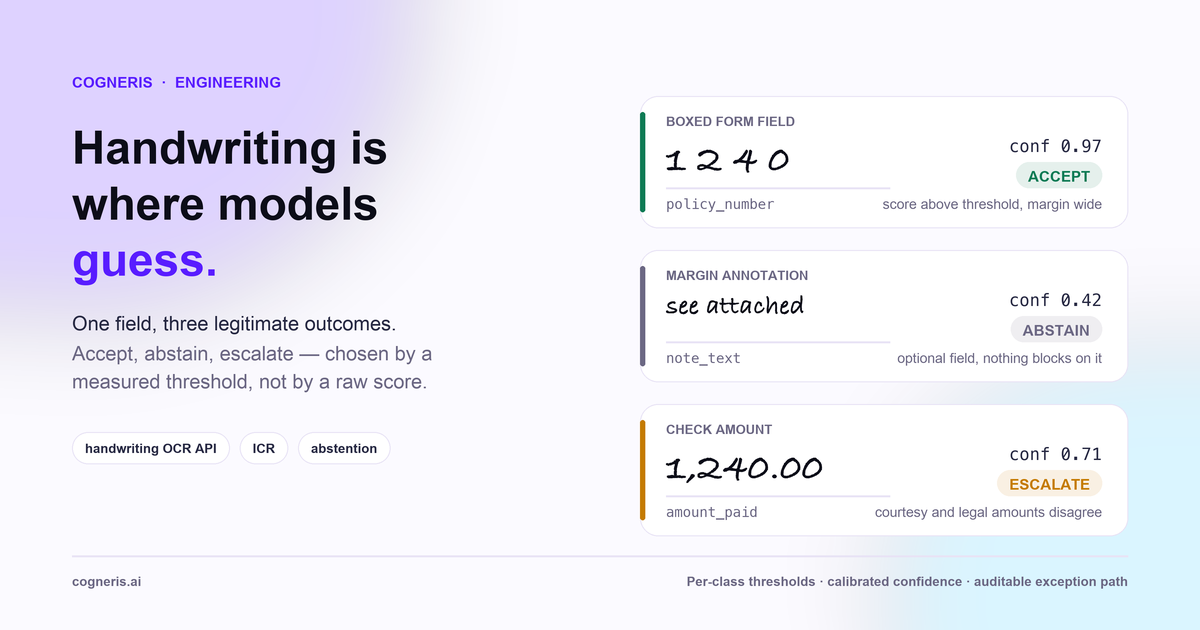
When printed text defeats an OCR engine, the failure is usually visible. Characters drop out, words become fragments, and a validation rule catches the damage before anything downstream believes it. The system looks broken because it is broken, and that is a useful property.
Handwriting removes that property. A recognizer reading a handwritten amount rarely returns fragments. It returns a clean, plausible, well-formed number that a schema will accept, a validator will pass and a ledger will store. The error survives every check that was designed to catch garbage, because it is not garbage. It is a confident guess.
So the design question for a handwriting OCR API is not how accurate the recognizer is on a benchmark. It is what the system does when the recognizer is unsure, and whether it can tell the difference between unsure and wrong.
Four kinds of handwriting, four different problems
Reporting one accuracy number over “handwriting” averages together tasks that fail for unrelated reasons. Separate them before measuring anything.
| Writing class | What the page looks like | Dominant failure | What constrains the answer |
|---|---|---|---|
| Constrained form field | Boxed cells, one glyph per box | Segmentation: stray marks and box edges read as characters | The grid geometry and the declared field type |
| Amount fields on checks | Courtesy amount in digits, legal amount in words | Digit confusion and a lost decimal separator | Two independent renderings of the same value |
| Clinical and claim notes | Cursive, abbreviations, domain shorthand | Vocabulary outside the training mix, substituted with something plausible | A controlled term list and the surrounding record |
| Free margin annotation | Anywhere on the page, any length | There is no field to attach the text to | Nothing — it is evidence, not a value |
These classes carry different risk, so they deserve different policies. A misread phone number on an intake form costs a callback. A misread amount on a check costs money and an investigation. A substituted abbreviation in a clinical record can be worse than either, because the value looks native to the document.
The last row deserves its own rule. Margin annotations are frequently the most informative marks on a claim file, and they almost never map cleanly onto a schema field. Treat them as attached evidence with a page and a region, not as a value to coerce into a column.
ICR is a field decision, not a glyph decision
Intelligent character recognition earned its name from the classical pipeline: detect the writing area, segment it into characters, classify each character, reassemble the string. Modern recognizers read a whole field as a sequence instead, and the segmentation step that used to dominate the error budget mostly disappears.
What did not change is the part that actually determines the outcome. A handwritten date field can only be a date. An amount field has a range, a currency and a decimal convention. A policy number has a length and a checksum. Decoding under those constraints removes whole families of error before the model is asked to be better.
read_field(region, field_spec):
    candidates = recognizer(region, top_k = 5)
    legal      = [c for c in candidates if field_spec.accepts(c)]
    if legal is empty:
        return ABSTAIN(reason = "no candidate satisfies the field")
    return best(legal), margin(legal[0], legal[1])
The margin between the best legal candidate and the runner-up carries more information than the top score alone. A field where the two leading readings are 1,240.00 and 1,740.00 is not a confident field, whatever number the recognizer printed next to the winner.
A confidence score is not a probability until you measure it
A recognizer that returns 0.94 is making a claim, not a measurement. The claim is only worth something once you have compared scores against observed outcomes on your own document mix, per writing class.
Bucket the scores, then compute how often the field was actually right inside each bucket. Do it separately for boxed form fields and for cursive notes, because a single curve over both hides the class that is failing.
calibration(class, bucket) := observed_field_accuracy(class, score in bucket)
threshold(class, field)    := min score where observed_accuracy >= target(field)
Handwriting is where overconfidence concentrates. The same recognizer can be well calibrated on printed fields and badly calibrated on cursive, which is exactly the shape that a global threshold cannot express. Thresholds belong to the pair of writing class and field, and they belong in the same versioned place as the rest of your validation rules.
Abstention is a product decision
Once thresholds are measured, the recognizer has three legitimate outcomes rather than one. It can answer, it can decline to answer, or it can send the field to a person.
answer    if  confidence >= threshold(class, field) and margin >= min_margin
abstain   if  the field is optional and nothing downstream blocks on it
escalate  otherwise
Choosing between abstain and escalate is an economic decision, not a technical one. The comparison is the probability of being wrong multiplied by the cost of being wrong, against the cost of a human touch. An optional annotation field can be left empty. A payable amount cannot, so it goes to human review instead.
This is why coverage and accuracy have to be published together. A recognizer that answers every field will always look better on accuracy-among-answered than one that abstains on the hard tail, and it is worse. Report the abstention rate beside the accuracy, or the number is an advertisement.
The exception path is where handwriting is actually solved
Escalation only helps if the reviewer can decide quickly, and that depends on what the API hands over. A field arriving in a queue as a bare string forces the reviewer to reopen the document and hunt for it, which is most of the cost of review.
- The cropped region — the exact pixels the recognizer read, not the whole page.
- The alternatives — the runner-up readings with their scores, because choosing is faster than transcribing.
- The redundant rendering — the legal amount next to the courtesy amount, when the document provides one.
- The reason — low score, thin margin, failed field constraint or disagreement between two renderings.
Then measure the queue like a product surface: touch time per field, correction rate by writing class, and how often the reviewer picks an alternative rather than typing a new value. Those three numbers tell you whether the recognizer is improving faster than volume is growing. We wrote separately about why the exception queue is the real product; handwriting is the workload that proves it.
The record that makes a handwritten field auditable
Every accepted handwritten value should be reconstructible months later, by someone who was not there. That means the response carries the decision, not only the answer.
{
  "document_id": "...",
  "field": "amount_paid",
  "value": "1240.00",
  "value_source": "legal_amount",
  "writing_class": "check_courtesy_legal",
  "confidence": 0.71,
  "margin": 0.08,
  "alternatives": [{"value": "1740.00", "confidence": 0.63}],
  "action": "escalate",
  "reason": "courtesy and legal amounts disagree",
  "threshold": "amount@0.93",
  "recognizer": "icr-handwriting@5",
  "policy": "abstention-policy@8",
  "evidence": [{"page": 1, "region": [0.62, 0.31, 0.88, 0.38]}]
}
Two constraints travel with that record. Do not store raw crops of handwriting outside the retention and access rules that govern the source document — a signature or a clinical note does not become less sensitive because it was cut out for an explanation. And version the policy alongside the recognizer, because a threshold change silently reclassifies which fields were auto-accepted, and an audit trail that cannot name the policy in force cannot answer why.
What to publish about a handwriting recognizer
Each of these numbers is defensible on its own and misleading on its own.
| Metric | Why it misleads alone | Publish it with |
|---|---|---|
| Character or word error rate | A low error rate still produces wrong fields when the error lands on a digit | Field-level exact match |
| Field accuracy | Hides everything the system declined to answer | Abstention rate |
| Abstention rate | Can be driven to any value by moving one threshold | Accuracy among answered fields |
| Review load | Hides who absorbs the residual work | Touch time and correction rate by class |
Report all four by writing class and by field, on a frozen set drawn from real arrivals. A recognizer evaluated only on clean boxed forms will meet its target and then fail on the first month of cursive.
A rollout that can prove it helped
Start in shadow mode over the real arrival mix. Read every handwritten field, record the proposed value, the score and the action the policy would have taken, and leave the current process in control. That produces a calibration curve on production data without exposing anyone to a bad read.
Then enable auto-acceptance one field at a time, beginning with fields that are constrained, high volume and reversible downstream. Hold a control slice so review load and correction rate stay comparable. Before expanding, the gate should answer five questions:
- Calibration — does observed accuracy match the score in every bucket, for each writing class?
- Abstention — do uncertain fields reach review instead of the database?
- Redundancy — when the document renders a value twice, is disagreement always escalated?
- Economics — did total review time fall against the manual baseline, counting the new queue?
- Traceability — can any accepted field be reconstructed from recognizer, policy and evidence?
Expand only when the answers hold across a full business cycle. Handwriting volume is seasonal in most of the workloads that produce it, and a threshold tuned on a quiet month will be tested by a loud one.
The most useful thing a recognizer can say
Handwriting will not stop being hard. Cursive, shorthand and margin notes are produced by people who were not thinking about a schema, and no model turns that into certainty. What a system can do is stop pretending, and the mechanism is unglamorous: measured thresholds per class, an explicit abstain, an exception path that is fast enough to use, and a record that says which policy made the call.
The most useful output of a handwriting OCR API is not a better guess. It is the ability to return “I could not read this” with a page, a region and a reason — and to be right about that.