
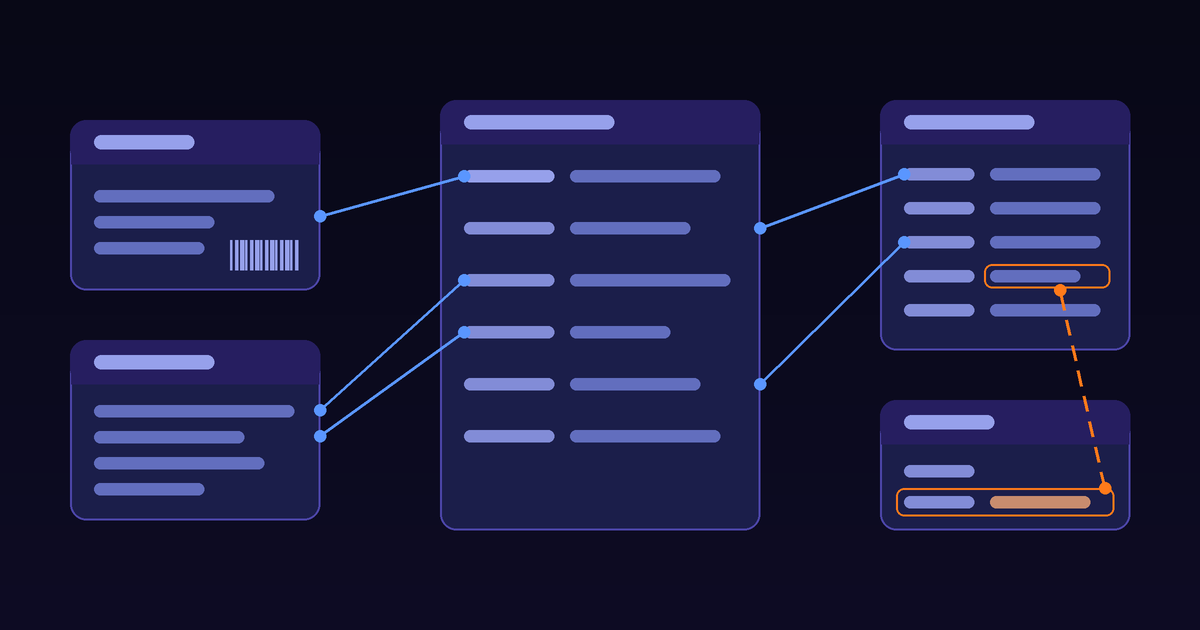
A return reaches the retailer as a small bundle of paper and labels. There is the return merchandise authorization the customer or store was issued, with a number, the items it covers and the reason given. There is the prepaid label on the outside of the box, with a tracking number and an address it was sent from. There is a packing slip inside, sometimes the original one and sometimes a return form. And there is the product itself, which carries its own label: a GTIN, often a serial number, sometimes a lot.
Each of those pieces was written by a different party at a different time, and each one says something about the same event. The authorization says what was agreed would come back. The label says what was shipped and from where. The slip says what the sender believes is in the box. The unit says what actually arrived. A return is settled cleanly when the four agree with each other and with the original sale.
This piece describes how to read that packet as fields, what each field is compared with, and where a disagreement goes. It also draws a line the extraction should not cross: a mismatch between documents is a reason for a person to look, not a finding that the return is fraudulent.
Four documents, one return
Every return packet has the same basic parts, even when they look nothing alike from one retailer to the next.
- The authorization — the RMA number, the original order or invoice it refers to, each item and quantity approved for return, the reason code, the disposition (refund, replacement, repair, credit) and often an expiry date for the authorization itself.
- The return label — carrier, tracking number, ship-from name and address, ship-to returns centre, and frequently the RMA number printed in a reference field.
- The packing slip or return form — the items and quantities the sender says are inside, the order number, and any note about condition or the reason for return.
- The unit and its labels — the product identifier, the serial or lot number where the product carries one, and the condition the receiving team records when it opens the box.
Behind those sit the records of the original sale: the order, the invoice and the outbound shipment, which is where the retailer recorded what it sent, to whom and, for serialized goods, which units. The return is checked against that history, not just against itself.
What the authorization carries
Retail EDI has a transaction set for exactly this document. X12 describes the 180 Return Merchandise Authorization and Notification as covering established business practice for returning merchandise to the vendor, and says it may satisfy a request for return, the authorization or disposition of the return, a notification of return, or a notification of a consumer return. The same document type therefore appears at several points in one return’s life.
The structure of the 180 is a useful field list even for returns that never touch EDI, because paper and portal RMAs carry the same facts. At the header and on each line it has a segment for the return disposition and reason, which records the disposition of the item, the reason given for the return, the response to that reason, and whether the item was used. It has a purchase order reference, date and time references, carrier details, and a line-item loop with the item identification, quantity and price. A separate loop on the line conveys serial number, lot number and inventory data, with the manufacturer associated with that serial or lot.
Two things follow for extraction. The reason the customer gave and the disposition the vendor decided are separate fields, and a packet that records only one of them has lost half of the decision. And serial and lot numbers belong to a line, not to the document: a return of three units of the same item can carry three serial numbers, and each one has to stay attached to the line it was read from.
A serial number only means something with its product
The serial number is the field that turns a return from a count into an identity. GS1 defines Application Identifier (21) as the serial number, an alphanumeric value of up to 20 characters, and its reference data lists it as requiring a product identifier such as the GTIN, carried in Application Identifier (01). The serial is unique within the product, so a serial read without the GTIN it belongs to identifies nothing in particular.
That is why the comparison is on the pair. When the retailer recorded the outbound shipment with serials, the return can be checked unit by unit: the GTIN and serial on the returned unit against the GTIN and serial on the shipment of the original order. When it did not, there is nothing to compare against, and the serial on the return is a value recorded for later, not a check that passed.
Most products are not serialized at all. An extraction that treats a missing serial as a mismatch will flood the review queue with clean returns. The useful states are three: the serial matches the outbound record, the serial differs from it, or no comparison was possible because one side has no serial. Only the second is a discrepancy.
Read each field against the original sale
Each value in the packet has a place it is usually read from, a record it is compared with, and a team that acts when the comparison fails. The table is a starting set for routing, not a returns policy.
| Document and field | Compared with | Divergence | Routing |
|---|---|---|---|
| RMA number on the authorization | RMA reference on the label and on the slip | Label or slip carries another RMA, or none | Returns desk confirms which authorization the box belongs to |
| Order or invoice on the authorization | The original order record | Order not found, or belongs to another customer account | Returns desk, before any refund is issued |
| Items and quantities approved | Lines and quantities on the original order | An item never ordered, or more units than were sold | Returns desk; the over-quantity is held |
| Authorization expiry | Carrier acceptance date on the label | Shipped after the authorization lapsed | Apply the retailer’s own late-return rule |
| Ship-from name and address on the label | Ship-to on the original order and the account address | A different address with no note explaining it | Recorded on the case; reviewed with the other signals |
| Items and quantities on the slip | The authorization and the receiving count | Slip lists more than the box holds, or the box holds more than the slip | Receiving recounts; the difference is noted on the case |
| GTIN on the returned unit | GTIN of the line on the original order | A different product, even in the same family | Receiving holds the unit; loss prevention review |
| Serial on the returned unit | Serial recorded on the outbound shipment | A serial that was not on that shipment | Held for loss prevention review, with both serials shown |
| Reason for return and condition noted | Disposition on the authorization | “Unopened” reason, opened unit received | Disposition reviewed before refund or restock |
The first three rows are identity checks and come first, because they decide whether the box belongs to this authorization and this sale at all. The GTIN and serial rows are the ones that need the product label read correctly; a misread digit on a serial creates a discrepancy that never existed, which is why the value is returned with the image region it came from.
A mismatch is not a verdict
Returns are a known route for abuse, and a packet that disagrees with the sale can be a sign of it: a box shipped from an address with no link to the account, a unit whose serial was never shipped to this customer, a cheaper item in the box of an expensive one. The retail page that describes this work lists label-swap and serial-number tampering among the patterns flagged for loss prevention review.
The same disagreements also have ordinary causes. A customer ships the box from an office or a relative’s house. A warehouse picked a different unit than it scanned. Two orders come back in one box with one slip. A store return is keyed against the wrong receipt. None of these is visible on any single document, and some of them are not visible on the documents at all.
So the extraction’s output is the comparison, not a conclusion. It reports which fields agree, which differ, by how much and on which document, and routes the case. Whether a return is refused, refunded, or referred for investigation is decided by people who can see the account history and the retailer’s own policy. An extraction that labels a customer as fraudulent on the strength of a mismatched address has made a decision it was never in a position to make.
A worked example
A customer ordered two units of the same cordless drill on one order, shipped together with both serials recorded at dispatch. They request a return of one unit, “defective”, and receive an RMA that authorizes one unit for refund within 30 days. The box arrives at the returns centre 12 days later.
| Item | Value | Source | Result |
|---|---|---|---|
| RMA number | Same on authorization, label and slip | All three documents | Box belongs to this authorization |
| Order reference | Original order, same account | Authorization | Matches |
| Quantity | 1 authorized, 1 on the slip, 1 received | Authorization, slip, receiving | Matches |
| Carrier acceptance | Day 12 of 30 | Label tracking | Inside the authorization period |
| Ship-from | Account address | Label | Matches |
| GTIN on the unit | Same as the ordered line | Product label | Matches |
| Serial on the unit | Not either of the two shipped serials | Product label against outbound record | Discrepancy: held for review with all three serials shown |
| Reason and condition | “Defective”; unit used, no visible damage | Authorization and receiving note | Recorded for the disposition decision |
Seven of eight rows agree, and the one that does not is the one that matters. The serial on the returned drill is not among the units that went out on this order. That can mean the unit was swapped. It can also mean the warehouse scanned one serial and packed another, or that the product label was replaced under warranty. The extraction puts the three serials side by side with the image regions they were read from, holds the refund, and routes the case. A person with access to the dispatch record and the customer’s history decides which explanation it is.
Patterns across returns
Some signals only exist across many packets: the same ship-from address on returns for several accounts, the same customer returning the same item repeatedly, the same serial appearing on more than one return. Those are aggregations over extracted fields, and they only work if each field was extracted consistently: the address normalized the same way, the serial kept with its GTIN, the RMA tied to its order.
The same restraint applies at that level. A repeat pattern is a reason to review a group of cases together. It is not a ruling on any single one of them, and the retailer’s policy, not the extraction, says what happens next.
What the extraction should deliver
For each return packet, a useful extraction returns structured records with the evidence for each value, not a summary:
- Authorization identity — RMA number, original order or invoice, each authorized line with quantity, the reason given, the disposition, and the authorization expiry, each as its own field.
- Label fields as printed — carrier, tracking number, acceptance date, ship-from and ship-to, and any RMA reference, without correcting the address toward the account record.
- Slip contents — items and quantities the sender listed, the order number and any note on condition.
- Unit identity — GTIN, serial and lot for each returned unit, each kept with the line it belongs to and the image region it was read from.
- Comparison results — for every field compared with the original sale: match, differs (with both values), or not comparable, so the reviewer sees the gap instead of a score.
The retail solutions page lists RMA packets among the documents Cogneris parses and describes RMA documents structured for pattern matching, with exceptions flagged for loss prevention review. That is the scope described here: each document read as fields, compared with the sale, and handed to a person with its source.
Where this sits next to other logistics documents
The return is the reverse of a delivery, and many of the same disciplines apply. Proof of delivery as dispute evidence covers the outbound side: counts, exception notes, signatures and timestamps that settle a shortage or damage claim on a delivery. A return that is approved ends in money moving back, and credit memo processing covers that document: a credit note applied to an origin invoice, in part or across periods. The RMA packet sits between the two, deciding whether the credit should be issued at all.
Read the packet as one story
A return packet is four documents written by different people about one box. The authorization says what was agreed, the label says what was sent, the slip says what the sender thinks is inside, and the unit says what arrived. Reading each one as fields, keeping serials with their products and lines, and comparing them with the original sale is what lets a returns team approve the clean majority quickly and look closely at the few that do not add up, without the extraction deciding which of those few is fraud.
Sources
- X12 transaction sets — the published description of the 180 Return Merchandise Authorization and Notification: return requests, authorization or disposition, notification of return and notification of consumer return.
- X12 180 segment reference, Release 8010 (Stedi) — the return disposition and reason segment (disposition, reason, response, whether used), the purchase order reference, the line-item loop, and the loop that carries serial number, lot number and inventory data.
- GS1 Application Identifier (21), Serial number — up to 20 alphanumeric characters, used together with a product identifier such as the GTIN.
- GS1 Application Identifier (01), Global Trade Item Number — the 14-digit product identifier the serial number belongs to.
This article explains document extraction and review handoffs. It does not describe any retailer’s return policy and does not determine whether any return is fraudulent.