
A staffing invoice can add up correctly and still bill the wrong work. The total may be the product of hours and rates, while the hours belong to a different week, the rate belongs to another role, or a replacement worker appears under the person who was originally scheduled. The arithmetic is valid; the evidence does not line up.
Reconciliation starts by comparing the supplier invoice with the approved time record for the same engagement. Extraction makes both documents usable. Matching connects their fields, applies the contract and approval rules that the buyer has configured, and explains the difference at the smallest useful level. It should support an accounts-payable review, not silently approve a payment.
Compare like with like
A time entry is not just a number of hours. It carries a person or worker reference, service date, role, work location or cost center where relevant, and a status that says whether someone authorized it. The invoice adds the supplier, billing period, billed worker, hours, rate, and amount. Those records can be compared only after their identities and periods have been aligned.
Before calculating a variance, resolve which invoice line refers to which approved time entry. Use stable worker or assignment identifiers when available; names alone can be ambiguous, abbreviated, or changed. Keep the source value beside any normalized value, and flag a missing or uncertain identity for review instead of attaching it to the closest-looking record.
- Scope — confirm supplier, contract, assignment, billing period, currency, and work location.
- Identity — map each billed worker and role to the approved assignment or an explicit replacement record.
- Time — compare billed hours with approved hours for the same service dates and category.
- Rate — apply the contract rate for that role, shift, location, and date when the agreement defines those dimensions.
- Evidence — retain the invoice line, time record, approval status, rule version, and calculated difference.
This sequence matters because an apparently small mismatch can come from a bad join, not a bad invoice. A worker-name collision should not become an hour variance, and a week-ending date should not substitute for the actual service dates if the contract is date-sensitive.
Separate the kinds of variance
A single “amount mismatch” does not tell accounts payable what to do. Calculate and label the differences separately so a reviewer can see whether the issue is time, price, identity, or approval.
| Variance | Example comparison | Useful next step |
|---|---|---|
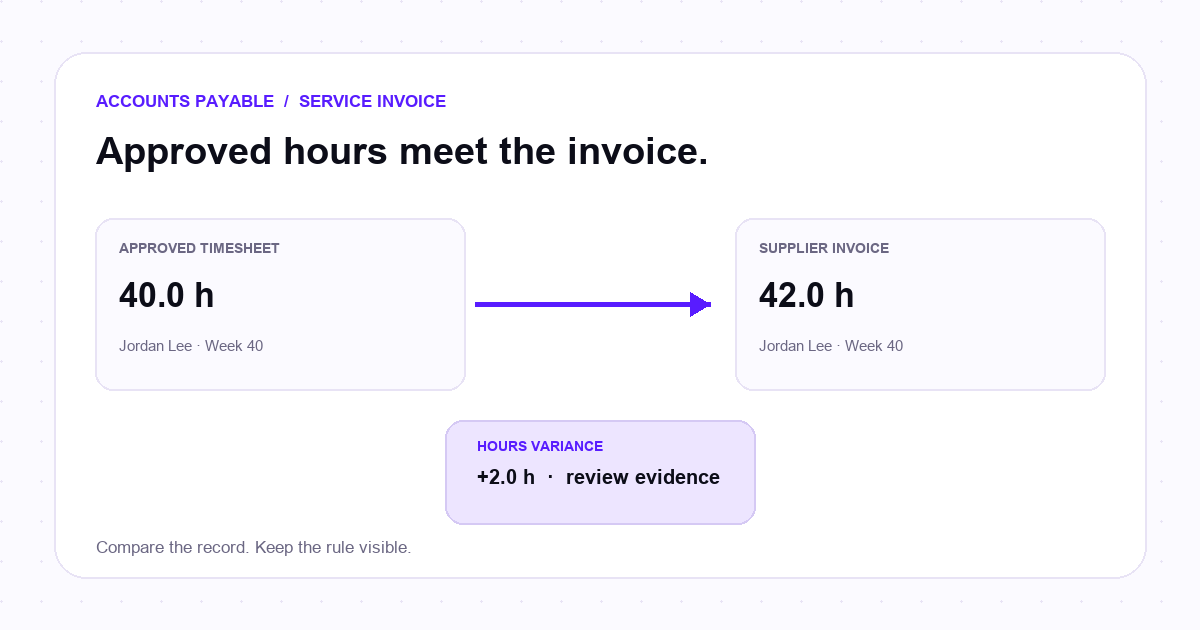
| Hours | Invoice bills 42.0 hours; approved record shows 40.0 | Check approval, corrected timesheet, and the service dates behind the extra 2.0 |
| Rate | Approved hours agree; invoice uses a different hourly rate | Compare the applicable contract rate and any approved rate change |
| Role or shift | Hours match, but the line is billed as a higher-rate role or shift | Verify the assignment and the evidence authorizing the classification |
| Identity or substitution | The billed name differs from the scheduled worker | Match to a documented replacement, or hold the line for confirmation |
| Period or duplicate | A date falls outside the billing period, or the same entry appears twice | Check period boundaries and prior invoices before treating it as payable |
Keep the calculation reproducible. For an hourly line, show billed hours, approved hours, the relevant rate, and the resulting amount difference. Do not net an overbilled line against an underbilled one from another worker or date: that can make the invoice total look right while hiding two separate exceptions.
Make rounding a visible rule
Time clocks, approved timesheets, payroll systems, and supplier invoices may represent time differently: exact minutes, decimal hours, quarter-hour increments, or a displayed value rounded for presentation. Convert units before comparing, and preserve the original precision. A display of “7.5 hours” should not erase whether the source was 7 hours 28 minutes or 7 hours 32 minutes.
Rounding should be a named, versioned rule agreed for the workflow, with its scope and stage clear. Does it apply to each clock interval, each daily total, or the whole billing period? Is the invoice expected to reflect unrounded approved time, or a contractual billing increment? Apply the same rule to comparable records, record the unrounded and rounded values, and route a result near a threshold for review if the governing policy is unclear. Never add an undocumented tolerance just to make the line pass.
Rules can vary by jurisdiction and worker category. For U.S. payroll recordkeeping, the Department of Labor describes records of hours worked each day and total hours each workweek, and says employers may use any timekeeping method that is complete and accurate. That is a recordkeeping example, not a universal billing specification or permission for a particular rounding method. Follow the applicable law, contract, and approved company policy for the engagement.
Keep overtime and substitutions distinct
Overtime is not merely “hours above the schedule.” The relevant workweek, worker classification, jurisdiction, contract, and approval process can all affect what the invoice should show. Preserve regular and overtime categories separately when the underlying records provide them. Compare each category to its own approved hours and rate rule; do not infer an overtime premium from a weekly total if the records do not establish the applicable basis.
As a U.S. example, federal guidance generally requires covered, nonexempt employees to receive overtime pay for hours over 40 in a workweek. That rule concerns wage obligations; it does not by itself establish what a staffing supplier may bill a client under a particular contract. A reconciliation system should expose the category and rate it observed, cite the source records, and send an unclear or disputed classification to the responsible reviewer.
A replacement worker needs the same care. If a scheduled worker is replaced, retain the original assignment, the replacement identity, effective dates, approval, and applicable rate. Do not merge the replacement’s hours into the original person’s history simply because both covered the same shift. If a correction arrives later, preserve both versions and record which one was approved and used for the invoice comparison.
Use tolerances to route, not to erase
Some organizations allow small differences caused by contract terms, system precision, or a documented billing convention. Tolerances should be defined by variance type: a monetary threshold is not a sensible substitute for an hours threshold, and a rate exception should not inherit the same rule as a date mismatch. Identify who set each limit, when it applies, and whether it permits automatic progression or only changes the review priority.
A tolerance is not evidence that the underlying records agree. Keep the measured difference even when it falls within policy, and show which rule classified it. A missing approval, unknown worker, period overlap, or unexplained premium may deserve review regardless of the dollar amount. Conversely, a known rounding difference may be low-risk if the contract defines how it is handled.
- Compare each invoice line with the matching approved record.
- Calculate hour, rate, category, and amount variances separately.
- Apply the named tolerance for that variance and preserve the raw values.
- Route exceptions with the source lines and rule to the contract owner or approver.
- Record the reviewer’s decision and any corrected invoice or time record as a new event.
This is invoice-to-timesheet reconciliation: it compares billed services with approved time evidence. It is not a goods-receipt check or a three-way match. If a service contract separately requires a milestone or acceptance record, make that a distinct comparison with its own evidence and policy.
What a reviewer needs to see
For each exception, present the billed value, approved value, normalized comparison, calculation, tolerance, and source location together. Include the supplier and assignment identifiers, service dates, approval state, relevant contract reference, and whether the line is regular time, overtime, or a replacement. A reviewer should be able to trace the result back to both documents without reconstructing the join by hand.
The invoice matching workflow describes Cogneris’ document comparison surface. Its public scope covers invoice extraction and matching against purchase orders and, for three-way matching, receipt evidence. Timesheet rules and any payment decision remain dependent on the customer’s records, contract, and approvals; do not assume a payroll or vendor-billing policy that has not been configured.
Make the difference explain itself
The useful result is not simply “matched” or “unmatched.” It is a line-level account of what was billed, what was approved, which rule applied, what remains uncertain, and who can resolve it. Keep hours, rates, overtime, rounding, identity, and period as separate dimensions; preserve source precision; and keep each correction in the audit trail.
When the evidence agrees, accounts payable can move forward with a reasoned comparison. When it does not, the exception arrives with enough context for the right person to act—without hiding a discrepancy inside a net total or letting document extraction make the payment decision.