
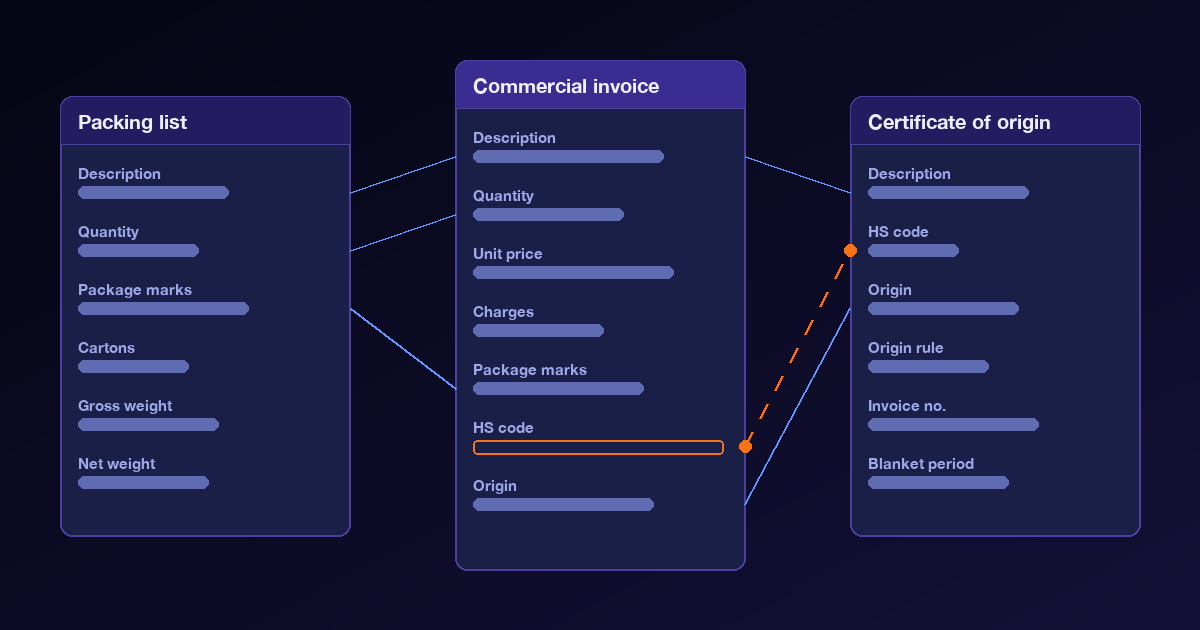
Most companies meet the commercial invoice as an accounts payable document. A supplier sends it, someone matches it to a purchase order, and it gets paid. For an imported shipment the same document has a second reader. Customs reads it to decide what the goods are, what they are worth, where they come from and how much duty is owed. The supplier wrote it for the first reader. The importer is answerable for what the second reader concludes.
That second reading is stricter. US customs regulations say what a commercial invoice must contain, require it to describe the contents of every package, and expect the tariff classification and the entered value to be noted on it or alongside it. A certificate of origin, when a trade agreement is claimed, has to describe the same goods in a way that relates back to the invoice. A packing list has to agree with both. Each document is written by someone different, and each one can be right on its own terms and still disagree with the others.
This piece describes what a commercial invoice has to carry for customs, how to read it against the packing list and the certificate of origin, what each kind of mismatch tends to mean and who owns it, and what an extraction has to return so the comparison can run as data. It deals with valuation, classification and origin. The physical side of a shipment, where weight, piece count and consignee are checked across the carrier’s documents, is covered in the air waybill reconciliation article.
Customs says what the invoice must contain
The US rules are in 19 CFR Part 141, Subpart F. Section 141.81 requires a commercial invoice for each shipment at the time the entry summary is filed, and, apart from installment shipments, says an invoice should not cover more than one distinct shipment from one consignor to one consignee on one conveyance. Section 141.83(c) says the invoice is prepared in the manner customary in the trade, but must contain the information that Sections 141.86 through 141.89 require. That is the point where a supplier’s document format stops being the supplier’s choice.
Section 141.86(a) lists the general information every invoice of imported merchandise must set out. Grouped by what each item is used for, the list looks like this:
- The transaction — the port of entry, and when, where, by whom and to whom the goods were sold, or for goods not sold, where, when and by whom they were shipped.
- What the goods are — a detailed description with the name each item is known by, its grade or quality, the marks and numbers it is sold under, and the marks and numbers of the packages.
- How much there is — quantities in the weights and measures of the country of shipment or of the United States.
- What they cost — the purchase price of each item in the currency of the purchase, the currency itself, and all charges itemised by name and amount, including freight, insurance, commission, containers and packing.
- What changes the value — rebates, drawbacks and bounties allowed on export, and any assists such as dies, molds, tools or engineering work supplied for production and not included in the price.
- Where they come from — the country of origin of the merchandise.
The rest of Section 141.86 adds requirements that matter for extraction. Paragraph (d) requires the invoice to be in English or to carry an accurate English translation. Paragraph (e) says each invoice must state in adequate detail what merchandise is in each individual package, which is why an invoice and its packing list are read together. Paragraph (g) requires every discount from list or base price to be set out for each class of goods. Paragraph (j) requires the invoice to name a responsible employee of the exporter who knows, or can find out, about the transaction.
None of this is exotic. It is the information anyone would need to value and classify a shipment. The difficulty is that it is spread across a header, a line table, a charges block, footnotes and attachments, and that a supplier invoice which is perfectly adequate for payment can leave half of it out.
The classification is a number with levels
The tariff classification is the field most people associate with customs, and it is the one an extraction should be most careful about. It works at more than one level of detail. Trade agreement rules are written against the Harmonized System nomenclature, and the USMCA certification of origin asks for the classification to six or more digits. The Harmonized Tariff Schedule of the United States carries more digits than that, and US export filings use a ten-digit commodity classification number: the export rules in 15 CFR 30.6(a)(12) ask for it, and say that reporting it does not relieve the filer of giving a complete and accurate description of the goods.
Section 141.90(b) assigns the classification on an import entry to the importer or customs broker. They must include the appropriate HTSUS subheading and the rate of duty on the invoice or with the invoice data, next to the articles they apply to, unless the invoice lines are linked to the entry summary electronically. A code printed by the seller is therefore information, not a decision. The seller may use the exporting country’s national digits, an outdated edition, or a code chosen for its own export filing.
What the invoice must reliably supply is a description good enough to support a classification. For some goods the regulation says exactly what that means. Section 141.89 lists classes of merchandise whose invoices must carry additional information. For ball or roller bearings in subheadings 8482.10.50 through 8482.80.00, for instance, the invoice must state whether each bearing is a ball or roller bearing, the type of roller bearing, whether it is a combination bearing, and for ball bearings the outside diameter and whether it is radial. An invoice line that says “bearings, assorted” fails that requirement no matter how clean the scan is.
That is the useful division of labour. The extraction returns the description and its attributes as printed, and any code the seller printed, with where each was found. A licensed broker or the importer’s classification team decides the classification. A check can still flag that a code is present without the attributes its class requires, or that the invoice and the certificate of origin disagree on the first six digits.
Read the invoice against the packing list and the certificate
A commercial invoice is rarely wrong on its own terms. It is wrong relative to something: the packing list that counts different cartons, the certificate of origin that describes different goods, the purchase order that agreed a different price, or the entry that declared a different value. Each of those documents answers some of the same questions, and each comparison has a different owner.
| Field on the invoice | Read it against | What a mismatch usually means | Action |
|---|---|---|---|
| Line description and attributes | Packing list; certificate of origin | Generic description, or attributes the goods class requires are missing | Ask the seller for a supplementary statement before entry |
| Quantity and unit of measure | Packing list per package | Partial shipment, a short-shipped line, or a unit conversion (pieces against sets, kilograms against pounds) | Reconcile the units first; route a true shortage to the buyer |
| Package marks and numbers | Packing list; shipping marks on the cartons | A carton listed on one document and not the other | Route to the forwarder before the goods are released |
| Unit price, currency and discounts | Purchase order; payment record | A price change after the order, or a discount shown on one document only | Route to purchasing; value questions go to the broker with both sources |
| Charges (freight, insurance, packing, commission) | Freight invoice; terms of sale | A charge folded into the unit price, or itemised on one document and missing from the other | Keep each charge separate so the broker can decide what is dutiable |
| Classification code, if printed | Certificate of origin; the broker’s classification | Different first six digits, or a national code from the export side | Treat the printed code as information; the broker decides |
| Country of origin | Certificate of origin; marking on the goods | Origin on the invoice differs from the producer’s certification | Hold any preference claim until the certifier confirms |
| Invoice number and date | Certificate of origin; entry | The certificate cites a different invoice, or covers a period that has ended | Ask for a corrected or new certification |
The table is a starting set for routing, not a customs procedure. Its point is that a mismatch is a finding about two documents, and that the finding names who has to act. An extraction that only reads the invoice can report a value; it cannot say whether it is the right one.
Value is the price plus what the invoice has to itemise
The commercial invoice is the starting point for customs value, and the regulation is written so that the starting point can be adjusted. Section 141.86(a)(8) requires every charge on the goods to be itemised by name and amount, and adds that charges for bringing the goods from alongside the carrier at the port of export to alongside the carrier at the first US port must be shown if they are not already included. The cost of packing, containers and inland freight to the port of export need not be itemised if it is included in the price and identified as included.
Section 141.90(c) then puts the arithmetic on the importer. The importer must show, on the invoice or an attached statement, the computation of every deduction from the total invoice value, such as non-dutiable charges, and every addition made to reach the aggregate entered value, and must show the entered unit value of each article where it differs from the invoiced unit value.
For an extraction, that has one practical consequence. Charges cannot be summed into a single total, and a unit price cannot be accepted without knowing what it includes. A line that reads “unit price 4.20, CIF” and a line that reads “unit price 3.85” with freight and insurance in a separate block can describe the same deal. The difference only survives if the extraction keeps the price, the currency, the terms printed on the invoice, each charge and each discount as separate values, each with its source on the page.
Assists are the harder case. Under Section 141.86(a)(11), the invoice must list goods or services supplied for production and not included in the price, such as moulds or tooling the buyer shipped to the factory. They often appear nowhere on the supplier’s invoice, because the supplier did not pay for them. A check cannot find an assist that no document mentions, but it can notice a purchase order or a separate tooling invoice that names one, and route it to the person preparing the entry.
A worked example
An importer receives a shipment of bearings from a supplier in Mexico and intends to claim USMCA preference. The commercial invoice, packing list and certificate of origin say the following. All names and values are invented for illustration.
| Field | Commercial invoice | Packing list | Certificate of origin | Result |
|---|---|---|---|---|
| Description | Bearings, assorted | Ball bearings, radial, 52 mm OD | Radial ball bearings | Invoice lacks the type and diameter the bearings class requires; ask for a supplementary statement |
| Quantity | 12,000 pcs | 40 cartons × 300 pcs | Not stated | Matched once cartons are expanded |
| Package marks | Cartons 1–40 | Cartons 1–38 | Not stated | Two cartons missing from the packing list; route to the forwarder |
| Classification | 8482.10 printed by seller | Not stated | 8482.80 | Six-digit subheadings differ; the broker classifies and the certifier confirms |
| Unit price and terms | USD 1.90, freight included | Not stated | Not stated | Freight amount not itemised; ask the seller to state it |
| Country of origin | Mexico | Not stated | Mexico, producer certifies | Matched |
| Invoice reference | INV 7741 | INV 7741 | Blanket, 12 months, period ends 30 September | Certificate expired before the shipment date; ask for a new certification |
| Responsible employee | Not named | Not stated | Signed by the producer’s export manager | Invoice lacks the named contact the regulation requires |
Two of the eight rows match and six do not, and the findings belong to different people. The description, the freight amount and the named contact are corrections the seller makes, usually by a supplementary statement attached to the invoice, which Section 141.86(i) allows. The missing cartons are a question for the forwarder before the goods are released. The classification difference belongs to the broker, who classifies the goods, and to the producer, who must certify under the same six digits. The expired certificate stops the preference claim until a new one arrives, however correct everything else is.
None of these is visible from the invoice alone. Each one appears only when a field on the invoice is put next to the same field in another document.
Origin claims depend on the certificate matching the invoice
The certificate of origin is the document that turns origin into a duty preference, and the USMCA rules show how tightly it is meant to tie to the invoice. Under 19 CFR 182.12(a), a certification need not follow a prescribed format and may be provided on an invoice or another document, except an invoice or commercial document issued in a country outside the agreement. It must be in the importer’s possession when the claim is made.
The same section lists what a certification must include to be valid. Among the items, it needs a description of the good sufficiently detailed to relate it to the invoice and to the Harmonized System, the HTSUS classification to six or more digits as needed for the applicable rule of origin, and the rule under which the good qualifies. For a certificate covering a single shipment, it needs the invoice number if known. For a blanket certificate covering multiple shipments of identical goods, it needs the period it covers, which cannot exceed 12 months.
Those requirements are field comparisons. The description on the certificate against the invoice line, the six digits against the classification, the invoice number against the invoice, the blanket period against the shipment date. Section 182.13 makes the importer responsible for the truthfulness of the claim and of the information in the certification, and Section 182.15 requires the importer to keep the certificate and supporting records for at least five years from the date of importation. A comparison that ran at entry, with both sources attached, is the record that answers a question asked four years later.
What the extraction should deliver
For each commercial invoice, a useful extraction returns the document as structured records, with the evidence for each value, not as a paragraph of text:
- Invoice identity — seller, buyer, consignee, invoice number and date, port of entry where stated, and the named responsible employee, each as its own field.
- Lines as a table — description as printed, the attributes stated (type, material, dimensions, grade), quantity with its unit, unit price, currency and line total, and any classification code the seller printed.
- Charges and discounts kept apart — freight, insurance, packing, commission, rebates and discounts as separate amounts with their names, plus the terms of sale exactly as printed.
- Origin per line — the country of origin attached to the line it applies to, not only to the header, since one invoice can mix origins.
- Package references — marks and carton numbers as a list, so they can be paired with the packing list one by one.
- Page and position evidence — for every value, where on which page it was read, so a reviewer of a mismatch sees the original in one step.
The comparison then runs as its own step: pair each invoice line with the packing list and the certificate of origin, classify each mismatch by field, and send it to the person who owns it with both sources attached. Nothing in that step classifies goods, determines value or decides whether a preference applies. Those decisions stay with the importer, its customs broker and the certifier.
The retail solutions page describes commercial invoices, packing lists and certificates of origin parsed by Cogneris for HTS classification and duty calculation by customs brokers. Nothing here describes a product feature for comparing the three documents with each other; the argument of this article is about the fields a commercial invoice has to become before that comparison can run.
Where this sits next to the other shipping documents
The commercial invoice sits among documents that other articles cover. Before it comes the order, and the purchase order change article explains why the version of the order an invoice is matched against matters. Alongside it travel the carrier’s documents: the air waybill reconciliation article checks weight, pieces and consignee across the air waybill, packing list, label and customs declaration, which is the physical question rather than the valuation one. After delivery, the proof of delivery article treats the delivery receipt as evidence in a dispute.
Of those documents, the commercial invoice is the one customs reads for value, classification and origin. That is why it is the right anchor for this comparison: the packing list says what is in each carton, the certificate says what the producer will stand behind, the order says what was agreed, and the invoice says what the importer is declaring.
Read the invoice the way customs will
The commercial invoice is the customs record of the transaction: what was sold, by whom, to whom, in what quantity, at what price and from where. Its value comes from comparison. Read against the packing list, it shows whether the cartons hold what was invoiced. Read against the certificate of origin, it shows whether a preference claim rests on the same goods and the same classification. Read against the regulation, it shows which required fields the seller left out while there is still time to ask. The extraction’s job is to make each of those checks possible: every line, every charge and every attribute as a separate value, with the page it came from.
Sources
- 19 CFR Part 141, Subpart F, Invoices — invoice for each shipment (141.81), type of invoice required (141.83), contents of invoices including the packing-list, discount and responsible-employee requirements (141.86), additional information for certain classes such as bearings (141.89), and notation of classification and value (141.90).
- 19 CFR Part 182, USMCA — certification of origin and its required data (182.12), importer obligations (182.13) and record keeping (182.15).
- 15 CFR 30.6, Electronic Export Information data elements — the ten-digit commodity classification number and the requirement for a complete description alongside it (30.6(a)(12)–(13)).
This article explains document extraction and review handoffs. It is not customs, classification, valuation or legal advice.